The best Intercom alternatives for SaaS support teams (2026)
The best Intercom alternatives for SaaS support teams in 2026: Zendesk, Help Scout, Front, Crisp, Pylon and Convot, with verified prices and AI costs.
On this page
- Why do SaaS teams look for an Intercom alternative?
- Does Salesforce owning Intercom change the decision?
- What do you give up when you leave Intercom?
- Is Zendesk a good Intercom alternative?
- Is Help Scout a good Intercom alternative?
- How do Intercom, Zendesk and Help Scout compare?
- Is Front a good Intercom alternative?
- Is Crisp a good Intercom alternative?
- Is Pylon a good Intercom alternative?
- Is Convot a good Intercom alternative?
- How do the Intercom alternatives compare?
- Which Intercom alternatives include a help center?
- What is the best Intercom alternative for multiple products?
- What is a cheaper alternative to Intercom Fin for AI support?
- How do you choose an Intercom alternative?
- How do you migrate away from Intercom?
- Common questions about Intercom alternatives
- Intercom alternatives, in summary
The best Intercom alternatives for SaaS support teams in 2026 are Zendesk for structured ticketing, Help Scout for simple email-first support with a free plan, Front for email-heavy account management, Crisp for low-cost chat, Pylon for B2B support through Slack Connect and Microsoft Teams, and Convot for teams that run more than one product and want a help center, changelog, roadmap and status page for each, with AI at $0.20 per resolved conversation. Intercom itself remains the strongest choice for in-product messaging, product tours and a mature AI agent, so switch for cost or fit, not because it is weak.
Ownership update, October 2026: the company behind Intercom renamed itself Fin, after its AI agent, and Salesforce completed its acquisition of Fin, formerly Intercom, on 10 September 2026. The help desk keeps the Intercom name, and Salesforce says Fin will continue to serve its customers as part of its AI Labs.
This guide covers why teams leave Intercom, what you give up, each alternative with verified prices, a comparison table, the cost of AI at your volume and how to choose. Prices were checked on vendor pricing pages on 30 September and 1 October 2026; we make Convot, so its section comes last and uses the same published-price standard.
Why do SaaS teams look for an Intercom alternative?
SaaS teams usually look for an Intercom alternative because of cost. Intercom is priced per seat, billed annually, at $29 (Essential), $85 (Advanced) or $132 (Expert) a month, with no free plan, and its Fin AI agent is charged on top from $0.99 per outcome. For 3 people on Advanced that is $255 a month before AI; 1,000 Fin outcomes a month would add at least $990.
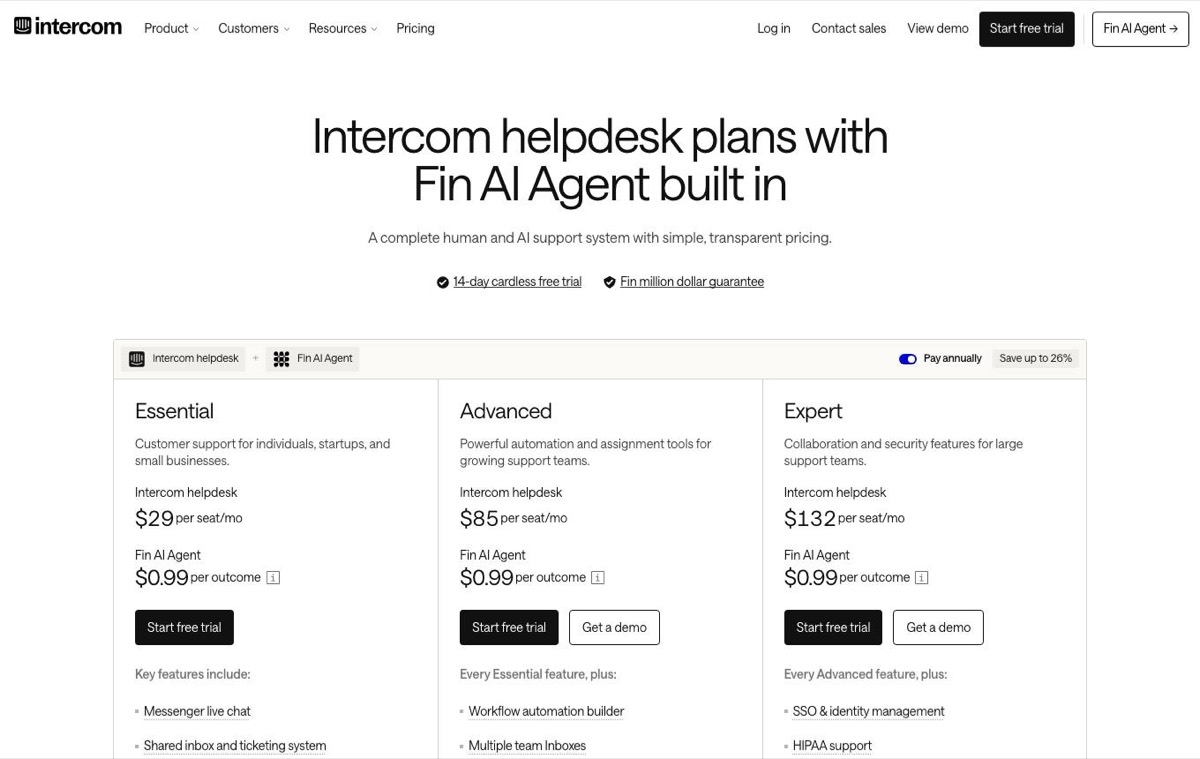 Intercom pricing page, captured 3 October 2026.
Two other reasons come up often: running more than one brand or product, which needs Intercom’s Expert plan for a multibrand Messenger and help center, and wanting tools Intercom does not list publicly, such as roadmap voting or a status page.
Does Salesforce owning Intercom change the decision?
Salesforce owning Intercom changes who sets its prices and roadmap, not the product you use today. The company behind Intercom renamed itself Fin, and Salesforce completed its acquisition of Fin, formerly Intercom, on 10 September 2026; Salesforce says Fin will continue to serve its customers as part of its AI Labs and complements its own Agentforce platform (Salesforce, 10 Sep 2026). Intercom’s pricing page was unchanged when checked on 3 October 2026.
If you are an Intercom customer, three things are worth checking before your next renewal: the per-seat and Fin outcome prices you will be offered, any change to the data processing terms that now involve Salesforce, and whether the features you rely on stay on your plan. None of these has been announced as changing; they are simply the terms a new owner can revisit. The guide to what the Salesforce acquisition means for Intercom customers covers the timeline and these checks in detail.
What do you give up when you leave Intercom?
Leaving Intercom means giving up three strengths: in-app messaging and product tours, an established AI agent in Fin, and a large integration ecosystem.
- In-app messaging and product tours. Intercom’s Messenger, outbound messages and product tours are among the most capable available.
- An established AI agent. Fin is Intercom’s own, built into the same platform.
- A large integration ecosystem, including CRM and data tools.
If proactive messaging or product tours are central to how you onboard users, confirm an alternative covers them before committing. If the main issue is cost or complexity, the options below are worth comparing.
Is Zendesk a good Intercom alternative?
Zendesk is a good Intercom alternative for teams that want structured ticketing: routing, SLAs and reporting are its strengths. It is priced per agent, billed annually: Support Team at $19 covers email and tickets only, Suite Team at $55 adds messaging and a help center, and Suite Professional is $115.
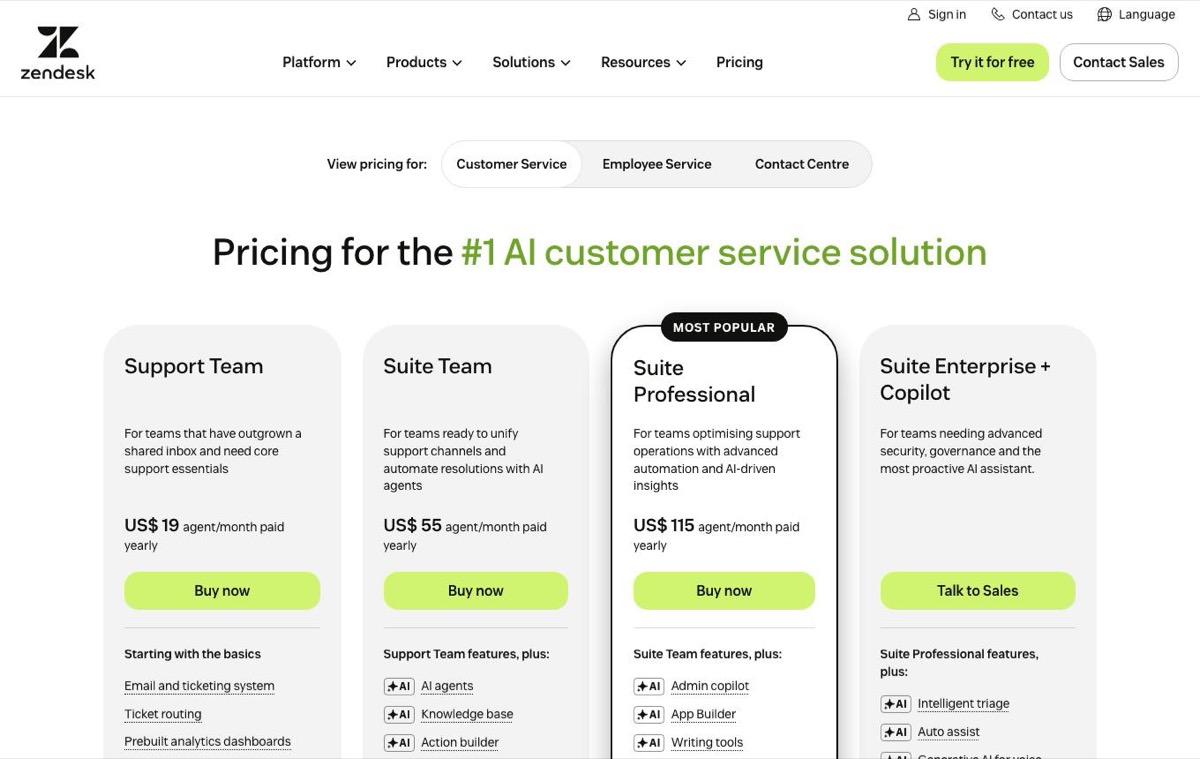 Zendesk pricing page, captured 3 October 2026.
For 3 agents on Suite Team that is $165 a month. Zendesk includes 5 AI resolutions per agent a month, then bills each one, reported by third parties at about $2.00 pay as you go and less on a committed plan; Zendesk does not publish the rate. It suits a team moving toward a structured ticketing operation rather than chat-first support. The guide to Zendesk alternatives for small teams covers it further.
Is Help Scout a good Intercom alternative?
Help Scout is a good Intercom alternative for teams whose support is mostly reactive and email-based. It offers a clean shared inbox, a Docs help center and the Beacon widget, with a free plan for up to 5 users with 1 inbox and 1 Docs site.
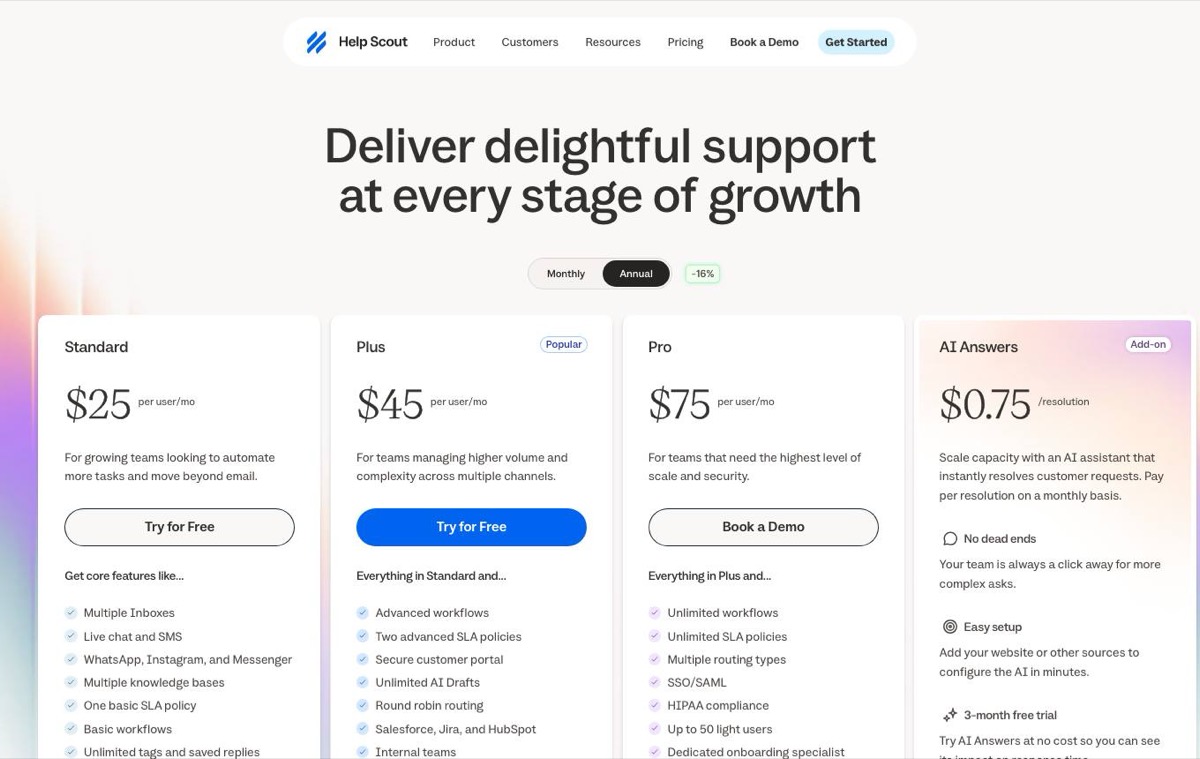 Help Scout pricing page on annual billing, captured 3 October 2026.
Help Scout’s paid plans are Help Scout Standard at $30, Help Scout Plus at $54 and Help Scout Pro at $90 per user a month billed monthly, or $25, $45 and $75 billed annually. AI Answers costs $0.75 per resolution. For 3 users, Help Scout Standard is $90 a month billed monthly, or $75 billed annually. Its in-app chat is lighter than Intercom’s Messenger, and proactive messaging is not its focus.
How do Intercom, Zendesk and Help Scout compare?
Intercom is best for in-product messaging and an established AI agent, at $29 to $132 per seat a month with Fin from $0.99 per outcome. Zendesk is best for structured ticketing, at $19 to $115 per agent with 5 AI resolutions per agent included. Help Scout is best for email-first support, at $25 to $75 per user billed annually ($30 to $90 monthly) with a free plan for up to 5 users and AI Answers at $0.75. For 3 people, Intercom costs $87 to $396 a month, Zendesk Suite Team $165 and Help Scout Standard $75.
| Intercom | Zendesk | Help Scout | |
|---|---|---|---|
| Best for | In-product messaging, product tours | Structured ticketing, voice | Email-first support |
| Price | $29 to $132 per seat | $19 to $115 per agent | $25 to $75 per user |
| Free plan | No | No, 14-day trial | Yes, up to 5 users |
| AI price | Fin, from $0.99 per outcome | 5 per agent included, then about $2.00 pay as you go (reported) | $0.75 per resolution |
Is Front a good Intercom alternative?
Front is a good Intercom alternative for teams that handle complex, relationship-driven accounts mostly by email. It treats the shared inbox as a collaborative email client, with assignment, comments and SLAs on top.
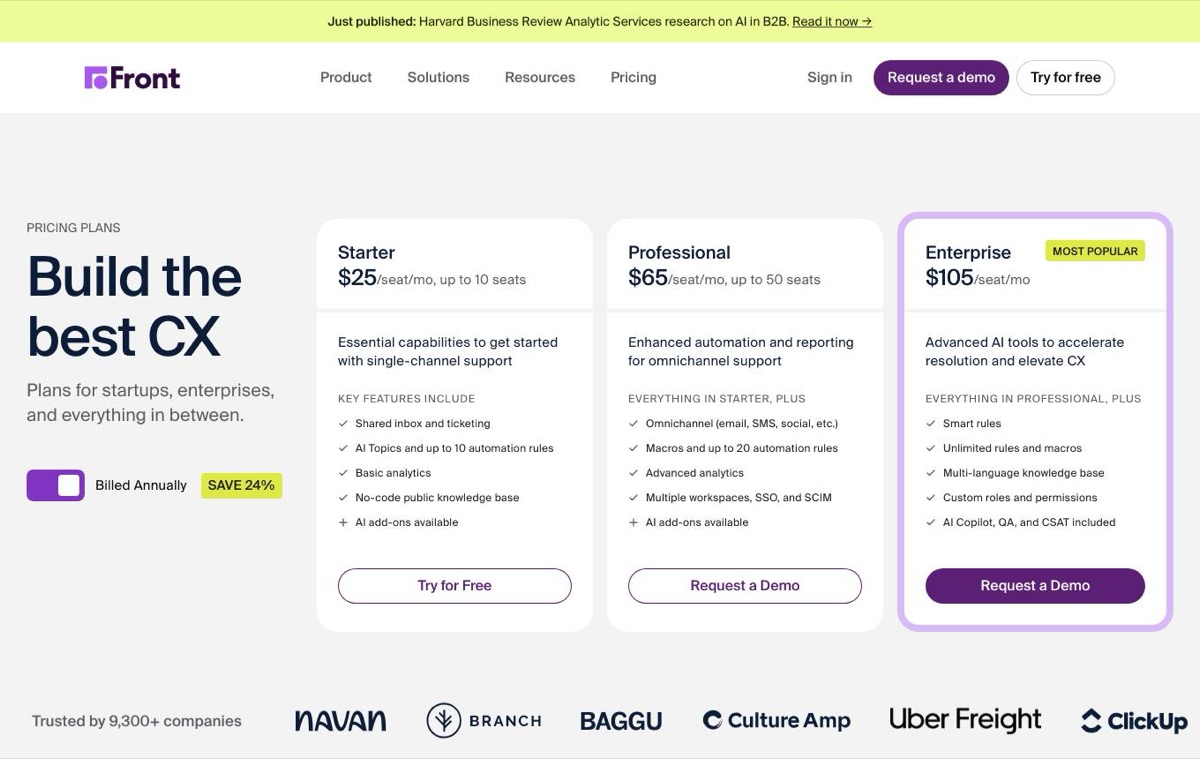 Front pricing page, captured 3 October 2026.
Front Starter is $25 per seat a month billed annually, or $75 for 3 seats, with 1 workspace and one channel type; Front Professional is $65 per seat, with up to 5 workspaces. AI is sold as add-ons: Copilot at $20 per seat and Autopilot from $0.05 per conversation. Front Starter supports one channel type (email, Front Chat or SMS), so live chat plus email needs Front Professional. It includes a basic knowledge base, with a customisable one on Front Professional, but its focus is the shared inbox, so it is a weaker fit for teams that live in in-product chat.
Is Crisp a good Intercom alternative?
Crisp is a good Intercom alternative for early-stage teams that want capable, low-cost chat. It is priced per workspace, one per website, rather than per seat: free for 2 seats, then Mini at $45, Essentials at $95 with 10 seats, a help center and an AI chatbot, and Plus at $295.
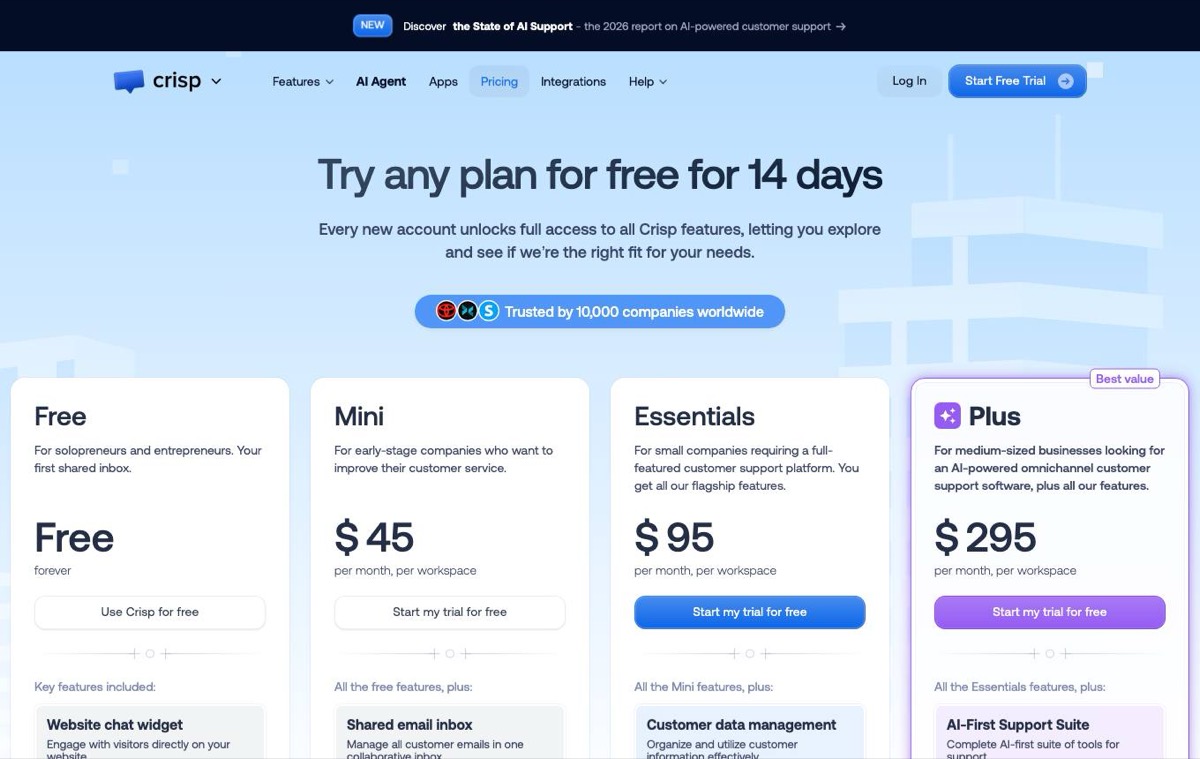 Crisp pricing page, captured 3 October 2026.
Crisp’s AI credits are bundled with paid plans, about $25 on Essentials for roughly 450 automated conversations. Its automation and reporting are lighter than Intercom’s, and each additional website is another workspace on another bill. The guide to Crisp vs Intercom compares the two directly.
Is Pylon a good Intercom alternative?
Pylon is a good Intercom alternative for B2B SaaS teams whose customers expect support inside shared Slack Connect or Microsoft Teams channels. It is aimed at B2B teams that already support customers in those shared channels. We have not verified Pylon’s pricing, features or limits, so check its site directly.
Is Convot a good Intercom alternative?
Convot is a good Intercom alternative for small SaaS teams, especially those running more than one product. Each product gets its own chat widget, help center, changelog, roadmap with voting, status page and in-chat scheduling, and every conversation, from chat and email, lands in one shared inbox with one record per customer.
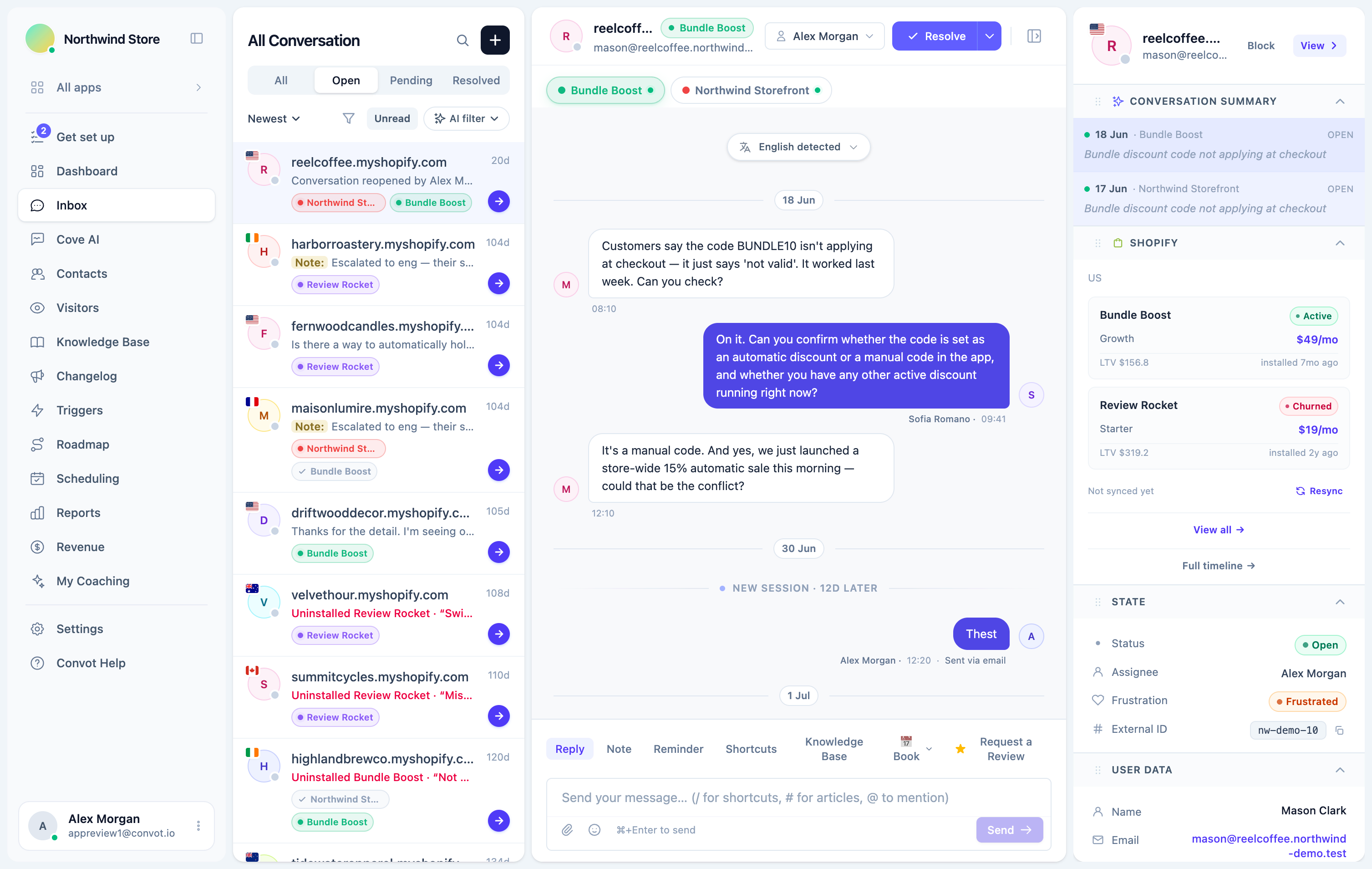 The Convot inbox, with conversations from every app in one place.
Convot is priced by how many apps you run, with seats included: free under $1,000 MRR for 1 app and 3 seats, then Starter at $49 a month for 1 app and 3 seats, with $20 per extra app and $10 per extra seat. The Cove AI agent is available on paid plans at $0.20 per resolved conversation in which it sent an automatic reply; it answers from your own help center and sources, shows them, and hands off when it is not confident. AI quality grading of conversations is included on every plan.
Its limits: Convot has no outbound campaigns or product tours, its integration ecosystem is smaller than Intercom’s, and moving from Intercom is not self-serve. The Convot team runs Intercom migrations for you, free, keeping original conversation dates; a self-serve importer exists only for Crisp. The Convot vs Intercom comparison has the detail.
How do the Intercom alternatives compare?
| Tool | Pricing unit | Free plan | Price for 3 people | AI agent price |
|---|---|---|---|---|
| Intercom | Per seat, annual | No | $87 (Essential) to $396 (Expert) | Fin, from $0.99 per outcome |
| Zendesk | Per agent, annual | No | $165 (Suite Team) | 5 per agent included, then about $2.00 pay as you go (reported) |
| Help Scout | Per user | Yes, up to 5 users | $75 (Help Scout Standard, annual; $90 monthly) | $0.75 per resolution |
| Front | Per seat, annual | No | $75 (Front Starter) | Autopilot from $0.05 per conversation |
| Crisp | Per workspace | Yes, 2 seats | $45 (Mini, 4 seats); $95 for Essentials with a help center | Credits bundled with paid plans |
| Pylon | Not verified | Not verified | Not verified | Not verified |
| Convot | Per app, seats included | Yes, under $1,000 MRR | $49 (Starter, 1 app, 3 seats) | Cove, $0.20 per resolved conversation |
AI prices use different units, outcomes, resolutions or conversations, so compare definitions as well as numbers.
Which Intercom alternatives include a help center?
Zendesk (from Suite Team), Help Scout, Crisp (from Essentials), Front and Convot all include a self-serve help center at some tier, though Front’s focus is the shared email inbox. A help center matters because it answers common questions before they become conversations, and because AI agents answer from it.
| Tool | Help center |
|---|---|
| Zendesk | Included from Suite Team at $55 per agent; not on Support Team at $19 |
| Help Scout | Docs sites included: 1 on the free plan, 2 on Help Scout Standard |
| Crisp | From Essentials, $95 a month per workspace |
| Front | Basic knowledge base on Front Starter; customisable on Front Professional |
| Convot | One per app, on every plan, on your own subdomain |
What is the best Intercom alternative for multiple products?
For a team running several products, the right alternative is the one whose price does not multiply with each product. Intercom needs its Expert plan at $132 per seat for a multibrand Messenger and help center, Crisp bills each website as its own workspace, and Help Scout Standard includes 2 inboxes and 2 Docs sites before charging for more. Convot is priced by app count, with each app getting its own widget, help center, changelog, roadmap and status page, and $20 a month for each app beyond the plan. The guide to help desks for teams running more than one app compares the options in detail.
What is a cheaper alternative to Intercom Fin for AI support?
Several Intercom alternatives charge less per AI answer than Fin’s $0.99 per outcome: Convot’s Cove at $0.20 per resolved conversation, Help Scout’s AI Answers at $0.75 per resolution and Front’s Autopilot from $0.05 per conversation, while Zendesk includes 5 AI resolutions per agent a month before charging per resolution, reported at about $2.00 pay as you go and less committed. The units differ, outcomes, resolutions or conversations, so compare definitions as well as prices. As a worked example at 1,000 AI-handled conversations a month:
| AI agent | Price per unit | Monthly cost at 1,000 |
|---|---|---|
| Intercom Fin | From $0.99 per outcome | At least $990 |
| Zendesk AI agents | About $2.00 pay as you go after the included 5 per agent (reported; not published by Zendesk), less committed | About $1,970 for 3 agents (15 included) |
| Help Scout AI Answers | $0.75 per resolution | $750 |
| Convot Cove | $0.20 per resolved conversation | $200 |
| Front Autopilot | From $0.05 per conversation | From $50 |
The difference between Fin’s $0.99 and Cove’s $0.20 at that volume is $790 a month, or $9,480 a year. Front’s Autopilot is lower still, but it is billed per conversation, not per resolution. Units are not identical across vendors, and some include a free allowance, so run your own numbers with the AI support cost calculator. The guide to what an AI support agent is explains what makes AI answers reliable, which matters more than the price.
How do you choose an Intercom alternative?
Choose by the reason you are leaving Intercom:
| If you… | Consider |
|---|---|
| Need structured ticketing and strong reporting | Zendesk |
| Want simple, reliable email-first support with a free plan | Help Scout |
| Handle complex, relationship-driven accounts by email | Front |
| Are cost-sensitive and want easy live chat | Crisp |
| Support business customers through Slack Connect or Teams | Pylon |
| Run several products and want one inbox with AI at $0.20 | Convot |
| Rely on product tours and outbound messaging | Stay on Intercom |
How do you migrate away from Intercom?
Migrating away from Intercom means moving contacts, conversation history and help articles, replacing the Messenger script, and rebuilding automations and saved replies. Import options vary by tool and are not verified here, so ask each vendor what it brings over, especially conversation dates and help center articles. With Convot, the team runs the Intercom migration for you at no cost.
Common questions about Intercom alternatives
What is the cheapest Intercom alternative? For one product, Help Scout, Crisp and Convot all have free plans with limits. On paid plans, Crisp Mini at $45 for 4 seats is the lowest published price, then Convot Starter at $49 for 3 seats and Front Starter at $75 for 3 seats billed annually. Crisp bills each website as its own workspace, so Convot is cheaper from 2 apps up: for 3 apps, Convot is $89 against $135 on Crisp Mini, or $108 with Crisp’s 20 percent discount for 3 or more workspaces.
What is the best Intercom alternative for startups? For startups, Help Scout and Convot both have free plans (Help Scout up to 5 users, Convot under $1,000 MRR with 1 app and 3 seats), and Crisp is free for 2 seats. On paid plans, Crisp Mini at $45 and Convot Starter at $49 are among the lowest published prices, with Front Starter at $75 for 3 seats billed annually.
Can I keep my Intercom conversation history? It depends on the tool, so ask each vendor what it brings over, especially original dates and help articles. With Convot, the team runs the migration for you, free, keeping original conversation dates.
Is there an Intercom alternative with cheaper AI? Several. Help Scout AI Answers is $0.75 per resolution and Convot’s Cove is $0.20 per resolved conversation, against Fin from $0.99 per outcome. Crisp bundles AI credits with its paid plans.
Which Intercom alternative is best for SaaS? It depends on how you support customers: Help Scout for email-first, Zendesk for ticketing, Pylon for Slack Connect, and Convot for small teams running several products who want a full self-serve layer per product.
Intercom alternatives, in summary
- Intercom is strongest for in-product messaging and product tours.
- Zendesk suits structured ticketing.
- Help Scout suits email-first teams, with a free plan.
- Front suits email-heavy account management.
- Crisp suits cost-sensitive teams that want chat.
- Pylon suits B2B support in shared channels.
- Convot suits small teams running several products, with AI at $0.20 per resolved conversation.
Check our pricing, or start free while you are under $1,000 MRR, with 1 app and 3 seats; Cove AI is added on a paid plan.
About the author
Tarang Agarwal is the founder of Convot. Convot is built by Sidepanda, a small studio that runs several Shopify apps of its own, including Appointo, Depo and Panda Bundle, and supports all of them from one Convot inbox.
Revenue-aware support for Shopify app teams.
Live chat, help center, and every merchant's MRR, plan, and LTV beside the conversation. Free under $1k MRR.
Start free