Tidio pricing (2026): Free, Starter $29, Growth from $59, Plus from $749 and Lyro AI costs
Tidio pricing in 2026: Free, Starter $29, Growth from $59, Plus from $749 a month, Lyro AI from $0.50 per conversation, and what counts as billable.

On this page
- Key takeaways
- How much does Tidio cost?
- What counts as a billable conversation in Tidio?
- What does each Tidio plan include?
- How much does Tidio’s Lyro AI cost?
- What makes a Tidio bill higher than the plan price?
- How does Tidio pricing compare with Help Scout, Intercom, Crisp and Convot?
- How do you estimate your real Tidio bill?
- Who is Tidio the right fit for?
- FAQ
Tidio costs $0 on the Free plan, $29 a month for Starter ($24.17 billed yearly), from $59 for Growth ($49.17 yearly), and from $749 for Plus, checked on Tidio’s pricing page on 16 October 2026. Plans are priced by billable conversations, not seats, and the Lyro AI agent is a separate meter from $0.50 per conversation.
Disclosure: Convot publishes this guide and sells a competing help desk. Tidio’s prices and plan details come from Tidio’s pricing page and Lyro page, read on 16 October 2026.
Key takeaways
- Four self-serve steps and a sales tier: Tidio Free, Tidio Starter $29, Tidio Growth from $59, Tidio Plus from $749, and Tidio Premium on request.
- You pay for conversations, not seats. A billable conversation is one a human on your team replies to; Lyro and Flows replies don’t count.
- Lyro AI is billed separately, from $0.50 per conversation, with a one-time 50 free conversations per account.
- Annual billing gives 2 months free: Tidio Starter drops to $24.17 and Tidio Growth to $49.17 a month.
- Self-serve plans allow up to 10 agents; Plus and Premium set custom seats.
How much does Tidio cost?
Tidio costs $0 to $29 a month at the entry level and from $59 for Growth, with Plus starting at $749 a month; billing yearly gives 2 months free. The catch is that Growth is not one price: it starts at 250 billable conversations and rises in steps up to 2,000, and the price climbs with each step, so check Tidio’s calculator for your volume.
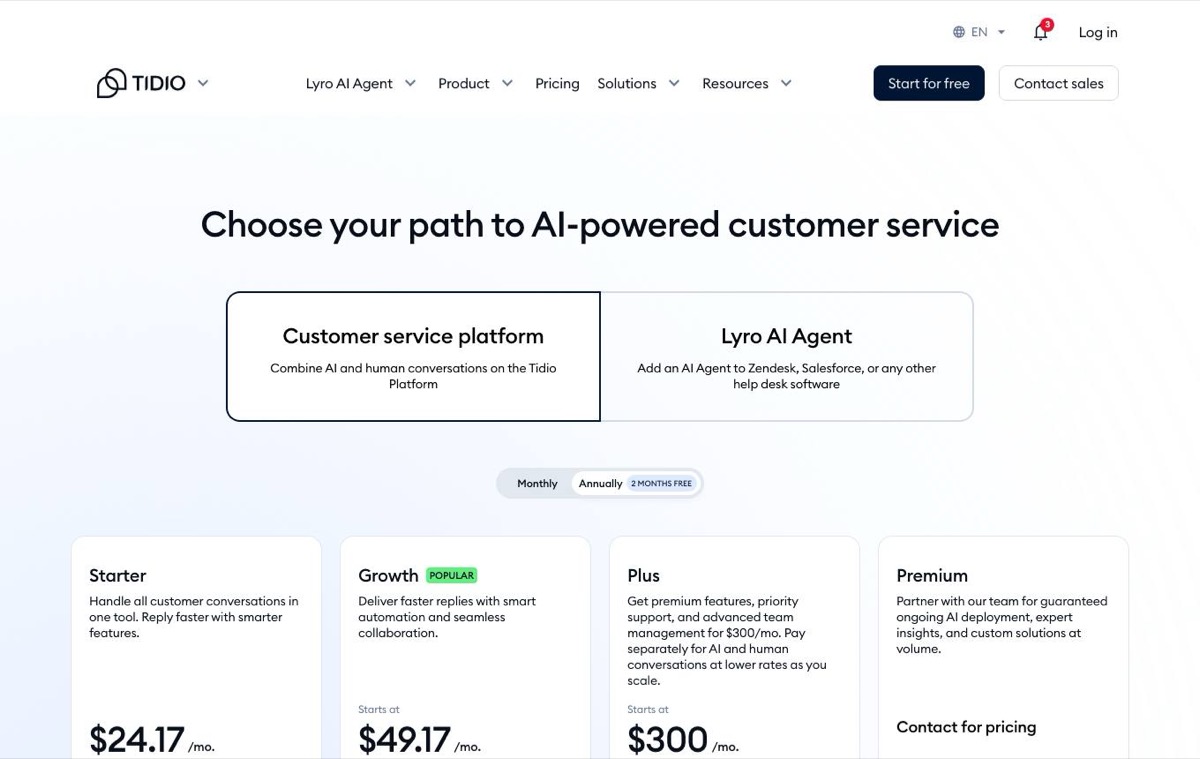 Tidio pricing page, captured 3 October 2026; prices re-checked 16 October 2026.
Lyro AI adds a second meter. It starts at $0.50 per conversation, and every account gets 50 free Lyro conversations once, not monthly (Tidio AI agent page). That is where the headline number stops matching the bill. Usage, not just the plan card, drives what you pay.
Tidio also sells add-ons instead of bundling everything into the base fee: Lyro and Flows are separate meters, and removing Tidio branding costs $16.67 a month. That matters because the sticker price is only the opening number, not the full monthly total.
For a quick market view, Tidio sits in the same broad category as the tools covered in this live chat software comparison guide, but its billing model is more usage-driven than seat-driven. To compare support pricing across vendors, see our help desk pricing index.
| Tidio plan (checked 16 October 2026) | Billed monthly | Billed yearly, per month | Billable conversations |
|---|---|---|---|
| Tidio Free | $0 | $0 | 50 |
| Tidio Starter | $29 | $24.17 | 100 |
| Tidio Growth | From $59 | From $49.17 | 250 to 2,000 |
| Tidio Plus | From $749 | Not listed | Custom |
| Tidio Premium | Contact sales | Contact sales | Custom, from 3,000 Lyro conversations |
What counts as a billable conversation in Tidio?
A billable conversation is one that a human on your team replies to or starts; replies from Lyro and Flows don’t count, and neither do unanswered messages. Self-serve plans allow up to 10 agents, so Tidio’s limit is conversation volume, not seats. Plus and Premium set custom seats.
What does each Tidio plan include?
Each Tidio plan adds conversation volume and team features: Starter adds the live visitor list and operating hours, Growth adds automation and permissions, and Plus adds departments, several projects and custom seats. Tidio’s Free plan is a test lane, not a support setup. It includes 50 billable conversations a month, the one-time 50 Lyro conversations and Flows for 100 visitors (Tidio pricing page). If you want to check whether visitors will use chat, it works. If you want to run support on it, the ceiling arrives fast.
Starter raises the limit to 100 billable conversations for $29 monthly or $24.17 billed yearly. It adds live chat and ticketing, the live visitors list, operating hours and basic analytics, which makes it the first usable paid tier. The catch is simple. A busy app or store can burn through 100 conversations without trying.
Growth is where the packaging gets harder to read. The plan starts at $59 monthly for 250 billable conversations, then rises in steps up to 2,000, with the price climbing at each step. It adds advanced analytics, user permissions, automatic chat assignment, macros and viewed-pages history, with up to 10 seats. That makes Growth the self-serve tier for teams that already know their support load and can work within the conversation ladder.
Plus starts at $749 a month and moves into custom conversation volumes, custom seats, departments, several projects and a dedicated success manager. Premium is priced on request and adds pay-per-resolution Lyro billing with a guaranteed 50% Lyro resolution rate, from 3,000 Lyro conversations. That is the point where budgeting stops being straightforward. If you need a rep to explain the bill, the published card is no longer the full story.
How much does Tidio’s Lyro AI cost?
Tidio’s Lyro AI agent costs from $0.50 per conversation, with a Lyro plan starting at $32.50 a month for 50 conversations; every account gets 50 free Lyro conversations once. Lyro is priced on usage, not headcount. Tidio’s AI agent page says Lyro starts at $0.50 per conversation and every account gets 50 free Lyro conversations. That makes the bill easy to model. If Lyro handles 1,000 conversations, you are at about $500 in usage at the starting rate before plan-specific quota or discounting. At 200 conversations, the usage cost is about $100 (Tidio AI agent page).
The free allowance is not a monthly refill. Tidio describes it as a one-time pool of 50 conversations that does not refill (Tidio AI agent page). Paid Lyro packages work differently. They renew monthly and run from 50 to 1,000 conversations, starting at $32.50 a month for 50, about $0.65 each at the entry tier. That difference matters more than the headline rate, because a one-time starter pool is not the same as a recurring bundle.
One Lyro conversation counts once however many times Lyro replies in it, and Lyro replies don’t use your billable conversations. That gives you two meters in the same account, the base plan quota and the Lyro quota. Forecast both, or your AI bill will surprise you. For example, Tidio Starter at $29 a month plus the entry Lyro package at $32.50 for 50 conversations comes to $61.50 a month, before any Growth step or the $16.67 branding add-on.
If you are comparing tools, see AI customer service agent pricing compared and check the usage meter first. Usage-based AI stays cheap only when the routing rules are strict.
What makes a Tidio bill higher than the plan price?
Four things push a Tidio bill above the plan price: monthly instead of yearly billing, moving up Growth’s conversation steps, the jump to Plus, and add-ons like Lyro and branding removal. Tidio’s bill is bigger than the plan line on the pricing page. Four levers change the total fast, and the headline number only shows part of it.
Annual billing lowers the sticker price
Starter drops from $29 to about $24.17, and Growth drops from $59 to about $49.17 on annual billing (Tidio pricing page). That is a real discount, but it only helps if you are ready to commit for the year. If your support volume is still shifting, the monthly option buys you flexibility.
Growth is a ladder, not a fixed tier
Same plan name, very different bill. Growth does not stay flat as usage moves up, so the invoice can climb with demand even if the feature set looks unchanged. That is the part buyers miss. They approve one tier and then the month ends with a higher total because support was busier than expected.
The Plus jump changes the buying motion
Plus starts at $749 a month, against $59 for entry-level Growth. Once pricing moves into that range, the conversation is no longer just about a posted plan: Plus is listed from $749 a month with custom limits, and Premium is priced through sales.
Upgrades behave like add-ons, not freebies
Extra Lyro conversations and Flows visitors are sold as separate quotas, and removing Tidio branding is a $16.67 monthly add-on (Tidio pricing page). That means the base subscription and the usage meter are separate costs. Budget only for the plan name, and you will undercount the bill.
| Cost lever | What changes | Why it matters |
|---|---|---|
| Annual billing | Starter and Growth drop on annual terms | Good if you can commit, bad if you need flexibility |
| Growth ladder | One plan spans a wide price range | The bill rises with volume, not just features |
| Plus jump | Self-serve ends and usage enters the quote | Procurement becomes sales-led |
| Upgrades | Lyro and visitor reaches cost extra | Add-ons can outrun the base plan |
How does Tidio pricing compare with Help Scout, Intercom, Crisp and Convot?
Tidio prices by conversation volume, Help Scout and Intercom by seat, Crisp by workspace and Convot by app count, so the cheapest choice depends on how your team grows. Tidio’s pricing makes more sense when you compare billing shape, not just feature lists. Help Scout is easier to budget if you want a per-seat model and do not want to watch conversation meters every week. Intercom fits teams that want an AI-heavy stack and are willing to pay for it. The full breakdown is in our Intercom pricing analysis. Crisp works better for teams that price around a workspace and do not mind the economics changing when several sites are involved.
Convot, which publishes this guide, prices by app count with seats included, from $49 to $299 a month (pricing), with Cove AI at $0.20 per resolved conversation. It shows the opposite pricing philosophy: no conversation meter for human replies.
| Tool | Billing shape | AI pricing shape | Good reason to pick it |
|---|---|---|---|
| Tidio | Conversation-based with plan ladders | Lyro is metered by conversation | You want live chat plus AI in one product |
| Help Scout | Per-seat | AI Answers $0.75 per resolution | You want straightforward shared inbox pricing |
| Intercom | Per-seat plus usage | Fin from $0.99 per outcome | You want a deeper AI-first support stack |
| Crisp | Workspace-based | AI credits included by plan | You support several sites from one workspace |
| Convot | By app count, seats included | Cove AI $0.20 per resolved conversation | You want one inbox for several apps and a predictable bill |
The right choice depends on what hurts most. If you hate per-seat sprawl, Tidio is already better than many tools. If you hate usage surprises, flat pricing models are easier to live with. If you support several apps from one team, pricing by app count is a cleaner fit than paying more every time the inbox gets busy.
How do you estimate your real Tidio bill?
Estimate a Tidio bill by counting human-answered conversations and AI-answered conversations separately, then pricing each against Tidio’s steps. Start with two pools. Estimate base-plan conversations and Lyro conversations separately, because Tidio can hit both meters in the same month. Mix them together and you will understate the bill.
Compare monthly and annual billing for the same tier. Starter drops from $29 to about $24.17, and Growth from $59 to about $49.17 on annual billing, as shown on Tidio pricing page.
Then find your monthly human-answered conversation count in Tidio’s Growth calculator, which runs from 250 to 2,000, and budget for the step you land on, not the $59 entry price.
Use the 7-day free trial (no card needed) and the free plan to load real chat volume for a week. Do not guess. Count actual conversations, then compare them with the included quotas.
Build the routing rule before launch: send low-confidence or account-specific questions to a human, so Lyro doesn’t become a usage-based support tax. A one-page estimate with those inputs is enough to approve or reject Tidio without a sales call.
Who is Tidio the right fit for?
Tidio fits small ecommerce and SaaS teams that want live chat first, a visual Flows builder, a free plan that is useful, and a price ladder they can grow into. It also fits teams that are comfortable watching conversation volume because that is what Tidio bills against.
It is not the cleanest fit for teams that want flat team pricing across many seats, or for buyers whose AI usage will run into heavy monthly volume. It’s also not the sharpest choice for Shopify app developers who want the merchant’s plan, MRR, and billing history sitting next to each conversation, because that’s a different kind of support workflow.
Help Scout is the safer pick if you want simpler per-seat budgeting. Intercom is the better match if your AI program is the main reason to buy. Crisp makes more sense if you manage several sites from one workspace. Convot is another option, with seats included and app-based pricing.
FAQ
Does Tidio have a free plan?
Tidio has a free plan with 50 billable conversations a month, a one-time 50 Lyro AI conversations and Flows for 100 visitors. Paid plans also come with a 7-day free trial that needs no card.
What is a billable conversation in Tidio?
A billable conversation is any live chat, ticket, email or social conversation that a human on your team replies to or starts. Unanswered messages don’t count, and replies from Lyro or Flows aren’t counted as agent replies.
How much is Tidio Lyro AI?
Lyro costs from $0.50 per conversation, with a Lyro plan starting at $32.50 a month for 50 conversations. Every account gets 50 free Lyro conversations once, and each conversation counts once however many replies Lyro sends.
How many agents can use Tidio?
Tidio’s self-serve plans allow up to 10 agents. Plus and Premium allow a custom number of seats through sales.
Is Tidio cheaper than Intercom?
Tidio is usually cheaper than Intercom for teams with several agents and modest volume, because it prices by conversations rather than seats, though Starter’s 100-conversation cap and the separate Lyro meter can close the gap. Tidio Starter is $29 a month for up to 10 agents and 100 billable conversations, while Intercom Essential is $29 per seat billed annually, so five agents cost about $145 on Intercom against $29 on Tidio before AI. Fin is from $0.99 per outcome and Lyro from $0.50 per conversation; the units differ, so compare cost per resolved case.
About the author
Tarang Agarwal is the founder of Convot. Convot is built by Sidepanda, a small studio that runs several Shopify apps of its own, including Appointo, Depo and Panda Bundle, and supports all of them from one Convot inbox.
Revenue-aware support for Shopify app teams.
Live chat, help center, and every merchant's MRR, plan, and LTV beside the conversation. Free under $1k MRR.
Start free