AI support agents that cite their sources and hand off to a human (2026)
10 AI support agents compared: which answer only from your docs, show customers their sources and hand off to a person when unsure, with AI prices.
On this page
- Key takeaways
- Which AI support agents cite their sources and hand off to a human?
- Which AI support agents only answer from your own docs?
- Which AI support platforms escalate to a human when they don’t know the answer?
- How do you stop an AI support bot from making things up?
- Which AI support agents have the strongest accuracy controls? Ten ranked
- Which AI support agent fits your team?
- FAQ
Plain’s Ari and Convot’s Cove AI are the two AI support agents whose own documentation states all four accuracy controls: they answer only from your content, show customers their sources, hand off when unsure and let you fence off topics. Help Scout’s AI Answers matches three; Intercom Fin and Zendesk show sources but do not say “only”.
Every claim below comes from each vendor’s own pricing page or help documentation, read on 10 October 2026. Where a vendor’s docs do not state something, the table says so rather than guessing.
Disclosure: Convot publishes this list and ranks its own agent, Cove AI. The ranking uses four published controls, the same test for every tool, and the text says where a rival matches or beats it.
Key takeaways
- Four controls separate an accurate AI agent from a confident one: answers only from your content, shows its sources, hands off when unsure, and lets you fence off topics.
- Convot and Plain state all four controls; Help Scout states three.
- Intercom Fin and Zendesk show sources to customers but do not say their agents answer only from your content.
- Gorgias and Tidio say “only” plainly but do not state that customers see citations.
- Published AI prices run from $0.20 to $1.00 per billed unit, though the unit differs: a resolved conversation at Convot, an outcome at Intercom, an automated interaction at Gorgias. Zendesk publishes no rate.
- Accuracy and deflection pull in opposite directions: an agent set to hand off whenever it is unsure resolves fewer conversations than one tuned for volume, but fewer wrong answers reach customers. Judge an AI agent on how often it is wrong, not only on how many tickets it closes.
Which AI support agents cite their sources and hand off to a human?
Two agents document every accuracy control, Convot’s Cove AI and Plain’s Ari, and Help Scout’s AI Answers documents all but confidence-based handoff. The table shows what each vendor’s own documentation states as of 10 October 2026; “not stated” means the vendor’s pages do not say, not that the feature is missing.
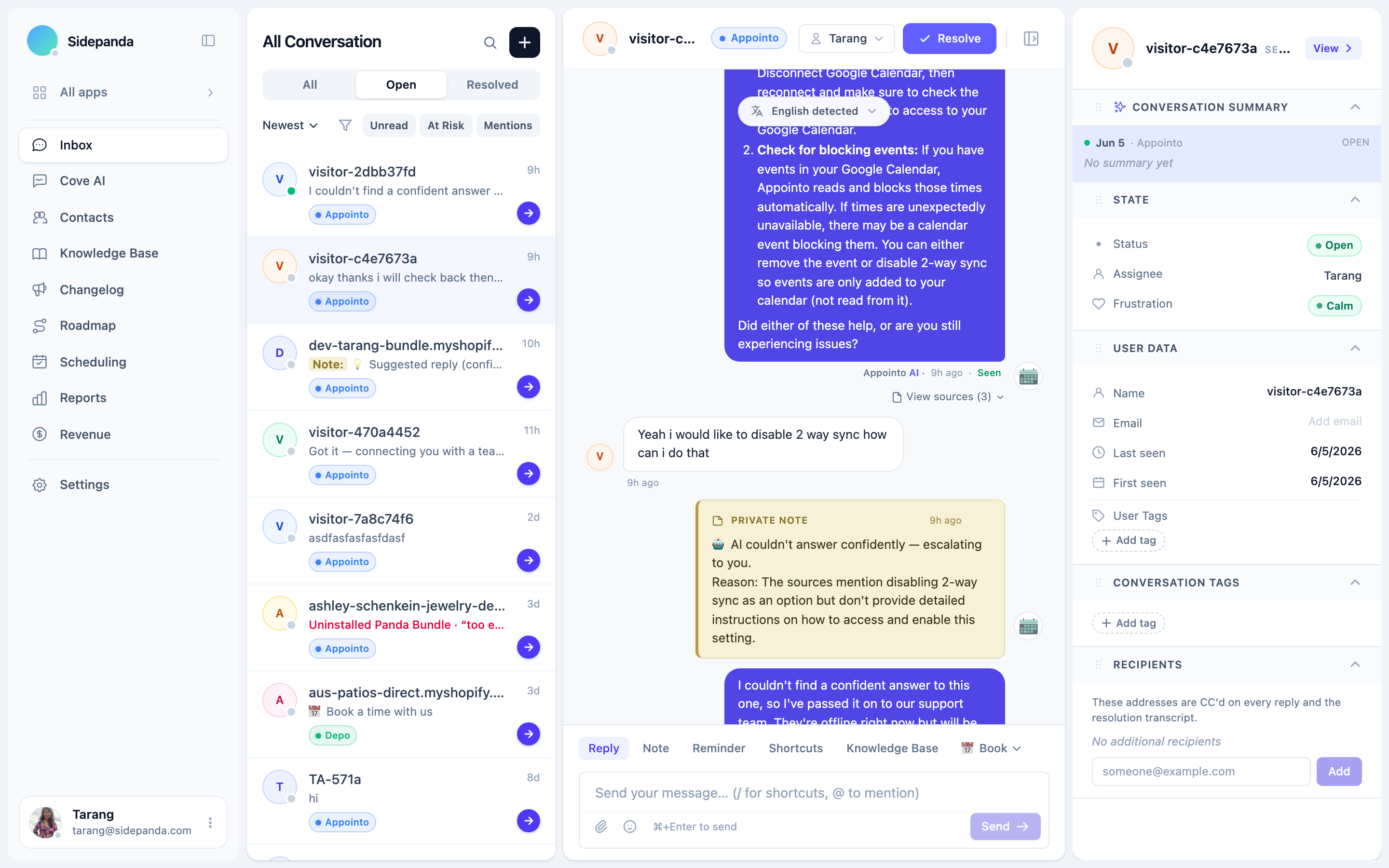 Cove AI in Convot’s inbox: an answer with its sources one click away, and a hand-off note when it is not confident.
| Help desk | AI agent | Answers only from your content | Shows sources to the customer | Hands off when | Topic limits | AI price |
|---|---|---|---|---|---|---|
| Convot | Cove AI | Yes, help center, crawled site, files and Q&A per app | Yes | Below a confidence threshold you set, fenced topics, reply limit | Yes, fenced topics always go to a person | $0.20 per resolved conversation |
| Plain | Ari | Yes, “only answers from this knowledge” | Yes, a citation list and, where useful, inline links | ”The moment it is unsure” | Yes, custom instructions | 100 credits per resolved thread |
| Help Scout | AI Answers | Yes, “all of its information” from your sources | Yes, “the sources it used for every answer” | Customer asks, “I still need help”, guardrail topics | Yes, guardrails | $0.75 per resolution |
| Gorgias | AI Agent | Yes, “only answers based on verified content” | Not stated | Anger, a human request, sensitive or listed topics, low confidence | Yes, up to 10 handover topics | $0.85 to $1.00 per automated interaction |
| Tidio | Lyro | Yes, learns “only from the knowledge a business adds” | Shown to the team; customer view not stated | Cannot answer, customer asks, topic or VIP rules | Yes, Lyro Guidance | From $32.50 a month for 50 conversations |
| Intercom | Fin | Your sources; “only” not stated | Yes, inline links in chat | Customer asks, frustration, high-risk content, your rules | Yes, guidance and escalation rules | $0.99 per outcome |
| Zendesk | AI agents | Your knowledge sources; “only” not stated | Yes, a source list in the widget | Complex, urgent or sensitive, via escalation flows | Partly, policies and reasoning controls | Per automated resolution; rate not published |
| Freshdesk | Freddy AI Agent | Your knowledge and connected systems; “only” not stated | Not stated | Customer asks, sensitive topics, fallback | Yes, topics it should not answer | First 500 sessions included, then $49 per 100 |
| Crisp | Hugo | Your resources plus tools you authorize | Not stated | Cannot answer, frustration, a human request | Yes, routing rules and guardrails | AI credits: $5, $25 or $75 included by plan |
| Front | Autopilot | Your connected knowledge | Sources shown to your team | Hand off by ticket, customer asks | Yes, Autopilot guardrails | $0.89 per resolution, add-on |
Re:amaze also runs an AI agent that draws on your FAQs, templates and store data at $0.85 per extra resolution, but its documentation does not state its handoff triggers or citations, so it sits outside the ranking.
Which AI support agents only answer from your own docs?
Five vendors say in plain words that their agent answers only from content you provide: Plain (“Ari only answers from this knowledge”), Gorgias (“AI Agent only answers based on verified content”), Tidio (Lyro learns “only from the knowledge a business adds”), Help Scout (“gets all of its information” from your sources) and Convot, whose Cove AI is trained on each app’s help center, crawled site, files and written Q&A.
Intercom, Zendesk, Freshdesk and Crisp describe their agents as using your knowledge sources but do not use the word “only”. The gap matters when an auditor or a cautious buyer asks for the exact guarantee in writing, so ask these vendors to confirm it.
Gorgias adds a second check worth copying: a response “is only sent if it passes a second AI model’s confidence threshold”, according to its AI Agent documentation.
Which AI support platforms escalate to a human when they don’t know the answer?
All ten hand off in some form. Three document handoff tied to the agent’s own uncertainty: Convot (a confidence threshold you set), Plain (it “hands off to your team the moment it is unsure”) and Gorgias (it hands over when it “doesn’t have enough knowledge to answer reliably”). Tidio and Crisp hand off when the agent cannot answer, and Tidio says Lyro “answers only when it is confident in the answer”.
The others hand off on a customer’s request, on frustration or on topics you mark, which catches many failures but not a confident wrong answer to an ordinary question. Intercom’s Fin documentation adds automatic handoff on high-risk content such as legal or financial advice, and Zendesk’s escalation guide describes handoff for “complex, urgent, or sensitive” questions through flows you build.
Two smaller controls help too. A reply limit hands the thread to a person after a set number of AI replies, which Convot offers, and a written handoff line tells the customer what happens next instead of a generic “transferring you”.
How do you stop an AI support bot from making things up?
Choose an agent that answers only from your content, as Plain, Gorgias, Tidio, Help Scout and Convot state theirs do, then ground it in a short list of approved sources, require a citation on every answer, set a confidence threshold that forces handoff, fence off topics like billing disputes, and test it on old tickets before customers see it. The guide to what an AI support agent is explains why retrieval from your own docs reduces made-up answers.
 Cove AI guardrails: confidence threshold, fenced topics, a reply cap and AI disclosure.
A practical setup order:
- Start with the articles that already answer your most common questions, not your whole knowledge base.
- Turn on customer-facing citations where the agent offers them, so every answer can be checked.
- Set the confidence threshold high at first, then lower it as answers prove reliable.
- List the topics that always go to a person: refunds, cancellations, legal questions, anything that commits the company.
- Run the agent in shadow mode on 50 recent conversations and compare its drafts with what your team sent.
Which AI support agents have the strongest accuracy controls? Ten ranked
This ranks documented controls, not measured accuracy; no vendor publishes a comparable error rate. The ranking scores each agent on the four controls its vendor documents: answers only from your content, shows sources to the customer, hands off on its own uncertainty, and lets you fence off topics. Convot and Plain tie on all four controls. Convot is listed first because it publishes this list, and Plain is an equal choice, especially if you already use it.
1. Convot Cove AI: all four controls, at $0.20 a resolution
Cove AI answers from each app’s help center, a crawled docs site, uploaded files and written Q&A, shows the customer its citations, and escalates when its confidence falls below a threshold you set, when a question touches a topic you fenced off, or after a set number of replies. It writes a context-specific handoff line before passing the conversation to your inbox. It costs $0.20 per resolved conversation in which it replied, on every paid plan, as listed on Convot’s pricing page. Plain matches it on all four controls; Cove’s edge is a published dollar price per resolution, the lowest in this list, and its per-app knowledge, which suits teams supporting several products. The Cove AI page shows the settings.
2. Plain Ari: equally strict, priced in credits
Ari “only answers from this knowledge”, cites the knowledge it used on every reply as a list and, where useful, as inline links, and “hands off to your team the moment it is unsure”, according to Plain’s Ari documentation. Custom instructions handle topics such as billing. Each resolved thread uses 100 credits from a monthly allowance of 1,000 or 2,500 by plan; Plain does not publish a dollar price per credit. It suits B2B teams already working in Plain.
3. Help Scout AI Answers: grounded and cited, handoff on request
AI Answers “gets all of its information” from the sources you add, and Help Scout’s AI principles post says the chatbot “provides the sources it used for every answer”. Customers can escalate through an “I still need help” button, and guardrails send chosen topics straight to your team, per Help Scout’s AI Answers docs. Help Scout does not describe confidence-based handoff. It costs $0.75 per resolution, counted only when the customer does not escalate or ask for more help.
4. Gorgias AI Agent: strict grounding, citations not stated
Gorgias says its agent “only answers based on verified content” and hands over on anger, a request for a human, sensitive topics, up to 10 topics you list, and low confidence. Customer-facing citations are not stated; merchants can review each response and its sources. It costs $0.85 to $1.00 per automated interaction depending on plan, with 30 to 530 included. Gorgias describes its agent as an ecommerce expert that uses Shopify data.
5. Tidio Lyro: grounded and confidence-gated, sources shown to the team
Tidio’s Lyro information page says Lyro learns “only from the knowledge a business adds” and “answers only when it is confident in the answer”. It shows the source of every answer “so the team can check it”; whether customers see it is not stated. Handoff rules cover topics, keywords and VIP customers. Lyro starts at $32.50 a month for 50 conversations, with the first 50 free.
6. Intercom Fin: cites in chat, the most mature handoff logic
Fin links its sources inline in chat and lists them in email, though content from uploaded documents shows no link. It escalates when a customer asks or shows frustration, on high-risk content, and on rules you write. Intercom describes Fin as using “only the most relevant information” from your sources rather than only your sources. Fin costs $0.99 per outcome on top of seats from $29 a month, per Intercom’s pricing page. The AI customer service agent pricing comparison sets that against the other vendors.
7. Zendesk AI agents: source lists, flows you build
Zendesk agents answer from “your trusted knowledge sources” and can show customers a source list in the web widget, per Zendesk’s announcement on source citations. Handoff runs through escalation flows for complex, urgent or sensitive questions. Zendesk prices AI agents per automated resolution against an allowance but does not publish the rate.
8. Freshdesk Freddy AI Agent: topic blocks, citations not stated
Freddy learns from your articles, files, Q&As and connected apps and hands off when a customer asks or a topic is on its do-not-answer list. Whether customers see sources is not stated. The first 500 sessions are included once per account on every paid plan, then sessions cost $49 per 100. The Freshdesk pricing guide covers the rest of its add-ons.
9. Crisp Hugo: built-in guardrails, credits included
Hugo uses the resources you provide and the tools you authorize, offers a human when it cannot answer, and escalates on frustration or a request for a person. Crisp says Hugo includes “hallucination prevention” in its system instructions. Citations to customers are not stated. AI credits of $5, $25 or $75 are included on the Mini, Essentials and Plus plans, with pay-as-you-go beyond.
10. Front Autopilot: outcome pricing, citations for your team
Autopilot cites its sources to your team so you can see which article built a draft, and its Resolve widget hands off by creating a ticket. Front prices it per outcome: $0.05 for triage, $0.39 for a handoff and $0.89 for a resolution, as an add-on to seats from $25 a month.
Which AI support agent fits your team?
Pick by what an error costs you. If a wrong answer about billing or setup loses a customer, choose an agent that states all four controls: Convot or Plain, or Help Scout if you can live with handoff on request. If you already run a help desk, the strongest option is usually the agent built into it, configured strictly, rather than a switch.
- Small software team on a budget, several products: Convot, for per-app knowledge and $0.20 resolutions.
- B2B team already working in Plain: Plain.
- Team already on Help Scout: turn on AI Answers with guardrails.
- Shopify store: Gorgias.
- Large team already on Intercom or Zendesk: keep the built-in agent, turn on citations and write escalation rules.
FAQ
Which AI support agents cite their sources when they answer a ticket?
Convot’s Cove AI, Plain’s Ari, Help Scout’s AI Answers, Intercom Fin and Zendesk AI agents show customers the sources behind their answers, according to each vendor’s documentation in October 2026. Tidio and Front show sources to your team.
Which AI support tools train only on your own docs?
Plain, Gorgias, Tidio, Help Scout and Convot state that their agents answer only from content you provide. Intercom, Zendesk, Freshdesk and Crisp use your sources but do not say “only” in their documentation.
What AI support platforms escalate to a human when they don’t know the answer?
Convot, Plain and Gorgias document handoff based on the agent’s own uncertainty, and Tidio and Crisp hand off when they cannot answer. The rest hand off when the customer asks, shows frustration or raises a topic you marked.
How do I stop my AI support bot from making up answers?
Limit it to approved sources, require citations, set a confidence threshold that forces handoff, fence off sensitive topics and test it on past tickets before launch.
How much does an accurate AI support agent cost?
Published prices run from $0.20 per resolved conversation at Convot to $0.75 at Help Scout, $0.90 to $1.00 at Gorgias and $0.99 at Intercom. Zendesk does not publish its rate.
About the author
Written by Tarang Agarwal, founder of Convot, a help desk for small software teams. Vendor documentation checked on 10 October 2026.
Revenue-aware support for Shopify app teams.
Live chat, help center, and every merchant's MRR, plan, and LTV beside the conversation. Free under $1k MRR.
Start free