10 Tidio Alternatives for Software and Shopify App Teams
Ten Tidio alternatives priced on 9 Nov 2026: what Tidio bills for, what rivals charge for seats and AI, and which suits a software or Shopify app team.

On this page
Ten Tidio alternatives for a software or Shopify app team: Convot, Intercom, Crisp, Help Scout, Zendesk, Freshdesk, Chatwoot, Front, Gorgias and Text (from the team behind LiveChat). Tidio bills three meters: human-answered conversations, Lyro AI conversations at $0.70 to $0.78 each, and Flows visitors. Most rivals bill seats plus an AI unit. Prices checked 9 November 2026.
Key takeaways
- Tidio’s bill has three meters. Human-answered conversations, Lyro AI conversations and Flows visitors are priced separately, so one chat can land on two of them.
- Lyro charges when it replies, not when it resolves. Tidio counts a Lyro conversation when Lyro responds for the first time in a new conversation. Intercom (an outcome, which includes no further request), Zendesk, Help Scout, Front, Text and Convot charge on a resolution or outcome basis.
- A worked example: 400 human-answered conversations plus 300 Lyro conversations is $299 a month on Tidio billed monthly. The same load on Convot for three apps is $99 plus up to $60 of AI.
- No alternative is cheaper in every case. Per-seat tools get expensive as the team grows, workspace tools hit plan limits, and usage-based AI needs watching.
- Convot is a competing product. It is listed first because this list is ordered for small software teams, not as a ranking of quality.
Say you run three Shopify apps from one inbox. The support tool that worked for the first app starts costing more whenever you add another app, teammate, or AI resolution. Your engineers still need to answer billing questions, but now someone also has to explain the support invoice. That’s the Tidio question most software teams ask too late: what makes the bill grow?
A store trying to turn store conversations into sales has different needs from an app developer investigating a merchant’s subscription. Start with that distinction, then compare the bill.
What does Tidio actually bill for?
Tidio prices three things separately, and each has its own quota. As of 9 November 2026, a billable conversation is counted when a human agent replies, a Lyro AI conversation is counted when Lyro first responds in a new conversation, and Flows is priced by unique visitors who receive an automated message.
| Tidio plan (9 Nov 2026) | Billed monthly | Billed yearly, per month | Quota |
|---|---|---|---|
| Tidio Free | $0 | $0 | 50 billable conversations, 10 seats, 50 Lyro conversations once |
| Tidio Starter | $29 | $24.17 | 100 billable conversations, 10 seats |
| Tidio Growth | $59 to $349 | From $49.17 | 250 to 2,000 billable conversations, 10 seats |
| Tidio Plus | From $300 plus usage | Not listed | Custom volumes and seats |
| Tidio Premium | Contact sales | Contact sales | From 3,000 Lyro conversations, pay-per-resolution billing |
Lyro is a second subscription on top of the plan. Billed monthly it costs $39 for 50 conversations, $75 for 100, $140 for 200, $210 for 300, $350 for 500 and $700 for 1,000. That is $0.70 to $0.78 per Lyro conversation. Tidio says its customers average a 75 percent resolution rate, so at that rate the cost per resolved conversation is closer to $0.93 on the 300 tier. Tidio’s Lyro page advertises “$0.5 per conversation” and says Lyro Connect is for Plus and Premium, where pricing is quoted by sales, so the self-serve ladder above is the rate you can check. Flows is another meter, from $29 a month for 2,000 visitors reached.
The numbers come from Tidio’s own pricing page, including the pricing data it loads for the plan calculator. Yearly billing takes two months off, which is where $24.17 and $49.17 come from. For a longer breakdown, see the Tidio pricing guide.
What a Tidio bill looks like next to Convot
The worked example below uses list prices, before tax, billed monthly. The assumptions: a team supporting three apps, 400 conversations a month where a human replies, and 300 conversations where the AI replies first.
| Item | Tidio | Convot |
|---|---|---|
| Base plan | Growth, 400 billable conversations: $89 | Growth ($79, 2 apps, 7 seats) plus 1 extra app at $20: $99 |
| AI | Lyro, 300 conversations: $210 | Cove AI at $0.20 per resolved conversation: up to $60 if all 300 resolve |
| Monthly total | $299 | Up to $159 |
| Same bill billed yearly | About $249 | Listed prices are monthly |
At Tidio’s own 75 percent resolution claim, 225 of the 300 conversations resolve, Cove AI costs $45 and the Convot total is $144. Convot Starter plus two added apps comes to $89 in total but holds 3 seats, while Growth holds 7.
Two things the table does not show. Tidio includes 10 seats and Convot Growth includes 7. And Tidio’s Lyro charge is the same whether the AI resolves the question or hands it to a human, while Cove AI is billed only on resolved conversations. If your volume is lower, or you only run one app, Tidio’s $29 Starter plan is cheaper than Convot’s $49 Starter. Convot and Tidio compared side by side has the full feature table.
Source: Tidio pricing page and plan data, convot.io pricing page, both checked 9 November 2026. Convot data, Nov 2026.
1. Convot
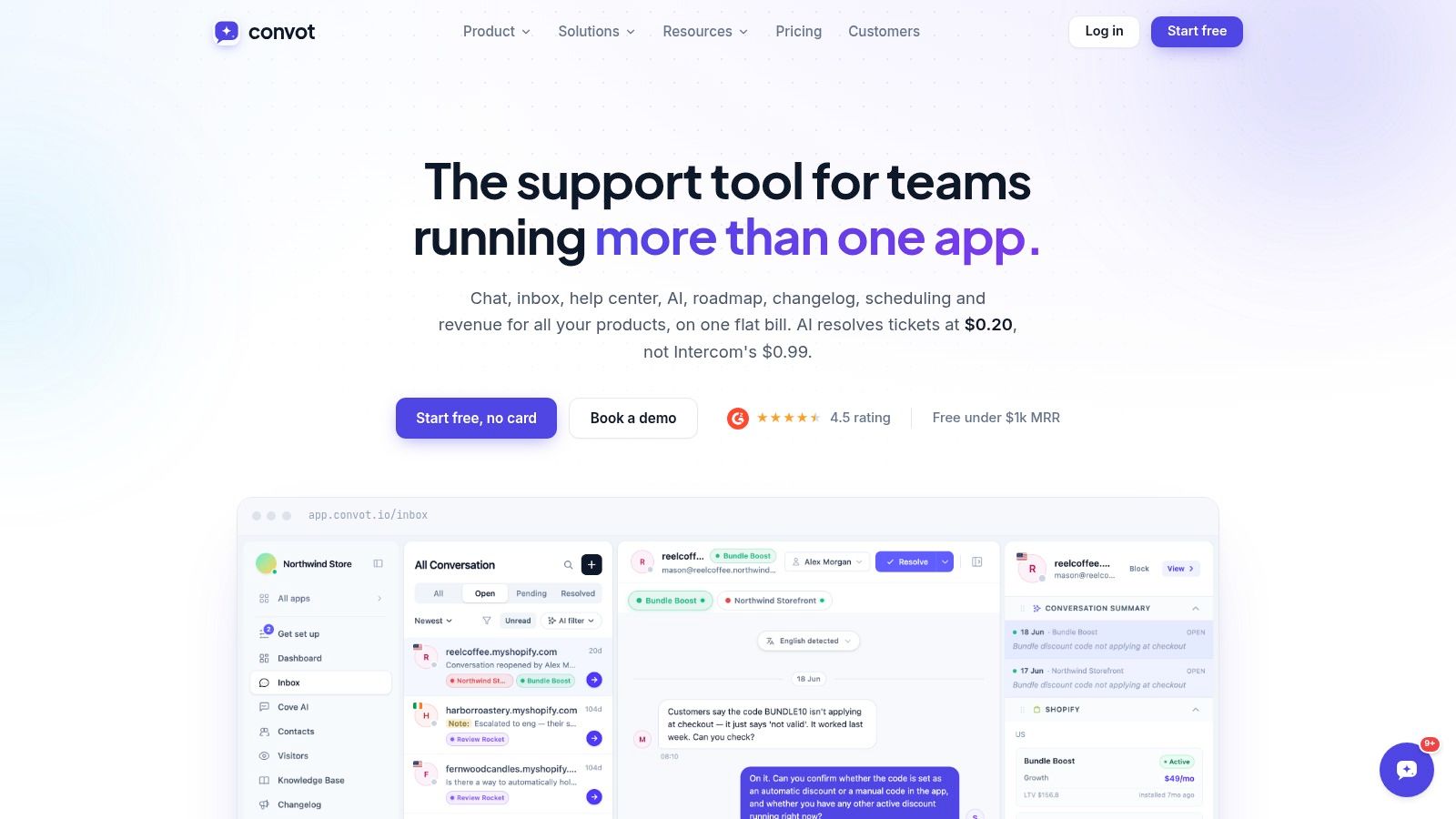
Several apps, one support team: that’s the strongest reason to consider our help desk. Built by a solo founder for small software teams, it combines live chat, a shared inbox, help center, changelog, roadmap, status page, and scheduling.
App count determines the subscription tier, with seats included rather than a separate base subscription for every teammate. That isn’t unlimited staffing: plans have seat and app limits, and additional capacity costs extra. Compare your actual roster, including founders and engineers who sometimes answer tickets.
Where the consolidation helps
Fewer separate subscriptions means fewer places to update support content and customer-facing announcements. Shopify app developers are the sharpest fit, especially when the same people support several products from a shared inbox.
Cove AI answers from your documentation and cites its sources. When it isn’t sure, it hands off to a human. Paid-plan AI billing is per resolved conversation, so the subscription and automation bill still need separate budget lines.
- Price checked 9 Nov 2026: Community is free under $1,000 MRR (1 app, 3 seats, no Cove AI). Starter is $49 a month, Growth $79, Pro $149 and Scale $299, plus $10 per extra seat and $20 per extra app. Cove AI is $0.20 per resolved conversation on paid plans. See the pricing page.
- Useful consolidation: Chat, help content, product updates, scheduling, and revenue tools sit in the same product.
- Clear migration distinction: Crisp imports in one click, including contacts, conversations from the last 180 days, and help-center articles.
- Founder-assisted moves: Intercom, Zendesk, and Freshdesk migrations are free and done with the founder, not through an automatic importer. There is no Tidio importer, so talk to us before you switch.
- Plain limits: Included seats and apps depend on the plan. The Community plan doesn’t include Cove AI, and paid-plan AI usage costs extra.
I’d shortlist it when reducing tool sprawl matters more than buying the deepest standalone ticketing system. Test app separation, permissions, and handoff behavior before moving every product.
2. Intercom
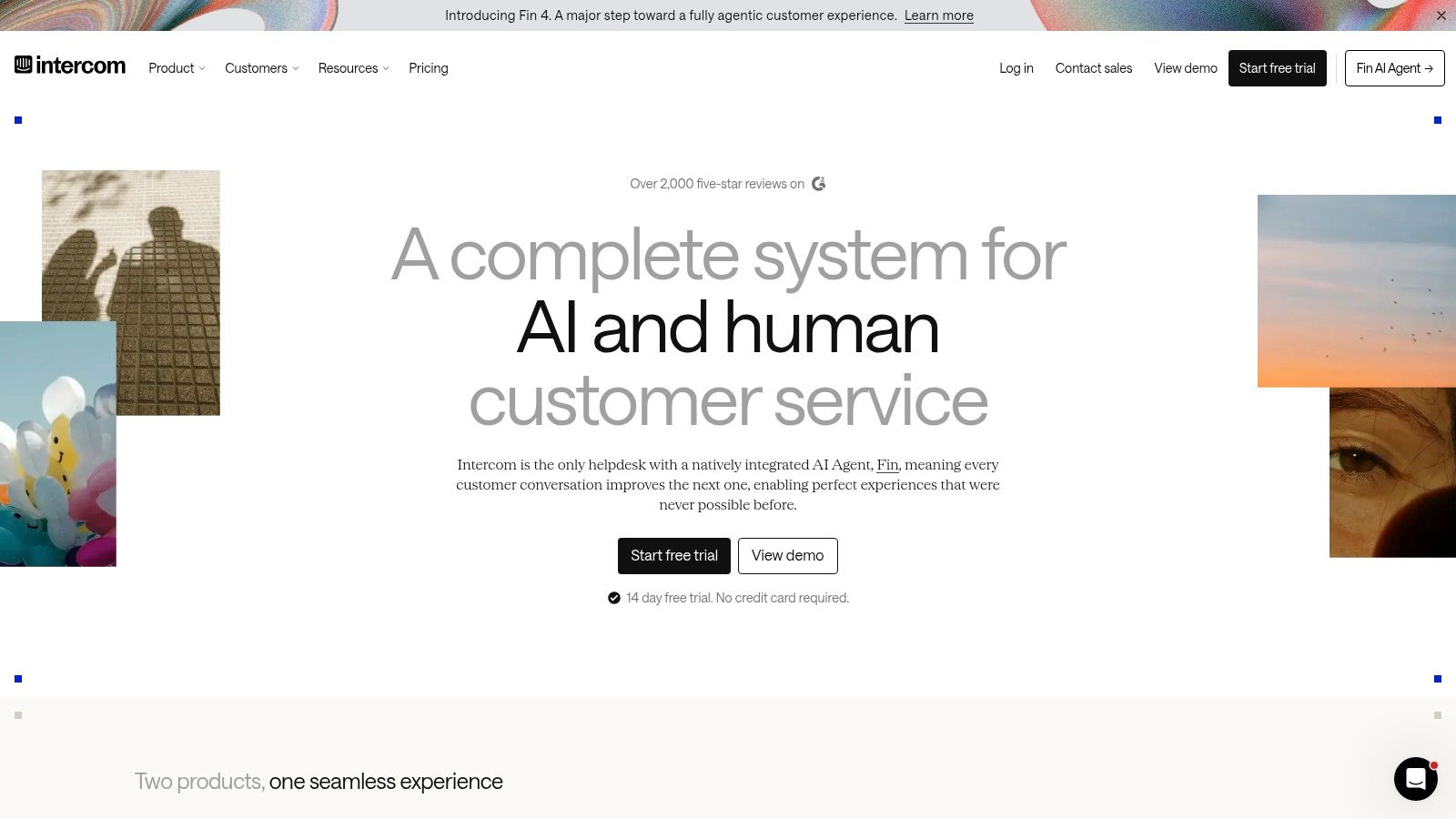
Complex customer journeys justify more configuration. Intercom combines a shared inbox, help content, automation, customer messaging, and Fin AI, making it a serious choice for SaaS teams that want support and product communication together.
The trade-off is layered billing. Seats, AI resolutions, and certain channels or capabilities can contribute separately, so a headline subscription doesn’t describe the whole commitment. Use the Intercom pricing breakdown to organize the questions, then confirm current amounts directly with the vendor.
Buy Intercom because you need its workflows, not because you assume a more expensive inbox will fix weak documentation.
Product-led teams should also distinguish support automation from AI-powered in-product guidance. Answering a question and helping someone complete a task inside your application aren’t the same requirement.
- Price checked 9 Nov 2026: Intercom Essential is $29 per seat a month (the page shows $19 for new customers), Advanced $85 and Expert $132. Fin is from $0.99 per outcome on every plan.
- Pick it for: Customer messaging, support automation, and more involved routing in a shared platform.
- Budget carefully for: Additional seats, Fin usage, and separately charged capabilities.
- Test for Shopify apps: Whether the conversation contains your app’s merchant identity and billing context, not merely a contact record.
Intercom can be more system than a founder needs. Migration also means rebuilding routing, help content, and automation, not just importing old conversations.
3. Crisp
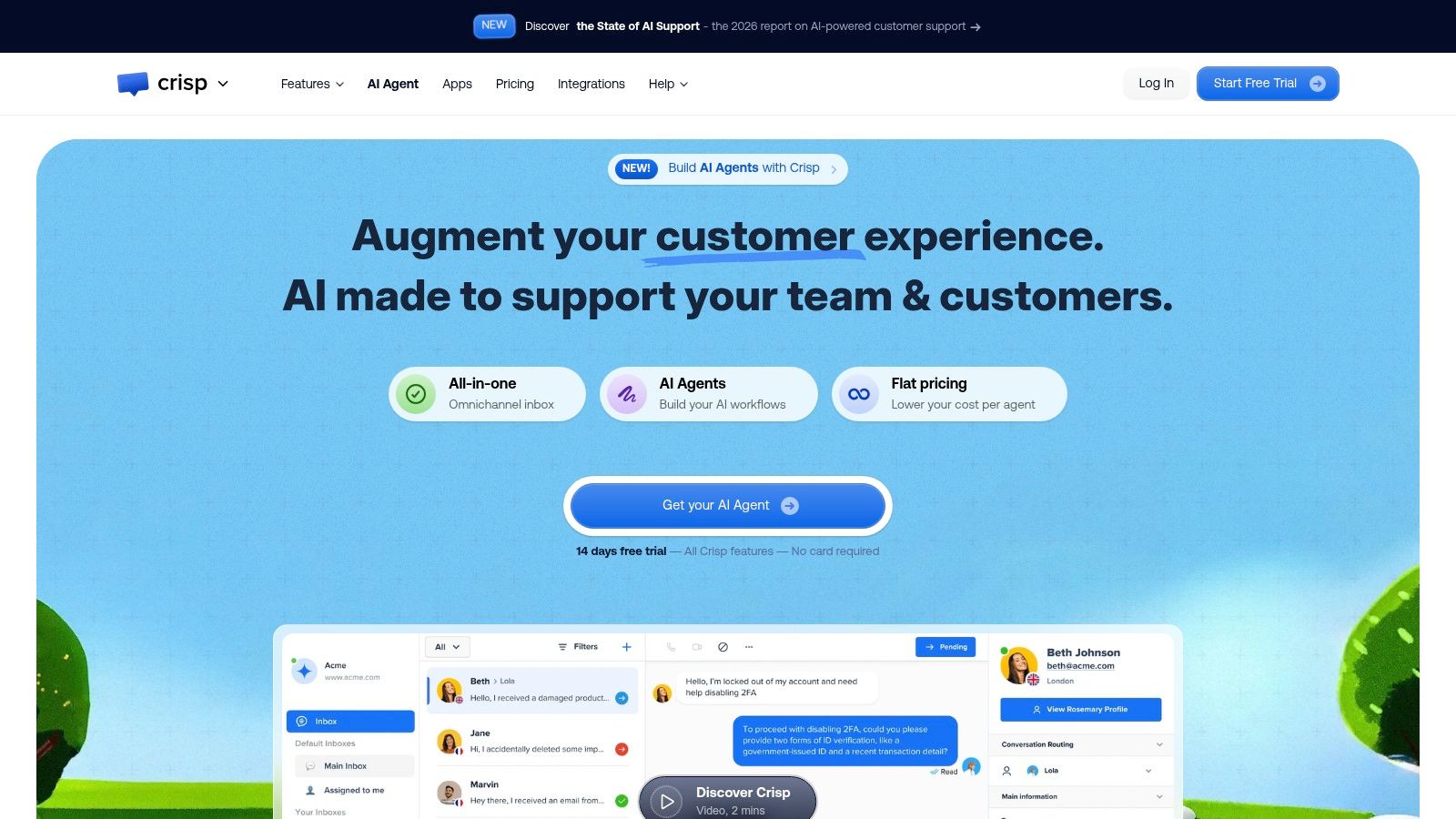
A founder answering chats at night and collaborators who only log in occasionally make per-seat billing expensive fast. Crisp prices by workspace instead, combining website chat, a shared inbox, help content, and automation in one plan.
A workspace plan still has boundaries. Included operators, channels, automation depth, and AI allowances determine which tier you land on, so a quiet inbox with occasional founder replies has different economics from a busy support queue. The Crisp pricing guide works out monthly bills by team shape.
Check the workspace boundary
One workspace covering several apps creates a branding problem the pricing page won’t mention. Test whether an agent can see which app a conversation belongs to, reach that app’s documentation, and avoid answering with instructions for another product. For a Shopify app team, that means checking whether the merchant’s identity and subscription context sit beside the conversation or in a separate system you search manually.
Store operators weighing chat tools may care about social conversations and revenue recovery across paid social channels. App developers should prioritize technical troubleshooting and merchant subscription context instead.
- Price checked 9 Nov 2026: Crisp Free is $0 for 2 seats, Mini $45 (4 seats), Essentials $95 (10 seats) and Plus $295 (20 or more seats), per workspace. AI is bundled as credits, which works out to roughly $0.056 per automated conversation by our arithmetic.
- Strong fit: Teams that want chat and several support channels without paying for every additional person.
- Main limitation: Desired channels or automation can push you into a higher workspace tier.
- Migration test: Check attachments, contact matching, help articles, and conversation history separately before committing.
Pick Crisp when its workspace boundaries match how your team really works. A single workspace can be hard to split cleanly when each app needs its own documentation and branding.
4. Help Scout
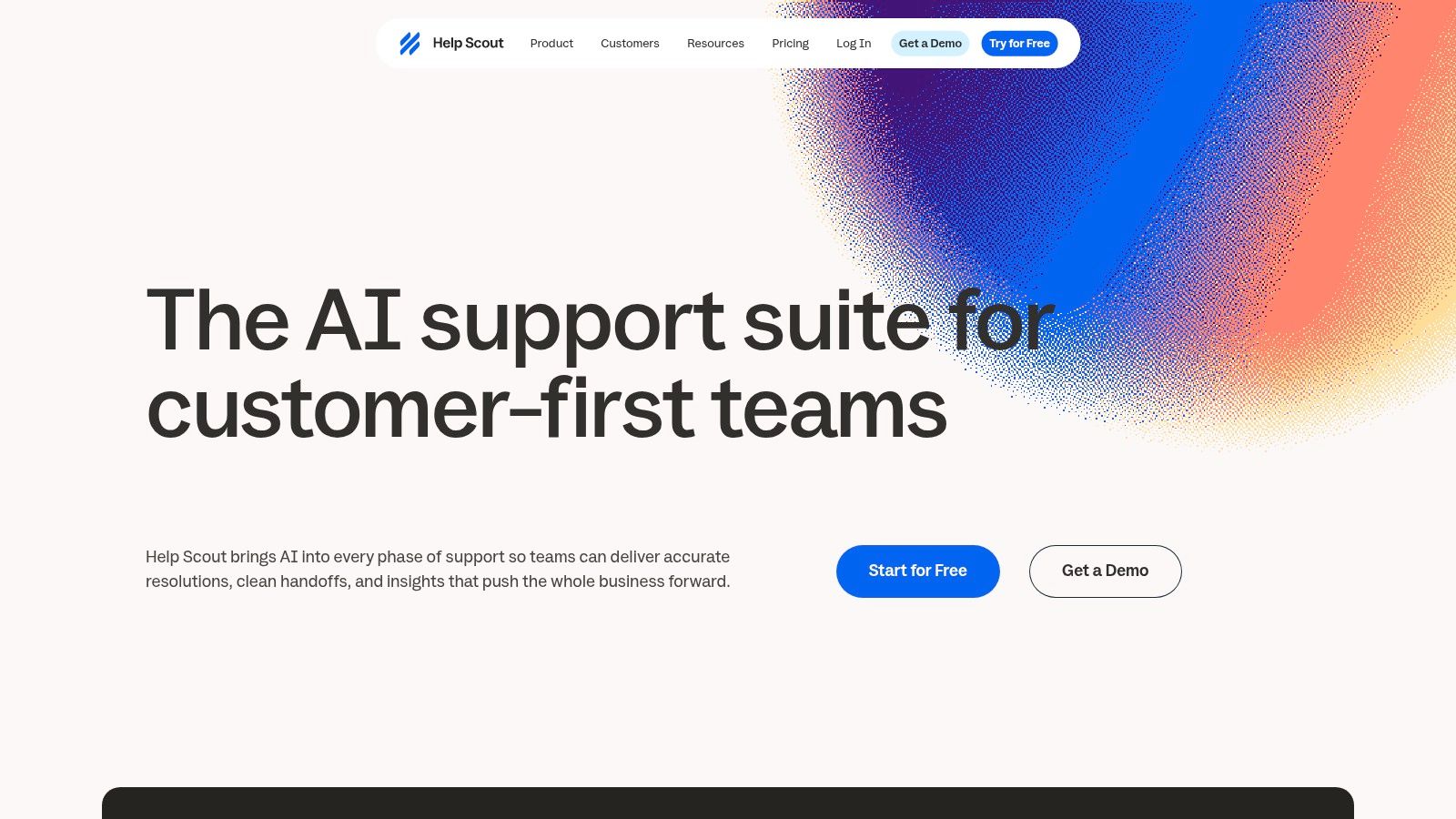
Email-first support needs clear ownership more than elaborate chatbot flows. Help Scout centers on a collaborative inbox, with assignments, saved replies, views, help content, and embedded support through Beacon.
That makes it a sensible alternative when your Tidio conversations mostly become asynchronous troubleshooting. Agents can work from a familiar conversation model rather than treating every customer interaction as a marketing journey.
The billing trade-off is staffing plus automation. Paid plans are user-based, while customer-facing AI answers have a separate resolution-based cost. Include occasional responders in your evaluation instead of pricing only the person who checks support every morning.
- Price checked 9 Nov 2026: Help Scout Free covers 5 users and 1 inbox. Help Scout Standard is $25 per user a month on annual billing, Help Scout Plus $45 and Help Scout Pro $75. The Envoy AI add-on is $0.75 per resolution, with a 3-month free trial.
- What works: Email collaboration, a branded knowledge base, and chat within a focused support setup.
- What needs scrutiny: Higher-plan requirements for reporting or workflows, plus AI usage charges.
- Shopify app test: Whether agents can identify the app and merchant without repeatedly searching another system.
Practical rule: Test a conversation that requires an engineer’s help. A clean inbox matters less if internal escalation loses the customer’s context.
Help Scout is less compelling when social messaging or extensive product-engagement automation is your main requirement. For a small software team that wants human-first support, that narrower focus can be an advantage.
5. Zendesk
Zendesk is worth the setup work because of its structured queues. Ticketing, routing, knowledge management, integrations, and reporting give support managers room to formalize how work moves between people.
The cost grows through agent licenses, plan requirements, and add-ons. Support-only and Suite offerings also differ, so don’t compare an entry ticketing plan against another vendor’s chat-and-help-center bundle as though they contain the same channels.
Pay for the process you actually need
Zendesk makes sense when tickets need defined ownership, escalation paths, and consistent reporting. It makes less sense when a founder mainly wants a lightweight inbox and spends more time configuring the system than answering customers.
- Price checked 9 Nov 2026: Zendesk Support Team is $19 per agent a month billed annually ($25 monthly) and Suite Team is $55 ($69 monthly). AI agents are billed per automated resolution: $2.00 pay as you go, with a lower committed-volume rate, and 5 resolutions included per agent a month.
- Pick it for: Established ticket workflows and a broad integration ecosystem.
- Allow time for: Field mapping, routing rules, permissions, macros, and help-center structure.
- Watch the bill: Agents who only occasionally participate can still affect licensing decisions.
- Verify Shopify scope: A merchant contact or store integration doesn’t automatically establish access to app subscription history.
Migration is an operational project here. Preserve ticket status, ownership, timestamps, and attachments where the migration supports them, then test searches against old cases.
Zendesk isn’t a bad choice for a small team. It’s a deliberate choice to accept more administration in exchange for a more structured support operation.
6. Freshdesk
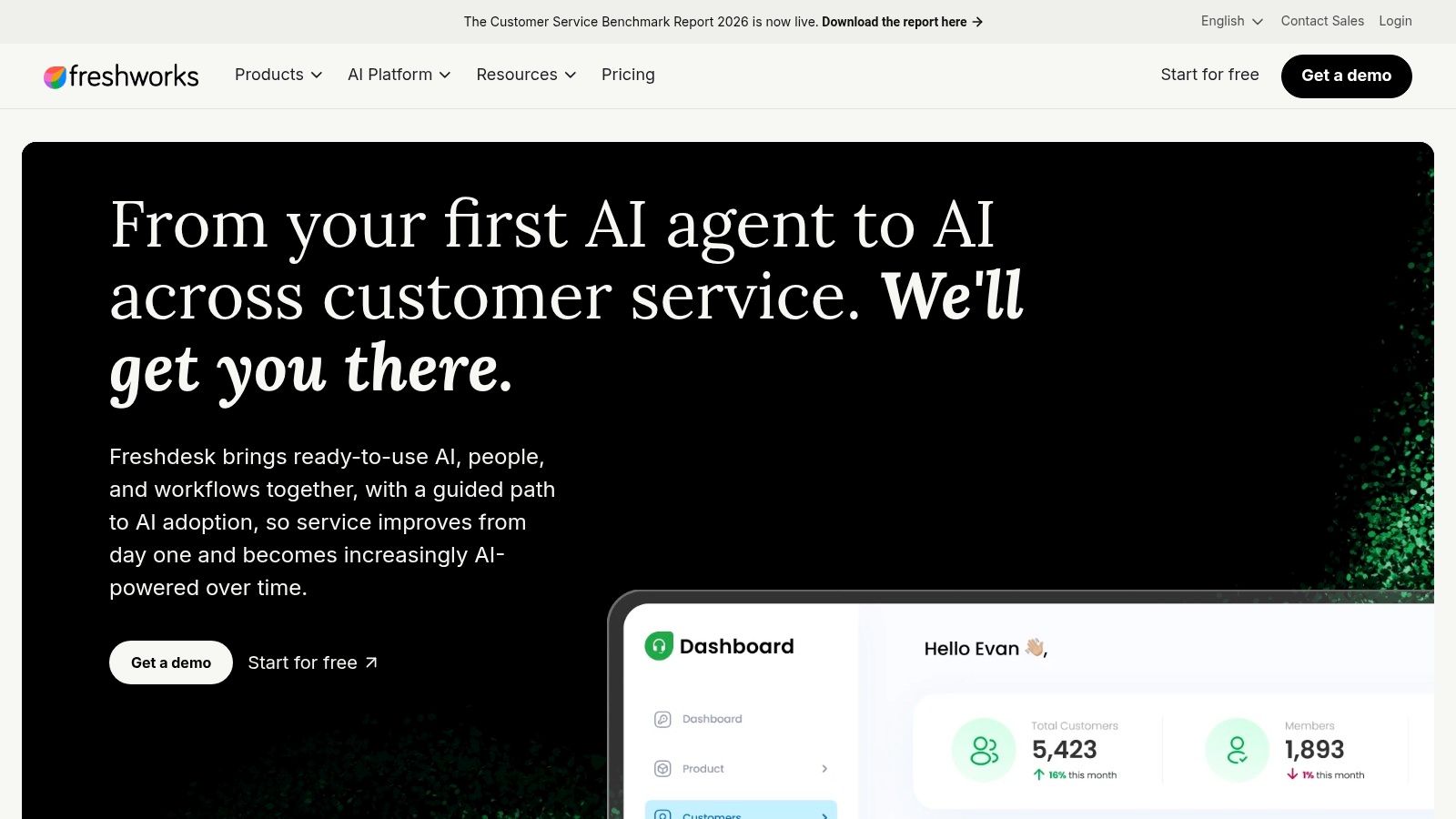
Follow-up work favors a ticketing system. Freshdesk combines ticket management, shared support workflows, a customer portal, knowledge content, and reporting, with Freddy AI options available.
The important distinction is product scope. Freshdesk and Freshdesk Omni are separate offerings, so confirm channel coverage before treating Freshdesk as a direct replacement for your current live-chat setup.
Per-agent subscriptions make staffing a recurring cost driver. AI Agent sessions and optional AI tools introduce another billing unit, which shouldn’t be treated as interchangeable with another vendor’s resolved conversations.
The Freshdesk pricing guide helps separate plan selection from add-ons. Use the vendor’s current page for the actual quote and record your check month.
- Price checked 9 Nov 2026: Freshdesk Growth is $19 per agent a month billed annually, Pro $55 and Enterprise $89. 500 Freddy AI Agent sessions are free once per account, then $49 per 100 sessions. The Freddy Copilot add-on is $29 per agent a month.
- Good reason to choose it: You need conventional ticketing now and more routing or reporting later.
- Good reason to pause: Your real requirement is lightweight chat, and the required channels belong to a different package.
- Migration priority: Preserve customer identity and ticket relationships, then rebuild rules deliberately.
For Shopify app teams, test a billing dispute alongside a technical issue. The inbox may handle ticket ownership well while still requiring a separate integration to provide the merchant context agents need.
7. Chatwoot
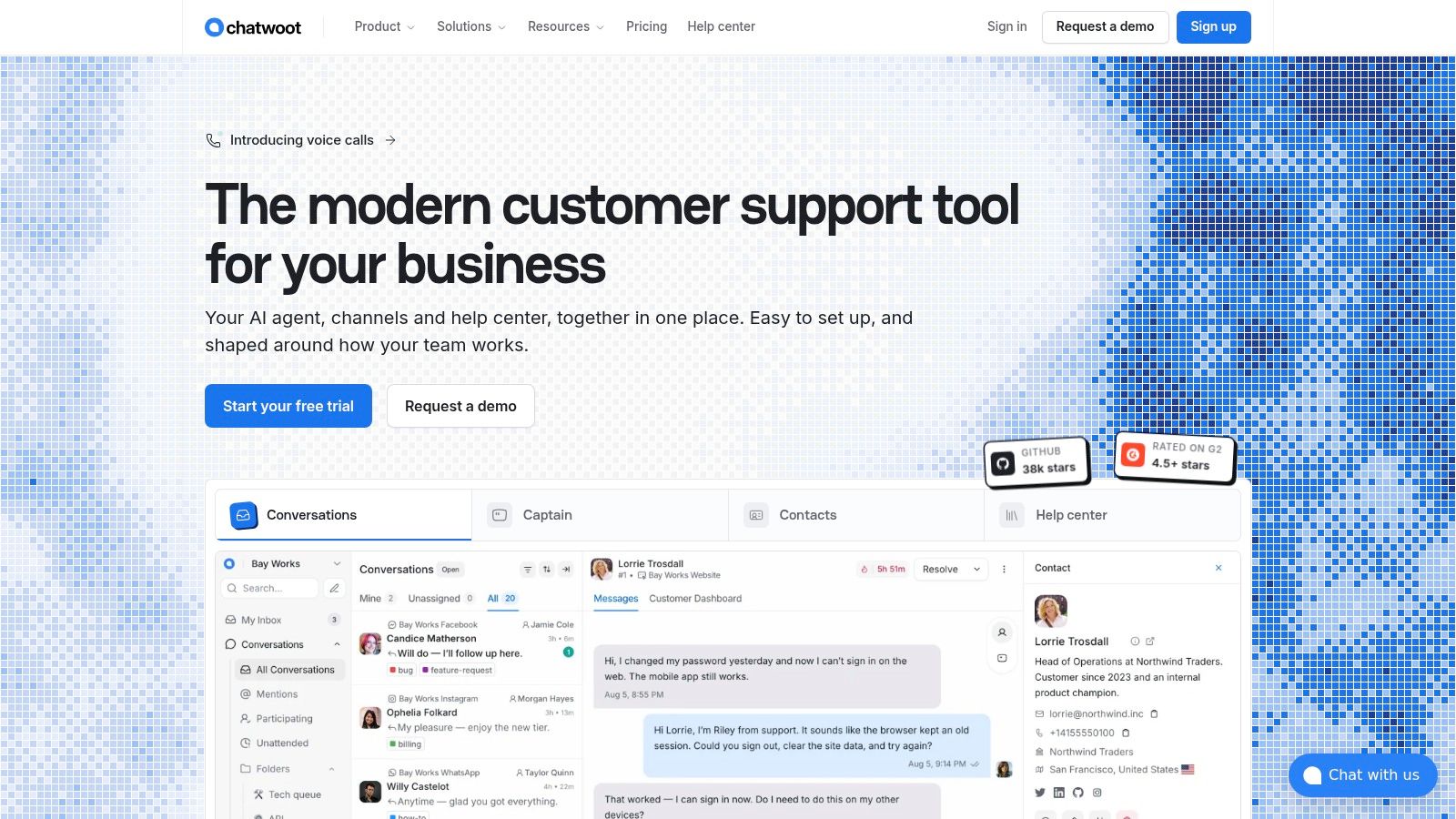
Infrastructure ownership changes the comparison. Chatwoot offers an open-source, self-hosted route as well as a hosted cloud product, with shared conversations across support channels.
Hosted plans use per-agent pricing, while Captain AI introduces credit allowances and potential extra usage. Self-hosting shifts part of the expense away from a SaaS subscription and into engineering responsibility.
That responsibility includes deployment, backups, upgrades, monitoring, and incident handling. A founder who already maintains production infrastructure may accept that trade. A founder trying to stop doing support infrastructure probably shouldn’t.
Control has an operating cost
- Price checked 9 Nov 2026: Chatwoot Hacker is $0 for up to 2 agents and 500 conversations a month. Startups is $19 per agent a month, Business $39 and Enterprise $99. Captain AI includes 300, 500 or 800 credits a month by plan, then $20 per 1,000 credits.
- Cloud advantage: Less infrastructure work while retaining a shared support workspace.
- Self-hosting advantage: More control over deployment and conversation storage.
- AI limitation: Credits need their own usage model rather than a comparison based only on agent licenses.
- Shopify app requirement: Define how merchant and app identity reach the inbox; self-hosting doesn’t create billing context automatically.
Chatwoot’s API can support conversation exports, which matters when planning a future exit. Test the exported structure rather than assuming an export reproduces every view or workflow.
I’d choose Chatwoot for control or open-source requirements. I wouldn’t choose it solely because the software license appears cheaper than a managed service.
8. Front
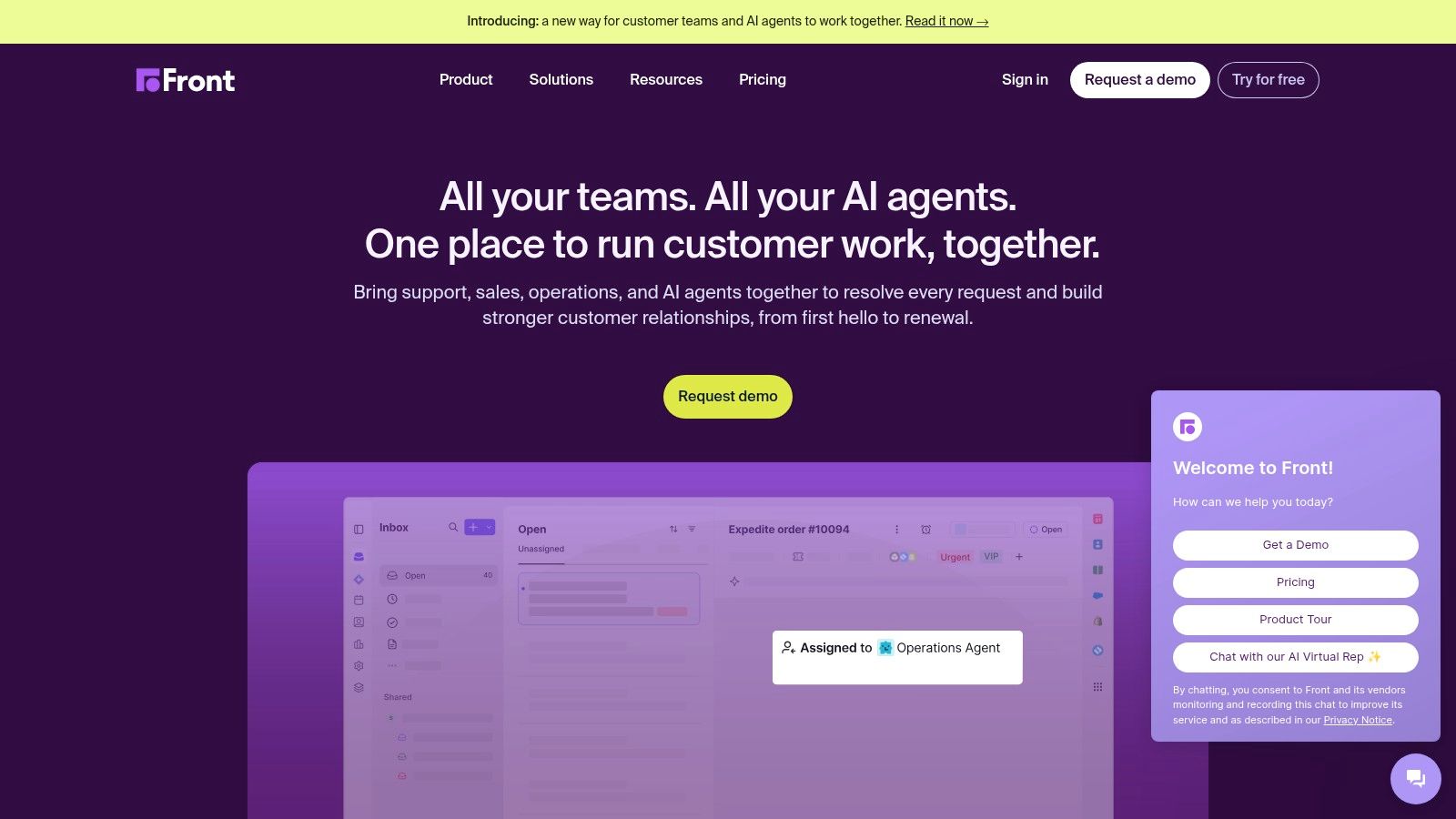
Cross-functional replies are Front’s strongest reason to be on the shortlist. Shared inboxes, assignments, comments, and drafts help customer-facing teams coordinate without passing every discussion through separate email threads.
The trade-off is seat-based billing, plus plan and AI considerations. Omnichannel requirements can move you beyond the entry tier, while AI assistance and automated handling need separate scrutiny.
For a software studio, the practical question is who needs regular access. Support, engineering, and founders may all contribute to a difficult merchant issue, but you shouldn’t price the platform using only the primary support agent.
- Price checked 9 Nov 2026: Front Starter is $25 per seat a month billed annually ($35 monthly, single channel type, up to 10 seats), Professional $65 ($85 monthly) and Enterprise $105. The Autopilot AI add-on is $0.89 per fully resolved conversation, or $0.39 when it hands off with context.
- Choose it when: Internal collaboration around customer conversations is the main bottleneck.
- Check before buying: Channel availability, knowledge-base requirements, and AI add-ons.
- Test Shopify fit: Whether app-specific account context remains visible during collaboration.
- Plan the move: Recreate assignments and shared inbox boundaries, not just message history.
The Front pricing breakdown is useful for separating seat costs from feature requirements. Confirm the current vendor quote before committing to an annual contract.
Front may be excessive for a solo founder answering a modest inbox. For teams that regularly draft replies together, collaboration can justify the additional licensing and configuration.
9. Gorgias

Store support and app support aren’t interchangeable. Gorgias focuses on ecommerce, connecting conversations with commerce workflows and customer or order information.
That’s a strong reason for a Shopify merchant to consider it. An app developer’s needs differ: the merchant is your customer, and the important context may concern an app subscription rather than an order placed in the merchant’s store.
Ticket usage drives help-desk pricing, with AI Agent conversations potentially adding another charge. Model busy periods and repeat contacts rather than treating the base subscription as the entire bill. For a wider look, see the Gorgias alternatives guide.
An order sidebar can be useful without answering the app developer’s billing question. Test the actual question your agents need to resolve.
- Price checked 9 Nov 2026: The Gorgias Starter helpdesk is $10 a month for 50 tickets, or $40 a month with the AI Agent (30 automated interactions), billed monthly. Basic is $90 monthly or $77 billed annually for 300 tickets. Past the included volume, tickets cost $0.40 each and automated interactions $1.50 each. Pricing is by ticket volume, not per agent.
- Best fit: Ecommerce brands whose support work depends on customer and order context.
- Less direct fit: SaaS teams investigating app configuration, subscription changes, and technical failures.
- Budget risk: Ticket volume and AI automation can both affect spending.
- Migration focus: Preserve the customer relationship and channel history without confusing store shoppers with app merchants.
Gorgias deserves consideration for its intended audience. Its ecommerce focus is a strength for merchants and a reason for app developers to inspect integration details carefully.
10. Text
Website-chat teams may prefer Text’s combined support offering from the team behind LiveChat. The proposition combines chat, ticketing, a shared inbox, omnichannel support, and AI rather than leaving website chat isolated from follow-up work.
Per-user billing makes headcount a cost driver. Plan-based AI resolution allowances introduce another limit, with additional packages relevant when automation usage grows.
Separate the new offering from legacy subscriptions
Existing LiveChat customers should confirm which product and subscription they’re evaluating. A familiar vendor name doesn’t mean older contracts, features, and the newer combined offering match.
- Price checked 9 Nov 2026: Text (from the team behind LiveChat) Essential is $19 per user a month billed annually ($25 monthly) with 10 AI resolutions a month. Growth is $79 ($99 monthly) with 200. Extra AI resolutions come in packs of 50 for $49.50, about $0.99 each.
- Reason to shortlist it: Website chat remains central, but your team also needs ticketing and broader support workflows.
- Limit to inspect: Included AI resolutions and the cost of additional capacity.
- Shopify test: Confirm what the connection exposes beside a conversation rather than assuming it includes app billing.
- Migration task: Check transcript continuity, customer matching, channel setup, and knowledge content.
Text is worth testing when you want chat to remain the starting point for support. It’s less attractive if your main objective is to avoid per-user billing or consolidate several app-specific subscriptions under an app-based model.
Compare the exact package you’ll buy. Don’t combine features from legacy LiveChat pages with assumptions about a different subscription.
Tidio alternatives at a glance
The main cost difference is what each vendor charges for: seats, agents, workspaces, apps, or AI resolutions. For a Shopify app team, also check what merchant context appears beside each conversation. Prices are list prices from each vendor’s own pricing page, checked 9 November 2026. Billing basis differs by row, so read the stated basis: where a row says annual it is the per-month price when billed yearly, and rows without a basis are monthly.
| Item | Starting price | Free plan | Pricing model | Best for |
|---|---|---|---|---|
| Tidio (reference) | Starter $29 a month, $24.17 yearly | Yes, 50 conversations, 10 seats | Billable conversations plus separate Lyro and Flows meters | Online stores wanting low-cost chat and visual flows |
| Convot | Free under $1,000 MRR; Starter $49 a month | Yes, 1 app and 3 seats, no AI | Flat team pricing by app count, with extra app and seat fees | Software teams supporting multiple products, especially Shopify apps |
| Intercom | Essential $29 per seat a month, list price | No | Per seat, plus Fin at $0.99 per outcome | SaaS teams needing advanced messaging and automation |
| Crisp | Mini $45 a month per workspace, monthly | Yes, 2 seats | Flat workspace subscription with bundled AI credits | Teams wanting omnichannel support without per-seat fees |
| Help Scout | Standard $25 per user a month, annual | Yes, 5 users | Per user, Envoy AI at $0.75 per resolution | Teams preferring email-focused support and a collaborative inbox |
| Zendesk | Support Team $19 per agent a month, annual | No | Per agent, AI at $2.00 per automated resolution pay as you go | Teams needing structured ticketing and complex support workflows |
| Freshdesk | Growth $19 per agent a month, annual | No | Per agent, AI at $49 per 100 sessions after 500 free once | Growing teams needing a conventional help desk and self-service tools |
| Chatwoot | Startups $19 per agent a month, as listed | Yes, up to 2 agents | Per agent, Captain AI credits at $20 per 1,000 extra | Technical teams interested in open-source or self-hosted support |
| Front | Starter $25 per seat a month, annual | No | Per seat, Autopilot at $0.89 per resolution | Customer-facing teams centered on shared email and collaboration |
| Gorgias | Starter helpdesk $10 a month, $40 with AI Agent, monthly | No | Ticket-volume tiers, AI at $1.50 per interaction past the limit | Ecommerce brands needing support linked to store and order data |
| Text (LiveChat team) | Essential $19 per user a month, annual | No | Per user, extra AI resolutions about $0.99 each | Businesses combining website chat, ticketing, and omnichannel support |
How do the AI prices compare?
The AI unit decides most of the difference, and the units are not the same thing. Tidio charges for a conversation Lyro replies in. Intercom, Zendesk, Help Scout, Text and Front charge for a resolution or outcome. Freshdesk charges for a session, Gorgias for an automated interaction, and Chatwoot for credits.
| Vendor and AI product | What triggers the charge | Price, 9 Nov 2026 |
|---|---|---|
| Convot, Cove AI | A resolved conversation | $0.20 |
| Tidio, Lyro | Lyro replies first in a new conversation | $0.70 to $0.78 billed monthly |
| Help Scout, Envoy | A resolution | $0.75 |
| Front, Autopilot | A fully resolved conversation | $0.89 |
| Intercom, Fin | An outcome | From $0.99 |
| Text, AI resolutions | A resolution beyond the plan allowance | About $0.99 |
| Zendesk, AI agents | An automated resolution | $2.00 pay as you go, lower if committed |
| Gorgias, AI Agent | An automated interaction past the plan limit | $1.50 |
Freshdesk ($49 per 100 sessions) and Chatwoot ($20 per 1,000 credits) are left out of the ranking because a session and a credit are not a conversation. Crisp is left out because it publishes no per-resolution price: its included AI credits work out to roughly $0.056 per automated conversation by our arithmetic, and the unit is an automated conversation, not a resolution. Compare the AI line on your own volume, not the headline number.
Source: each vendor’s public pricing page, checked 9 November 2026. Convot data, Nov 2026.
Pick one tool and test it on one app first
Run the trial on one app before you move the rest. Pick the app with the messiest mix of routine questions, technical troubleshooting, and billing conversations, so the test covers more than easy documentation lookups. Two weeks on real traffic tells you more than a demo account.
Price your actual seat count, app count, and monthly AI volume against each vendor’s own pricing page, and write the month you checked beside every figure, including add-ons and annual-billing assumptions. Keep AI units in separate columns: a session, a credit, a conversation, and a resolution are not the same thing. A $0.20 charge per resolved conversation behaves differently on the bill than a $0.99 one at the same volume. If you want the Convot side of that sum, the Convot pricing page lists every tier.
Shopify billing context deserves a hands-on test. The Shopify Partner API exposes app event history such as installs, charges and credits. API availability doesn’t prove a help desk shows that data beside the conversation or attaches it to the right merchant, so open a real merchant chat during the trial and look.
Migration checklist
- Export before changing anything: Save contacts, conversations, attachments, help articles, and the identifiers connecting customers to apps.
- Test difficult records: merged contacts, reopened conversations, and customers who use several of your products.
- Map human ownership first: Rebuild assignments, internal escalation, and notifications before enabling AI.
- Validate the uncertain answer: Ask an ambiguous billing question and confirm the AI cites its source or hands off with the conversation intact.
- Protect the cutover: Keep the old system accessible until you’ve checked history and new-message delivery.
- Plan an exit: Confirm how you’ll retrieve conversations and documentation if the replacement disappoints you.
Import paths differ by source, so check yours before committing. A Crisp move can be a one-click import of contacts, conversations from the last 180 days, and help-center articles, and a Crisp-compatible SDK means the host-page embed doesn’t need a rewrite. Moves from Intercom, Zendesk, or Freshdesk are guided migrations rather than self-serve importers, so budget the time for one. There is no one-click Tidio importer, so plan on exporting from Tidio and rebuilding.
Limits to accept deliberately
Per-seat tools charge more as participation grows. Workspace tools still have plan boundaries. App-based subscriptions still cap included apps and seats. Usage-based AI requires monitoring even when the base subscription feels predictable.
Self-hosting means maintenance, and migration assistance doesn’t guarantee every custom field or automation transfers unchanged. An ecommerce integration doesn’t establish access to Shopify app subscription history either. Some capabilities are still in progress everywhere: Convot’s native mobile SDK for in-app chat, for example, is early access. A vendor that tells you plainly what the product can’t do today, and whether the free plan is enough for your situation, is easier to trial with clear expectations than one that doesn’t. Name the limits before signing, not after deployment.
Convot makes a competing product and is one option in this roundup, so weigh its positioning against the other vendors here. Choose it, or any alternative, only if the trial shows clearer context, dependable human handoffs, and a bill you can explain.
FAQ
How much does Tidio cost?
Tidio is $0 on Free, $29 a month on Starter for 100 billable conversations, and $59 to $349 a month on Growth for 250 to 2,000, billed monthly as of 9 November 2026. Plus starts at $300 a month plus usage. Lyro AI and Flows are priced separately on top.
How much does Tidio’s Lyro AI cost?
Lyro costs $39 a month for 50 conversations, $140 for 200 and $350 for 500 when billed monthly, which is $0.70 to $0.78 per conversation. It is counted when Lyro first replies, whether or not it resolves the question. New accounts get 50 Lyro conversations free once.
What is the cheapest Tidio alternative?
The answer depends on team size and AI volume. Crisp Free, Chatwoot Hacker and Help Scout Free cost nothing for small teams, and Convot is free under $1,000 MRR. For AI, Convot at $0.20 per resolved conversation is the lowest published unit price in the table above, and Crisp’s included credits work out lower still by our estimate, on a different unit.
What is the best Tidio alternative for Shopify app developers?
Pick on whether the tool shows merchant context beside the conversation. Convot is built for app teams and connects to the Shopify Partner API, which is why it is listed first, but it makes a competing product. Test merchant identity and subscription context in any tool during a two-week trial.
Can I move from Tidio without losing my history?
There is no one-click Tidio importer in Convot. Export your contacts and conversations from Tidio, then check how the new tool maps them. Moves from Crisp use the built-in importer. Moves from Intercom, Zendesk and Freshdesk are free and done with the founder.
Is Tidio or Intercom cheaper for a small team?
Tidio can be cheaper at low volume with several agents, because it prices by conversations rather than seats. For three agents and 100 human-answered conversations, Tidio Starter is $29 a month while Intercom Essential is 3 x $29 = $87 before any Fin outcomes at $0.99. Work out both on your own seat count and AI volume.
For small software teams, Convot combines live chat, a shared inbox, help content, product updates, and scheduling with app-based, whole-team pricing. Bring your app count and migration requirements, and compare whether consolidating those tools fits your Tidio replacement plan. The Convot versus Tidio comparison is the quickest place to start.
About the author
Tarang Agarwal is the founder of Convot. Convot is built by Sidepanda, a small studio that runs several Shopify apps of its own, including Appointo, Depo and Panda Bundle, and supports all of them from one Convot inbox.
Revenue-aware support for Shopify app teams.
Live chat, help center, and every merchant's MRR, plan, and LTV beside the conversation. Free under $1k MRR.
Start free