131 AI Customer Service Statistics for 2026 (Updated October)
131 AI customer service statistics for 2026, each traced to the original study: adoption, cost per resolution, customer trust, jobs and rules. Updated monthly.
On this page
- Key Takeaways
- How fast are support teams adopting AI?
- Where do customers go for help first?
- What do customers think of AI support?
- Does AI make support teams faster and better?
- What does an AI resolution cost?
- What happens to support jobs?
- What do regulators require of support chatbots?
- What comes next for AI in customer service?
- Methodology and Sources
- Sources
Support teams are spending heavily on AI while their customers still want a human within reach, and the published price of one AI-handled conversation varies twentyfold between vendors. These 131 statistics show where AI customer service actually stands in 2026: who uses it, what it costs, what customers think of it, what it does to support jobs and which rules now apply.
Every number on this page is traced to the organisation that produced it: the survey firm, regulator, statistics office, court, academic team or company that ran the study or set the price. Where a number is a vendor’s own claim about its own product, or a forecast rather than a measurement, the text says so. The section on AI pricing uses Convot’s own data, collected from vendor pricing pages.
Updated October 2026. We check every link and price monthly and replace numbers when a newer study is published.
Key Takeaways
- AI spending by customer service leaders rose 38% while overall service budgets grew 2% (Gartner, Aug 2026).
- 87% of customers say a company using GenAI for service must offer a way to reach a human (Gartner, Aug 2026).
- In their last service interaction, customers were about three times more likely to use ChatGPT, Gemini or Copilot than the company’s own chatbot (Gartner, Aug 2026).
- 49% of US adults now use AI chatbots, up from 33% in 2024 (Pew Research Center, Jun 2026).
- Support agents with a generative AI assistant resolved 14% more issues per hour, across 5,179 agents (NBER, Apr 2023).
- The published price of one AI-handled conversation ranges from $0.05 to $0.99 across nine help desks, a twentyfold spread (Convot, Oct 2026).
- Only 24% of service and support leaders show positive financial returns across their AI use cases (Gartner, Jul 2026).
- 37% of US firms with 250 or more employees use AI (US Census Bureau, May 2026).
- 84% of consumers give a virtual agent three attempts or fewer to resolve an issue (Genesys, Jul 2026).
- US customer service representative jobs are projected to fall 5% between 2025 and 2035 (US Bureau of Labor Statistics, Aug 2026).
- Since 2 August 2026, EU rules require AI systems that talk to people to tell them they are talking to an AI (European Commission, Jul 2026).
- Salesforce completed its acquisition of Fin, the AI customer service company formerly called Intercom, on 10 September 2026, after agreeing a price of about $3.6 billion (Salesforce, Sep 2026).
- Gartner forecasts that by 2030 the cost per resolution for GenAI in customer service will exceed $3 (Gartner, Jan 2026).
How fast are support teams adopting AI?
AI is now the default plan for support teams, not the experiment. The gap is between buying it and getting it to work, and between large companies and small ones.
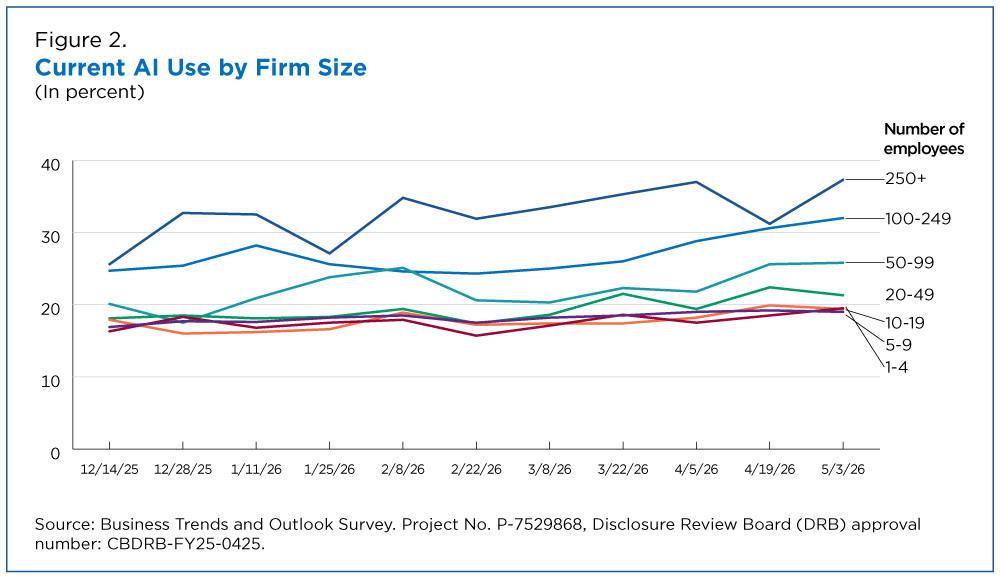 Figure 1: Large firms pulled ahead on AI use through the first half of 2026 while the smallest firms stayed under 20%, which is why most AI support tooling is still built and priced for enterprise teams. Source: US Census Bureau, Large Firms With at Least 20 Employees Biggest AI Users, May 2026. Chart published by the source, captured 3 Oct 2026.
How many support teams use AI now?
Most service organizations now use some form of AI, though each survey defines adoption differently.
- 66% of customer service organizations now use agentic AI, up from 39% in 2025 (Salesforce, May 2026).
- 85% of service organizations use at least one form of AI (Salesforce, May 2026).
- 92% of organizations have implemented or piloted AI use cases in customer service (Five9, Jun 2026).
- 82% of senior support leaders invested in AI for customer service in 2025 (Intercom, Jan 2026).
- 87% of senior support leaders plan to invest in AI for customer service in 2026 (Intercom, Jan 2026).
- Fewer than 20% of US firms with four or fewer employees report using AI (US Census Bureau, May 2026).
How much are companies spending on AI for support?
Customer service is where AI budgets are concentrating, and the vendor revenue shows it.
- Service and support leaders put a median 12% of their 2025 budget into AI, the highest of 10 business functions assessed (Gartner, Jul 2026).
- Salesforce’s Agentforce annual recurring revenue passed $1.5 billion, up more than 240% year on year (Salesforce, Aug 2026).
- More than 12,000 teams use Fin, the AI agent from the company formerly called Intercom (Intercom, Mar 2026).
- Fin brings a global customer base of more than 30,000 companies to Salesforce (Salesforce, Jun 2026).
- 91% of service and support leaders report pressure from executive leadership to implement AI (Gartner, Feb 2026).
How mature are AI support deployments?
Very few teams have finished the job. Most are still connecting AI to their channels and data.
- Only 10% of support teams report reaching a mature level of AI deployment (Intercom, Jan 2026).
- 52% of organizations plan to scale AI from support into other departments in 2026 (Intercom, Jan 2026).
- 83% of service organizations with customer-facing AI agents run them across five or more channels (Salesforce, May 2026).
- 40% of case resolution interactions involving AI are completed entirely autonomously (Salesforce, May 2026).
- 70% of organizations with AI service agents say they see measurable value within 60 days (Salesforce, May 2026).
Where do customers go for help first?
Customers have their own AI now, and many reach for it before they reach for yours. When they do contact a company, phone and human help still carry more weight than the chatbot.
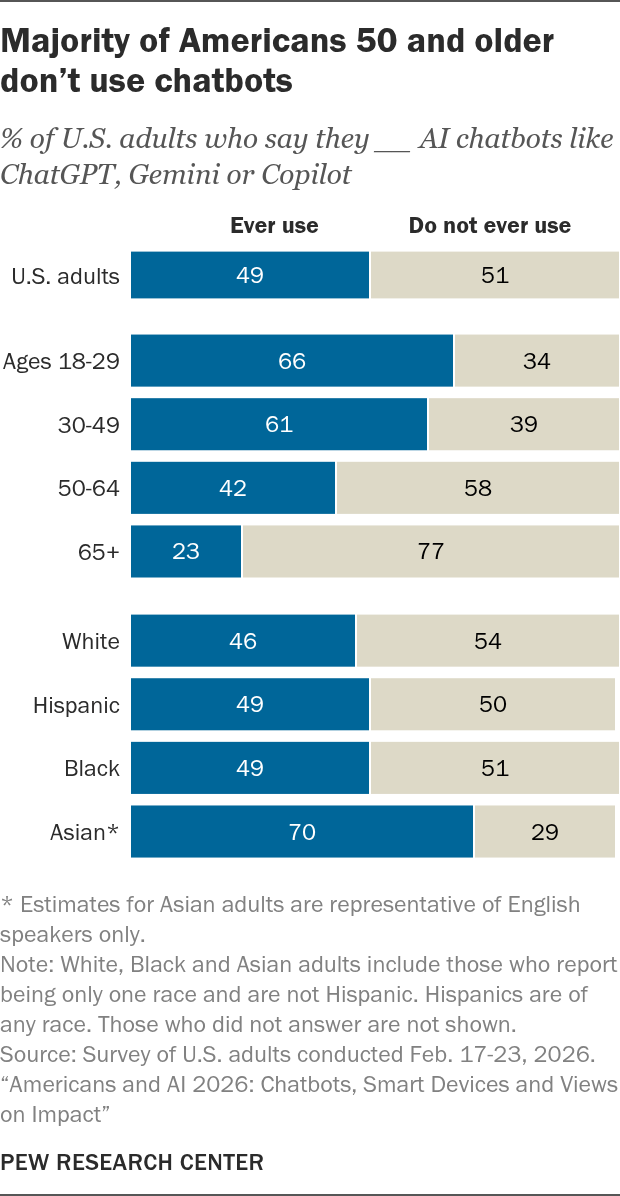 Figure 2: Chatbot use is now a majority habit for adults under 50 and a minority one above it, so a support chatbot meets a very different customer depending on who your users are. Source: Pew Research Center, Why don’t Americans use chatbots?, Feb 2026. Chart published by the source, captured 3 Oct 2026.
How many people use AI chatbots?
About half of US adults use AI chatbots, and use is far higher among younger adults.
- 44% of US adults have used ChatGPT, against 24% for Gemini (Pew Research Center, Jun 2026).
- 66% of US adults aged 18 to 29 use AI chatbots, against 23% of adults aged 65 and over (Pew Research Center, Jun 2026).
- 38% of US online adults say they have used generative AI (Forrester, Jan 2026).
- In every country Forrester surveyed, more than 50% of online adults have used GenAI as a new way to find answers (Forrester, Jan 2026).
- 58% of customers who use GenAI have used it to complete a task on their behalf, rising to 74% in B2B (Gartner, Jul 2026).
Which support channels do customers prefer?
Phone still leads on preference, and the gap between the channels people use and the ones they want is widest for chatbots.
- Phone is the most preferred service channel overall, preferred by 23% of Gen Z rising to 66% of the Silent Generation (Five9, Jun 2026).
- Two-thirds of consumers still prefer speaking with a human (Five9, Jun 2026).
- Nearly 70% of Americans tend to use phone support, but only 35% prefer it (YouGov, Mar 2025).
- 18% of US consumers tend to use chatbots for customer service, but only 1% prefer them (YouGov, Mar 2025).
- 31% of US consumers use live chat for customer service and 10% prefer it (YouGov, Mar 2025).
For response times, queue dropout, satisfaction and costs specific to chat, see the live chat statistics.
How fast do customers expect an answer?
Expectations rise every year, and AI has made round-the-clock service the baseline.
- 88% of customers expect faster response times than they did a year ago (Zendesk, Nov 2025).
- 74% of consumers now expect customer service to be available 24/7 because of AI (Zendesk, Nov 2025).
What do customers think of AI support?
Customers will use AI support, but only on their terms: tell them it is AI, let them reach a person, and do not make them repeat themselves. Most of the frustration in these numbers comes from breaking one of those three rules.
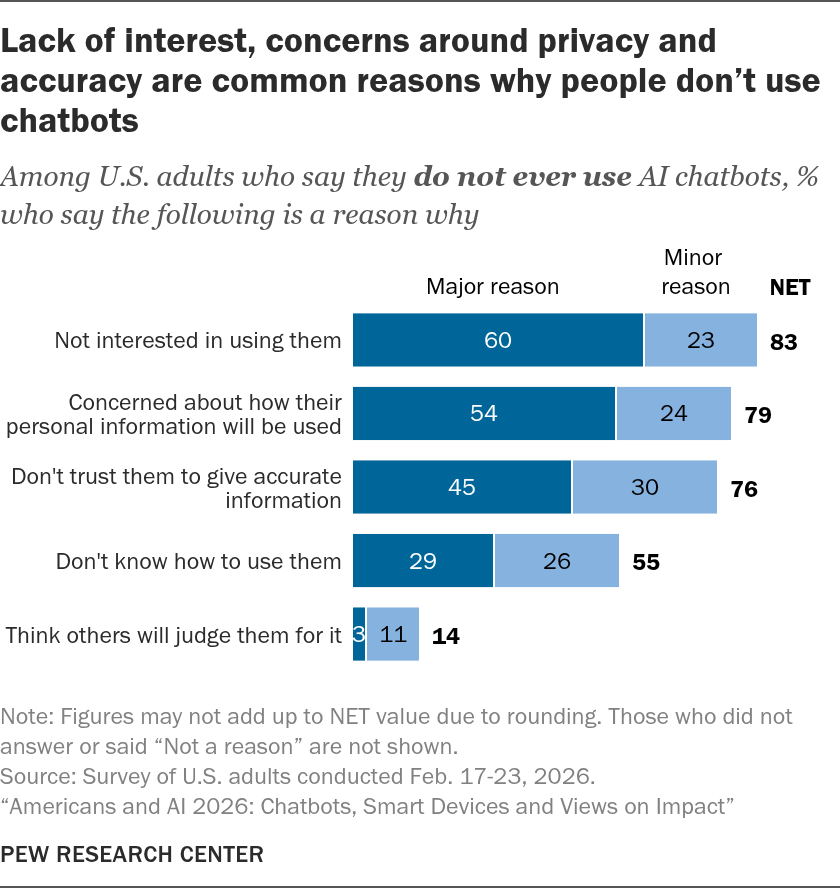 Figure 3: Among adults who avoid chatbots, three in four say they do not trust them to give accurate information, the exact fear an AI support agent has to overcome before it can resolve anything. Source: Pew Research Center, Why don’t Americans use chatbots?, Feb 2026. Chart published by the source, captured 3 Oct 2026.
Do customers trust AI customer service?
Trust is conditional. Customers accept AI when it is disclosed and when a human stays within reach.
- 64% of customers would prefer that companies did not use AI in customer service (Gartner, Jul 2024).
- 53% of customers would consider switching to a competitor if they found out a company was going to use AI for customer service (Gartner, Jul 2024).
- 71% of consumers say it is very or extremely important to know when they are interacting with an AI agent (Five9, Jun 2026).
- 95% of consumers expect an explanation for decisions made by AI (Zendesk, Nov 2025).
- Half of consumers worry that companies’ AI use will stop them connecting with a human (Qualtrics XM Institute, Oct 2025).
- 30% of consumers would work with an AI agent instead of a person for faster service, rising to 37% among Gen Z and millennials (Salesforce, Oct 2024).
- 76% of consumers do not care whether a person or AI resolves their issue, as long as it is solved quickly and completely (Genesys, Jul 2026).
- In a field experiment, telling customers they were talking to a chatbot before the conversation cut purchase rates by more than 79.7% (INFORMS, Sep 2019).
Where does AI support frustrate customers?
The failures cluster around not understanding the question and losing context at the handoff.
- Nearly one in five consumers who used AI for customer service saw no benefit, a failure rate almost four times that of AI use in general (Qualtrics XM Institute, Oct 2025).
- When an issue goes unresolved, customer satisfaction drops to 2.83 on a five-point scale, and the leading cause is the agent, human or AI, not understanding the problem (Qualtrics XM Institute, Jun 2026).
- 83% of consumers say they still have to repeat themselves at least sometimes after being transferred from AI to a human (Five9, Jun 2026).
- 74% of consumers are frustrated when they have to repeat information to a new agent (Zendesk, Nov 2025).
- 76% of US adults who never use chatbots say not trusting them to give accurate information is a reason (Pew Research Center, Jun 2026).
When does AI support work for customers?
AI support earns its place when it is quick, polite and backed by a clear route to a person.
- 80% of consumers are willing to use AI-powered customer service (Five9, Jun 2026).
- 76% of consumers expect AI to improve the quality and speed of customer service (Genesys, Jul 2026).
- 45% of consumers are more likely to use an AI agent if there is a clear escalation path to a human (Salesforce, Oct 2024).
- AI-handled interactions scored 4.41 out of 5 on friendliness, tied for the highest of any channel, but only 4.08 on understanding (Qualtrics XM Institute, Jun 2026).
- 50% of customers say their interactions are easier when companies use GenAI (Gartner, Aug 2026).
Does AI make support teams faster and better?
The controlled studies show real but modest gains, concentrated among newer agents. The large resolution rates come from vendors measuring their own products, each with its own definition.
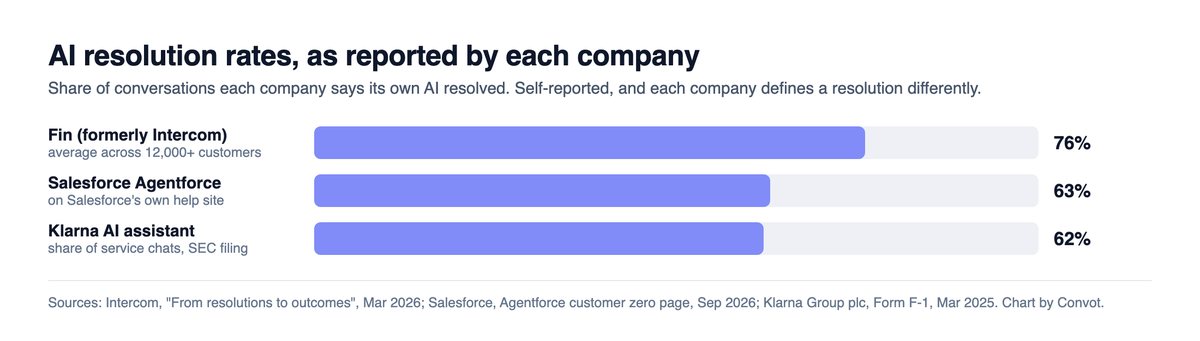 Figure 4: The headline resolution rates in AI support all come from companies measuring their own AI, which is why they cluster in the 60s and 70s and cannot be compared like for like. Source: Intercom, From resolutions to outcomes, Mar 2026, with Salesforce and Klarna figures cited below. Chart by Convot from the cited figures, captured 3 Oct 2026.
Does AI make support agents more productive?
Randomized trials find gains for agents, largest for the least experienced, and some quality loss at the top.
- In a randomized test at Alibaba, a generative AI assistant cut issue identification time by 8.2% and chat duration by 1.1% for new customer service agents (Alibaba field experiment, arXiv, Jul 2026).
- In the same test, the lowest-performing agents cut chat duration by 5.9% with the assistant, while top performers saw service quality decline (Alibaba field experiment, arXiv, Jul 2026).
- AI assistance raised average customer ratings by 0.042 points on a five-point scale, a 1.2% improvement (Alibaba field experiment, arXiv, Jul 2026).
- 17.9% of agents given the AI assistant never used it, and only 6.2% used it in every chat (Alibaba field experiment, arXiv, Jul 2026).
- In Danish workplaces that encourage AI chatbots and provide tools and training, 19% of workers report saving more than an hour a day (NBER, Mar 2026).
- 85% of chatbot users in the same Danish study say they reallocate the time saved to other tasks (NBER, Mar 2026).
How many conversations does AI resolve?
Vendors report resolution rates above 60%, but they measure their own customers and define a resolution their own way.
- Fin’s average resolution rate across its customers is 76%, as reported by the vendor (Intercom, Mar 2026).
- Fin handles about 2 million resolutions a week, as reported by the vendor (Fin, Oct 2026).
- Salesforce’s Agentforce agent on its own help site resolves more than 63% of conversations instantly, as reported by the vendor (Salesforce, Sep 2026).
- Agentforce on Salesforce’s help site has passed five million customer conversations (Salesforce, Sep 2026).
- Klarna reports its AI assistant has handled 62% of customer service chats since February 2024, across 20.1 million conversations (Klarna, Mar 2025).
- Klarna reports repeat inquiries dropped 25% in the month after its AI assistant launched (Klarna, Mar 2025).
- Klarna said its customers resolve errands in under 2 minutes with the AI assistant, against 11 minutes before (Klarna, Feb 2024).
- In a three-month trial on routine emails only, Octopus Energy’s AI assistant scored 76% customer satisfaction against 72% for human advisors (Octopus Energy, Jul 2026).
- An agentic AI system cut average chat duration by 3.2% across all chats in a randomized trial of 647 Alibaba service workers (Alibaba agentic AI experiment, arXiv, Jun 2026).
- In the chats the agentic AI could handle, duration fell 16.8%, but customer ratings for those chats fell too (Alibaba agentic AI experiment, arXiv, Jun 2026).
For how an AI agent decides when to answer and when to hand off, see what an AI support agent is. Teams reviewing Fin now that Salesforce owns it can compare options in the Intercom alternatives guide.
What does AI support save?
Published savings figures are rare, and the best documented ones come from a single company’s filings.
- Klarna says its AI assistant delivered about $39 million in cost savings in 2024 (Klarna, Mar 2025).
- Klarna says its customer service cost per transaction fell 40% between the first quarter of 2023 and the first quarter of 2025 (Klarna, May 2025).
What does an AI resolution cost?
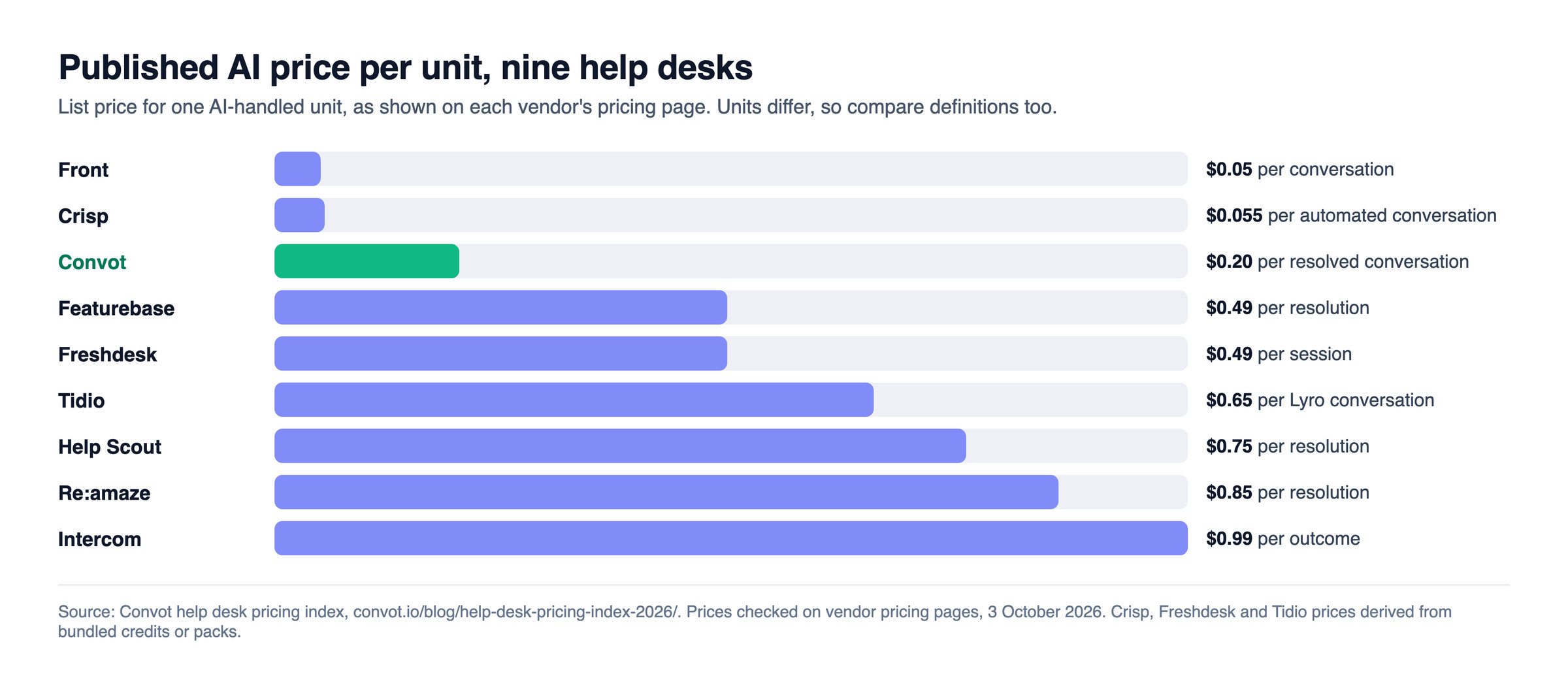
Nobody agrees on what an AI resolution is, so nobody agrees on what it costs. Convot checked the published AI price on nine help desks’ own pricing pages and found six different billing units.
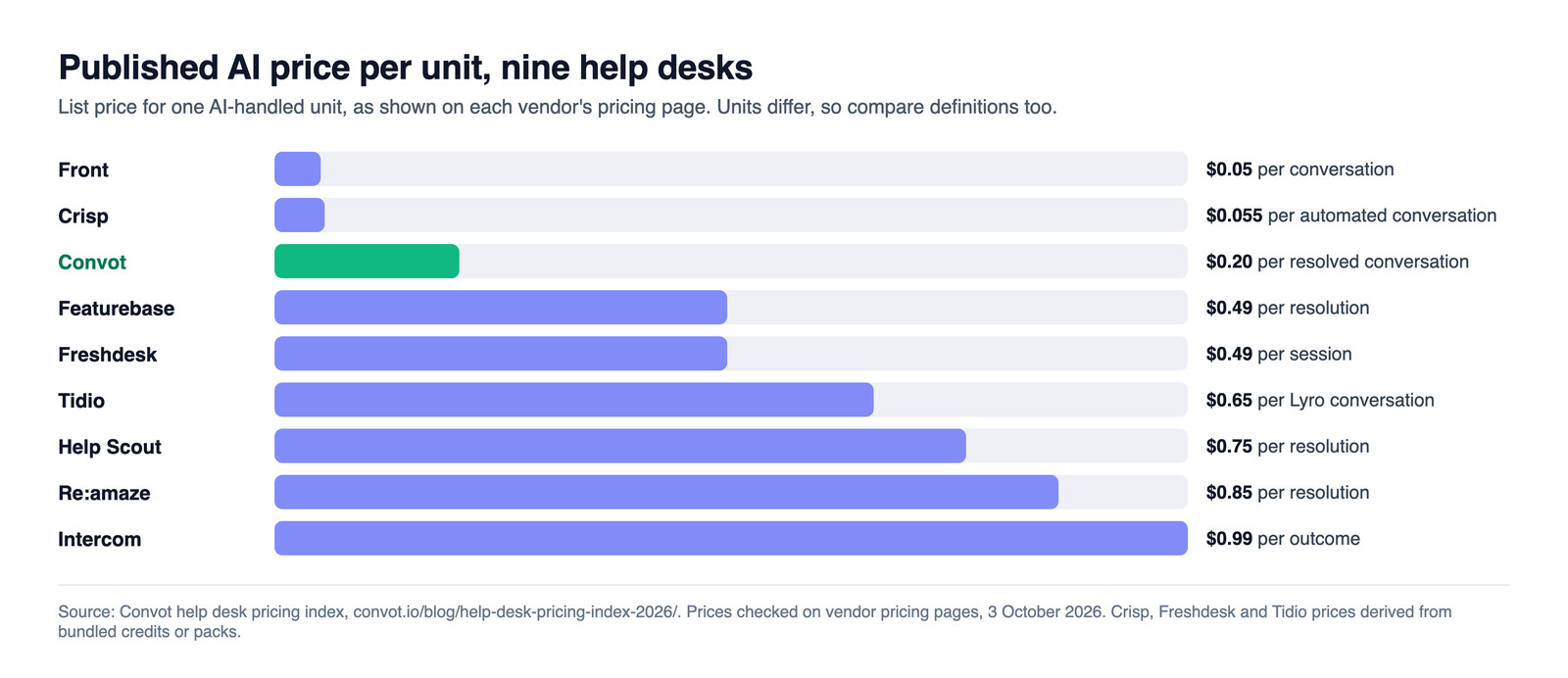 Figure 5: The cheapest published AI price is about a twentieth of the most expensive, and the units differ as much as the prices, so a per-unit price alone says little about the monthly bill. Source: Convot, Help desk pricing index, Oct 2026. Chart by Convot from vendor pricing pages, captured 3 Oct 2026.
What does each help desk charge for AI?
Each price below is the list price on the vendor’s own pricing page, checked on 3 October 2026.
- Front’s Autopilot AI agent starts at $0.05 per conversation (Front, Oct 2026).
- Crisp bundles $5 of AI credits, about 90 automated conversations, into its Mini plan, roughly $0.055 per conversation (Crisp, Oct 2026).
- Convot’s Cove AI costs $0.20 per resolved conversation in which it replied, on paid plans (Convot, Oct 2026).
- Featurebase charges $0.49 per AI resolution (Featurebase, Oct 2026).
- Freshdesk includes 500 Freddy AI Agent sessions, then charges $49 per 100 sessions (Freshworks, Oct 2026).
- Tidio’s Lyro AI agent starts at $32.50 a month for 50 Lyro conversations, about $0.65 each (Tidio, Oct 2026).
- Help Scout’s AI Answers costs $0.75 per resolution (Help Scout, Oct 2026).
- Re:amaze includes 5 to 20 AI resolutions per user a month, then charges $0.85 per additional resolution (Re:amaze, Oct 2026).
- Fin, formerly Intercom, charges $0.99 per outcome (Intercom, Oct 2026).
Why are AI prices so hard to compare?
The unit changes from vendor to vendor, and Zendesk, one of the largest help desks, does not show a per-resolution price on its pricing page at all.
- The median published AI price across the nine help desks is $0.49 per unit (Convot, Oct 2026).
- The nine help desks bill AI in six different units: conversation, automated conversation, resolved conversation, resolution, session and outcome (Convot, Oct 2026).
- At 1,000 AI resolutions a month, list prices range from $200 on Convot to $990 on Fin, before seat or plan fees (Convot, Oct 2026).
- Zendesk bills AI per automated resolution but did not show a dollar rate on its pricing page when checked; the widely quoted $2.00 pay-as-you-go figure comes from third parties (Convot, Oct 2026).
To model these prices at your own volume, use the help desk price calculator or the AI support cost calculator.
What happens to support jobs?
The job is shrinking slowly, not vanishing, and the early damage is concentrated on the youngest workers in the most exposed roles. Most companies using AI have not cut headcount.
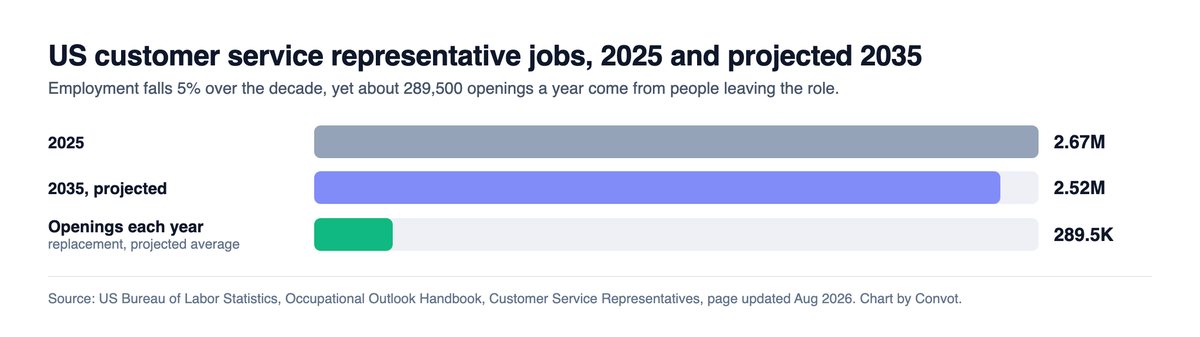 Figure 6: The occupation loses about 142,000 jobs over a decade, yet replacement still creates nearly 290,000 openings a year, which is a slow squeeze rather than a collapse. Source: US Bureau of Labor Statistics, Occupational Outlook Handbook: Customer Service Representatives, Aug 2026. Chart by Convot from BLS projections, captured 3 Oct 2026.
How many people work in customer service?
Customer service remains one of the largest occupations in the US, with steady openings despite a projected decline.
- About 289,500 customer service representative openings are projected each year over the decade, all from replacing workers who leave (US Bureau of Labor Statistics, Aug 2026).
- The median pay for US customer service representatives was $44,770 a year in 2025 (US Bureau of Labor Statistics, Aug 2026).
- Concentrix, a customer experience outsourcer, had about 455,000 employees and told investors some of its lower complexity services have been replaced by tools its clients deploy (Concentrix, Jan 2026).
Is AI replacing support workers?
The evidence so far points to fewer young hires and changed roles, not mass layoffs.
- Employment of US workers aged 22 to 25 in the most AI-exposed occupations, which include customer service, is 19% below where it would be had it kept pace with less exposed peers (Stanford Digital Economy Lab, Aug 2026).
- Danish register data show no significant effect of AI chatbot adoption on earnings or hours in any of 11 exposed occupations, including customer support specialists (NBER, Mar 2026).
- Among Canadian businesses using AI, 89.4% reported no change in employment levels (Statistics Canada, Jun 2025).
- Klarna’s full-time headcount fell from 5,527 in 2022 to 3,422 in 2024, a decline the company attributes partly to AI (Klarna, Mar 2025).
- Nearly 80% of service organizations plan to move at least some agents into new roles because of expected automation (Gartner, Feb 2026).
How exposed are support jobs to AI?
Contact centre work sits in the middle of the exposure range, high enough to change the job, not high enough to remove it.
- The International Labour Organization scores contact centre information clerks at 0.58 on its GenAI exposure index (ILO, May 2025).
- 24% of jobs worldwide have some exposure to GenAI, rising to 34% in high-income countries (ILO, May 2025).
- 31% of Canadian workers are in jobs with high AI exposure and low complementarity (Statistics Canada, Sep 2024).
What do regulators require of support chatbots?
Disclosure is now law in the EU and in several US states, and courts have already held a company liable for its chatbot’s answer. The common thread is simple: tell people it is AI, and stand behind what it says.
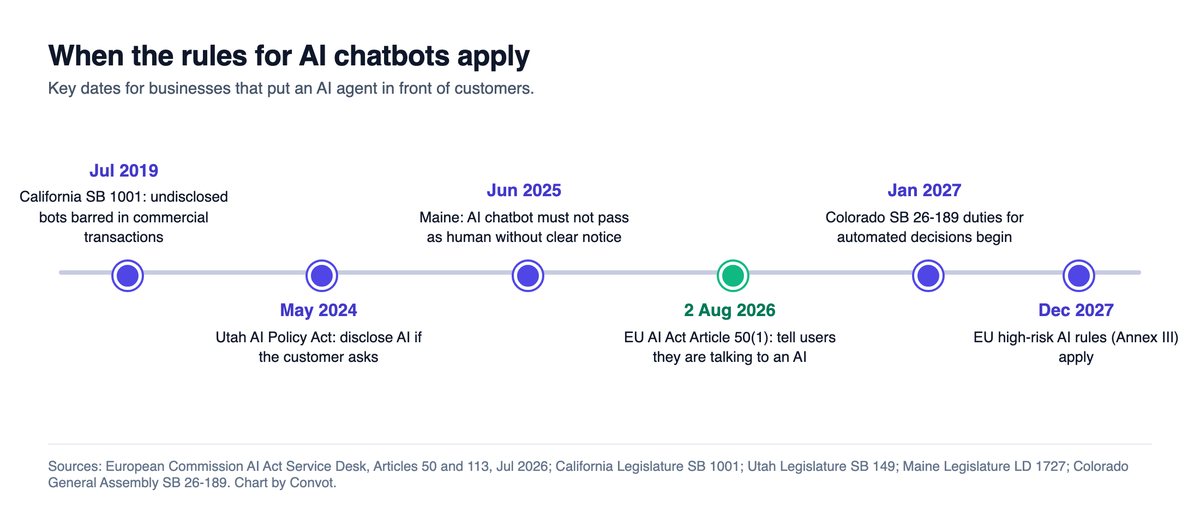 Figure 7: The EU disclosure rule of August 2026 is the first that applies to every business with customers in the EU, while the US rules remain state by state and narrower in scope. Source: European Commission, AI Act Service Desk, Article 50, Jul 2026, with state laws cited below. Chart by Convot from the cited laws, captured 3 Oct 2026.
What does the EU AI Act require of chatbots?
Article 50 requires disclosure from 2 August 2026, with fines for breaches. The later deadlines apply to other parts of the Act.
- Providers of AI systems that interact directly with people must design them so users are told they are talking to an AI, unless that is obvious (European Commission, Jul 2026).
- Breaching the Article 50 transparency duties can bring fines of up to EUR 15 million or 3% of worldwide annual turnover for companies (European Commission, Jul 2026).
- The highest tier of AI Act fines, for prohibited practices, reaches EUR 35 million or 7% of worldwide annual turnover (European Commission, Jul 2026).
- AI systems already on the market have until 2 December 2026 to meet the separate machine-readable marking duty for generated content; the chatbot disclosure duty was not delayed (European Commission, Jul 2026).
- The AI Act’s high-risk rules for Annex III systems now apply from 2 December 2027 (European Commission, Jul 2026).
What do US regulators and states require?
US rules come from consumer protection agencies and state laws, each narrower than the EU rule.
- In 2022 over 98 million people, about 37% of the US population, used a bank’s chatbot (Consumer Financial Protection Bureau, Jun 2023).
- Each of the 10 largest US commercial banks had deployed a chatbot in customer service (Consumer Financial Protection Bureau, Jun 2023).
- The CFPB warned of chatbot doom loops that leave customers with no way to reach a human representative (Consumer Financial Protection Bureau, Jun 2023).
- The FTC’s Operation AI Comply sweep against deceptive AI claims included a $193,000 settlement with DoNotPay over its robot lawyer claims (Federal Trade Commission, Sep 2024).
- The FTC ordered seven companies to hand over information about their consumer-facing AI chatbots (Federal Trade Commission, Sep 2025).
- California’s SB 1001 makes it unlawful to use an undisclosed bot to mislead someone in a commercial transaction, and disclosing that it is a bot removes liability (California Legislature, Sep 2018).
- California’s SB 243 lets users sue for $1,000 per violation by a companion chatbot, and expressly excludes bots used only for customer service (California Legislature, Oct 2025).
- Utah requires a business using generative AI with consumers to disclose it is AI if the consumer asks, with fines of up to $2,500 per violation (Utah State Legislature, May 2024).
- Utah’s 2025 amendment limits that duty to a clear and unambiguous request and extends the law to 1 July 2027 (Utah State Legislature, May 2025).
- Maine bars using an AI chatbot in trade in a way that could make a reasonable consumer think they are talking to a human, unless clearly told otherwise (Maine Legislature, Jun 2025).
- Colorado’s SB 26-189 sets notice duties for automated decision tools from 1 January 2027, aimed at consequential decisions rather than general support chat (Colorado General Assembly, May 2026).
Is a company liable for what its chatbot says?
At least one tribunal has said yes, and a UK regulator has extended online safety rules to some chatbots.
- In Moffatt v. Air Canada, a British Columbia tribunal held the airline responsible for wrong refund advice from its website chatbot and ordered it to pay $812.02 (Civil Resolution Tribunal of British Columbia, Feb 2024).
- Ofcom said a site or app whose generative AI chatbot lets users share its output with other users is a user-to-user service under the UK Online Safety Act (Ofcom, Nov 2024).
What comes next for AI in customer service?
Analysts expect AI to resolve most routine issues within a few years, and they also expect it to get more expensive and to send more hard cases back to humans. Read each number below as a forecast, not a result.
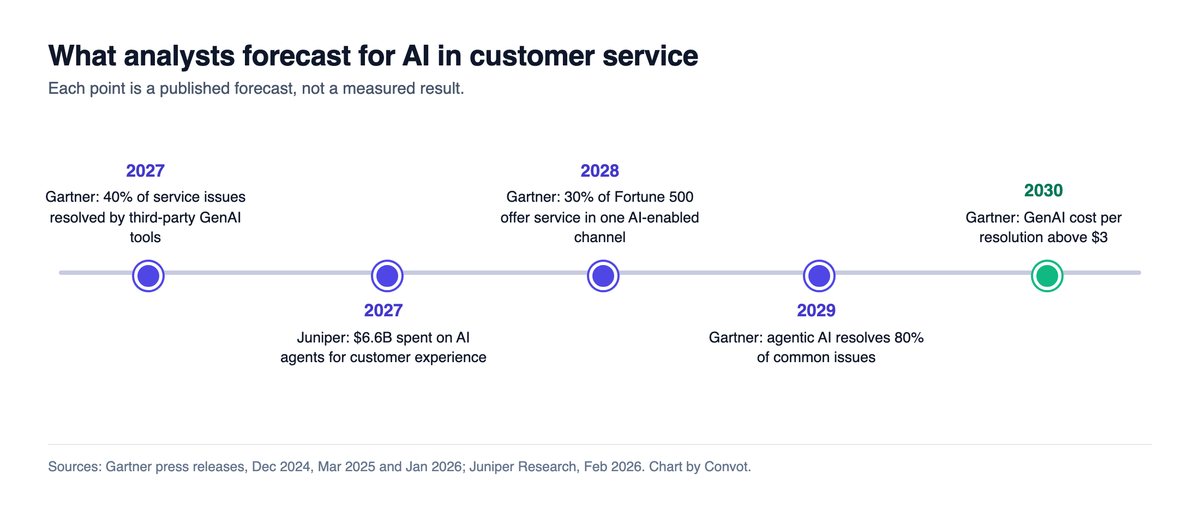 Figure 8: The same analyst that forecasts AI resolving most common issues by 2029 also forecasts each resolution costing more than many offshore human agents by 2030, so cheap AI is not a safe assumption. Source: Gartner, Agentic AI will autonomously resolve 80% of common customer service issues by 2029, Mar 2025, with other forecasts cited below. Chart by Convot from the cited forecasts, captured 3 Oct 2026.
How much will AI resolve, and where?
Forecasts agree that AI takes most routine volume, but much of it may happen outside the company’s own channels.
- Gartner forecasts that by 2029 agentic AI will resolve 80% of common customer service issues without human intervention, cutting operational costs by 30% (Gartner, Mar 2025).
- Gartner forecasts that by 2027, 40% of all customer service issues will be fully resolved by unofficial third-party GenAI tools (Gartner, Dec 2024).
- Gartner forecasts that by 2028, 30% of Fortune 500 companies will offer service only through a single AI-enabled channel (Gartner, Dec 2024).
- Juniper Research forecasts contact centre voice calls will grow from 24 billion in 2025 to over 39 billion by 2029, because chatbots cannot solve complex queries (Juniper Research, Jul 2025).
What will go wrong in 2026?
Forrester expects a rough year for teams that push AI into places it cannot succeed.
- Forrester predicted that in 2026 a third of companies will harm customer experience with frustrating AI self-service (Forrester, Oct 2025).
- Forrester predicted that one in four brands will see a 10% increase in successful simple self-service interactions by the end of 2026 (Forrester, Nov 2025).
- Forrester predicted that at least three major brands will see single-day call volume spikes 100 times above normal as consumer AI agents flood call queues (Forrester, Nov 2025).
How will AI change support budgets and pricing?
Spending on AI agents keeps rising, and per-seat pricing is expected to give way to usage and outcome pricing.
- IDC forecasts that by 2028 pure seat-based software pricing will be obsolete, forcing 70% of vendors to change their pricing models (IDC, Oct 2025).
- IDC forecasts that by 2026, 40% of all G2000 job roles will involve working with AI agents (IDC, Oct 2025).
- Juniper Research forecasts spending on AI agents for customer experience will reach $6.6 billion by 2027, up from $1.3 billion in 2025 (Juniper Research, Feb 2026).
- Juniper Research forecasts conversational AI service revenue will grow from $2.4 billion in 2026 to $8.5 billion by 2030 (Juniper Research, Jun 2026).
- Deloitte predicted that as many as 75% of companies may invest in agentic AI in 2026 (Deloitte, Nov 2025).
Methodology and Sources
We included only statistics we could trace to the organisation that produced them: survey firms and analysts publishing their own research, government statistics offices, regulators, legislatures, courts, peer-reviewed or preprint academic papers, and company filings or announcements. We excluded any number found only on a statistics roundup or listicle. Each link was opened in October 2026 to confirm the number, the date and the source. Vendor claims about their own products are labelled as vendor-reported, and forecasts are labelled as forecasts. The AI pricing data comes from Convot’s help desk pricing index, checked against each vendor’s own pricing page. We review every statistic monthly and replace figures when a newer study is published. You are welcome to cite any number on this page with a link back.
Sources
- Gartner: AI spending surge, Aug 2026; Customers want access to a human, Aug 2026; Third-party GenAI, Jul 2026; Leaders under pressure, Feb 2026; Cost per resolution forecast, Jan 2026; Agentic AI forecast, Mar 2025; Third-party tools forecast, Dec 2024; Single AI channel forecast, Dec 2024; Customers prefer no AI, Jul 2024
- Salesforce: State of Service AI agents research; State of Service: AI Agents Edition; Q2 FY27 results; Agreement to acquire Fin; Acquisition of Fin completed; Agentforce customer zero; AI connected customer research
- Intercom and Fin: Customer Service Transformation Report 2026; From resolutions to outcomes; Pricing; fin.ai
- Five9, 2026 Business Leaders CX Report
- Genesys, State of Customer Experience
- Zendesk: CX Trends 2026; CX Trends 2026 press release
- Qualtrics XM Institute: AI customer service failure rates; The future of customer service
- Pew Research Center: Americans and AI 2026; Why don’t Americans use chatbots?; ChatGPT tops the list of chatbots
- Forrester, The State of GenAI and Consumers for 2026; Forrester 2026 predictions; Forrester, Predictions 2026 for customer service
- YouGov, How Americans prefer to contact businesses
- US Census Bureau, Business Trends and Outlook Survey
- US Bureau of Labor Statistics, Customer Service Representatives
- NBER, Generative AI at Work; NBER, Still Waters, Rapid Currents
- Alibaba field experiment (arXiv 2603.29888); Alibaba agentic AI experiment (arXiv 2605.14830)
- Stanford Digital Economy Lab, Canaries in the Coal Mine
- International Labour Organization, Generative AI and Jobs
- Statistics Canada: AI use by businesses, Q2 2025; Exposure to AI in Canadian jobs
- Klarna: Form F-1; AI assistant launch; Q1 2025 results
- Octopus Energy, AI trial
- Concentrix, Form 10-K
- INFORMS, Machines vs. Humans
- European Commission: AI Act Article 50; Article 99; Article 113; Transparency rules quick facts
- Consumer Financial Protection Bureau, Chatbots in consumer finance
- Federal Trade Commission: Operation AI Comply; AI chatbot inquiry
- State laws: California SB 1001; California SB 243; Utah SB 149; Utah SB 226; Maine LD 1727; Colorado SB 26-189
- Civil Resolution Tribunal of British Columbia, Moffatt v. Air Canada; Ofcom, Generative AI and chatbots
- IDC FutureScape 2026; Juniper Research: AI agent spend, Conversational AI revenue, Contact centre calls; Deloitte 2026 TMT Predictions
- Vendor pricing pages: Front, Crisp, Convot, Featurebase, Freshdesk, Tidio, Help Scout, Re:amaze; Convot help desk pricing index
Revenue-aware support for Shopify app teams.
Live chat, help center, and every merchant's MRR, plan, and LTV beside the conversation. Free under $1k MRR.
Start free