72 Mobile App Support Statistics for 2026 (Updated October)
72 mobile app support statistics, including our study of 74,588 Google Play reviews: ratings, complaints, developer replies and store rules. Updated monthly.
On this page
- Key Takeaways
- How big is the mobile app economy?
- How do users rate mobile apps today?
- What do unhappy mobile users complain about?
- How often do app reviews mention support?
- Do mobile developers reply to app reviews?
- How fast do developers reply to reviews?
- Does replying to a review change the rating?
- What do Apple and Google require of app support?
- Methodology and Sources
- Sources
Mobile app users rarely write about support in their reviews. They write about crashes, ads, logins and money, and they give one star when something breaks. These 72 statistics show what support looks like for mobile app developers in 2026: the size of the app economy, how users rate apps, what they complain about, how often and how fast developers reply, whether replies change ratings, and what Apple and Google require.
Much of the data is new. We studied 74,588 recent Google Play reviews of 525 top apps across 36 categories, and compared them with our study of the Shopify App Store. The rest comes from Apple and Google’s own documentation and announcements, Pew Research Center, Gartner and peer-reviewed research. The method, and where it is thin, is set out at the end.
Updated October 2026. We re-run the Google Play study and check every link monthly.
Key Takeaways
- 28.7% of recent Google Play reviews of top apps give 1 star (Convot Google Play study, Oct 2026).
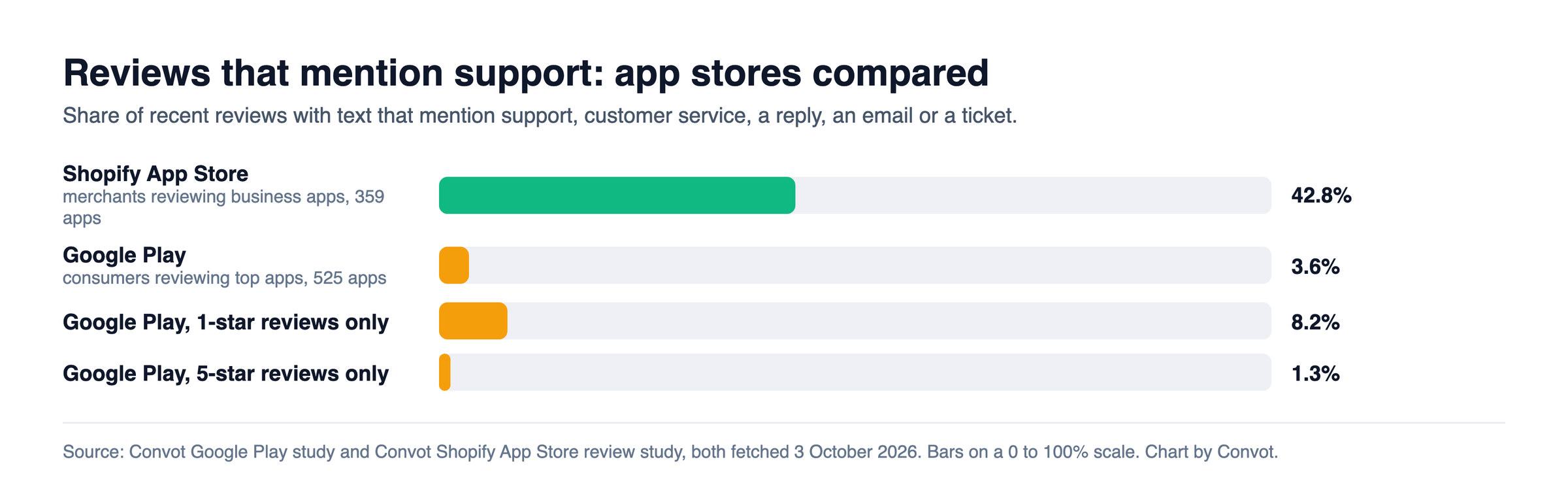
- Only 3.6% of recent Google Play reviews mention support, against 42.8% of reviews on the Shopify App Store (Convot Google Play study, Oct 2026).
- 43.2% of top Google Play apps did not reply to any of their 150 newest reviews (Convot Google Play study, Oct 2026).
- Apps with 100 million or more installs replied to 15.2% of recent reviews, half the rate of apps with 1 million to 100 million (Convot Google Play study, Oct 2026).
- When Google Play developers reply to a review, the median reply comes about 7 hours after it was posted (Convot Google Play study, Oct 2026).
- 18.9% of one- and two-star Google Play reviews are about money: paying, subscriptions, premium features or refunds (Convot Google Play study, Oct 2026).
- Top Google Play apps show a median rating of 4.54, but their recent reviews average 3.52 stars (Convot Google Play study, Oct 2026).
- Users changed their rating 38.7% of the time after a developer responded to their review, in a study of 10,713 top Google Play apps (McIlroy et al., IEEE Software, May 2017).
- Apple’s App Review evaluated more than 9.1 million app submissions in 2025 (Apple Newsroom, May 2026).
- Apple blocked close to 195 million fraudulent ratings and reviews in 2025 (Apple Newsroom, May 2026).
- Apple lets an app ask a user for a rating up to three times in 365 days (Apple, Ratings, Reviews, and Responses, Oct 2026).
- 91% of US adults own a smartphone (Pew Research Center, Mobile Fact Sheet, Nov 2025).
How big is the mobile app economy?
The app stores are enormous, and almost all of that scale sits with apps that pay the stores little or nothing. For a small team, the competition for attention is fierce and reviews are one of the few levers it controls.
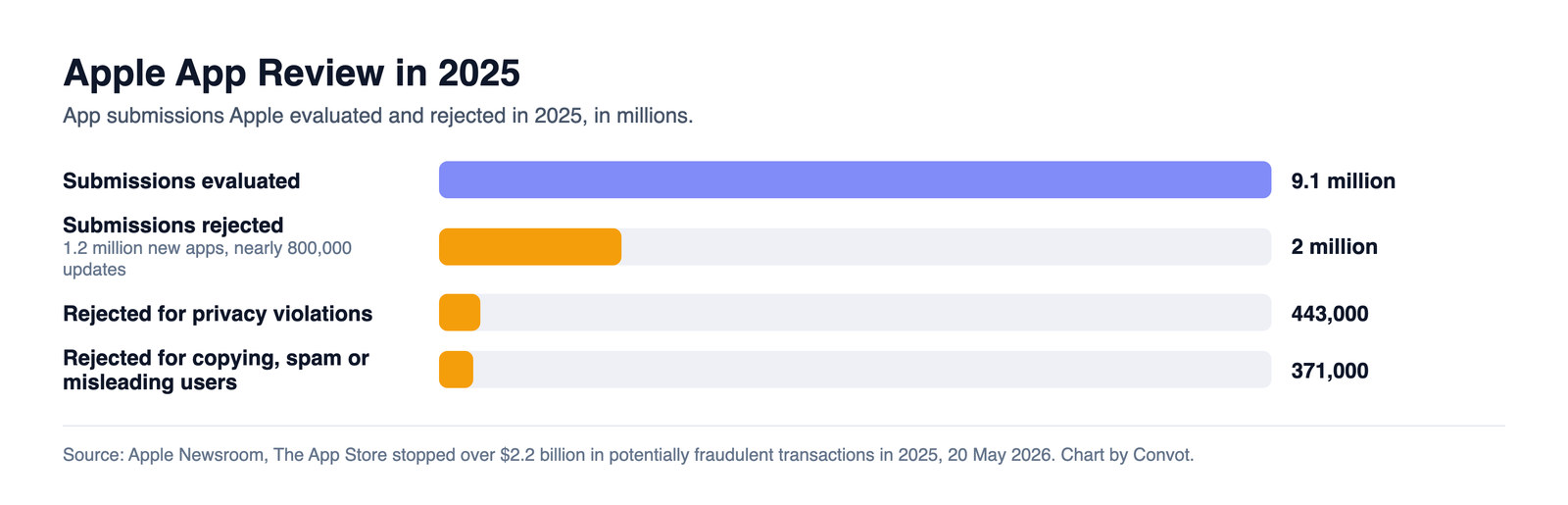 Figure 1: Apple rejected more than one submission in five in 2025, so even getting an app or an update in front of users takes work before support starts. Source: Apple Newsroom, May 2026. Chart by Convot from Apple’s figures.
How large are the App Store and Google Play?
Apple and Google publish their own scale figures.
- The App Store ecosystem facilitated more than $1.4 trillion in developer billings and sales in 2025, according to a study by Analysis Group economists commissioned by Apple (Apple Newsroom, Jun 2026).
- That 2025 total was $1.1 trillion of physical goods and services, $149 billion of digital goods and services, and $151 billion of in-app advertising (Apple Newsroom, Jun 2026).
- The App Store has more than 850 million average weekly users across 175 countries and regions (Apple Newsroom, Jun 2026).
- Apple welcomed more than 306,000 new developers in 2025 (Apple Newsroom, May 2026).
- Google Play prevented more than 1.75 million policy-violating apps from being published in 2025 and banned more than 80,000 developer accounts (Google, Feb 2026).
- Google Play runs more than 10,000 safety checks on every app it publishes (Google, Feb 2026).
What do the stores charge developers?
Most small developers pay a reduced fee or none.
- Developers paid no commission to Apple on more than 90% of 2025 App Store ecosystem billings and sales (Apple Newsroom, Jun 2026).
- Apple’s Small Business Program charges a 15% commission to developers with up to $1 million in proceeds in the prior year (Apple, App Store Small Business Program, Oct 2026).
- Google says 97% of developers distribute on Google Play at no charge, and 99% of those who pay a service fee qualify for 15% or less (Google Play Console Help, Service fees, Oct 2026).
How many people use smartphones?
Smartphones are close to universal in the US, and for some users the only way online.
- 98% of US adults own a cellphone of some kind, up from the 35% who owned a smartphone in Pew’s first survey in 2011 (Pew Research Center, Mobile Fact Sheet, Nov 2025).
- 16% of US adults are smartphone-only internet users, including 27% of adults aged 18 to 29 (Pew Research Center, Mobile Fact Sheet, Nov 2025).
How do users rate mobile apps today?
Mobile reviews are far harsher than reviews of business apps. Consumers who are happy rarely write; consumers who hit a problem often do, and they give one star.
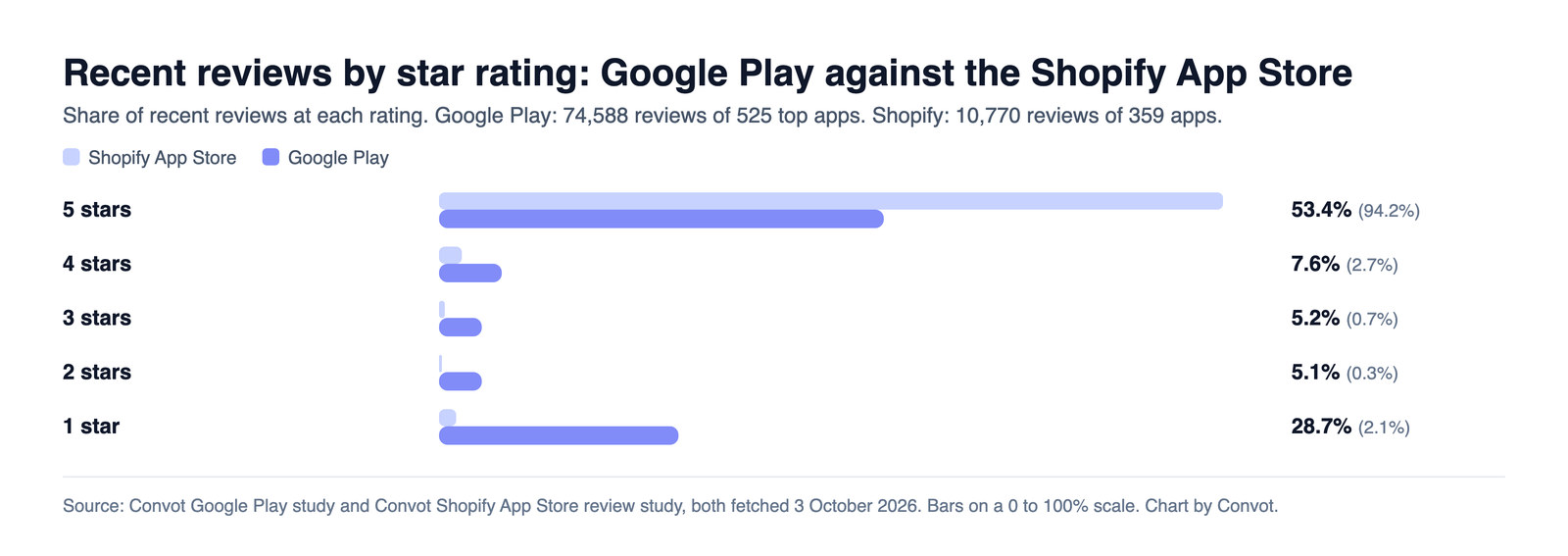 Figure 2: One recent Google Play review in four is a one-star review, against one in fifty on the Shopify App Store, so mobile teams get far more public criticism to respond to. Source: Convot Google Play study and Convot Shopify App Store review study, Oct 2026. Chart by Convot.
What does the rating spread look like?
Our study of 74,588 recent reviews found ratings split at the extremes.
- 53.4% of recent Google Play reviews of top apps give 5 stars (Convot Google Play study, Oct 2026).
- Only 17.9% of recent reviews sit in the middle, at 2, 3 or 4 stars (Convot Google Play study, Oct 2026).
- In 2013 data from Apple’s App Store, 61.96% of reviews gave 5 stars and 11.62% gave 1 star (Pagano and Maalej, IEEE RE, Jul 2013).
Is the public rating a fair picture of recent experience?
The listed rating is often a poor guide to recent experience, because it includes years of older ratings.
- 40.8% of top apps have recent reviews that average a full star or more below their listed rating (Convot Google Play study, Oct 2026).
- Google says the rating shown on Google Play is weighted towards recent ratings and does not reset when a new version is published (Google Play Console Help, Ratings and reviews, Oct 2026).
- Apple’s summary rating is specific to each country or region and can be reset with a new version, but a reset does not remove written reviews (Apple, Ratings, Reviews, and Responses, Oct 2026).
Which categories get the harshest reviews?
Category matters more than size.
- 51.6% of recent reviews of top dating apps give 1 star, the highest share of any category (Convot Google Play study, Oct 2026).
- Books and reference apps had the lowest one-star share at 13.7%, followed by games at 15.7% (Convot Google Play study, Oct 2026).
What do unhappy mobile users complain about?
Money comes first, then things that stop the app working. Very few angry users mention support by name, which means they never tried it or could not find it.
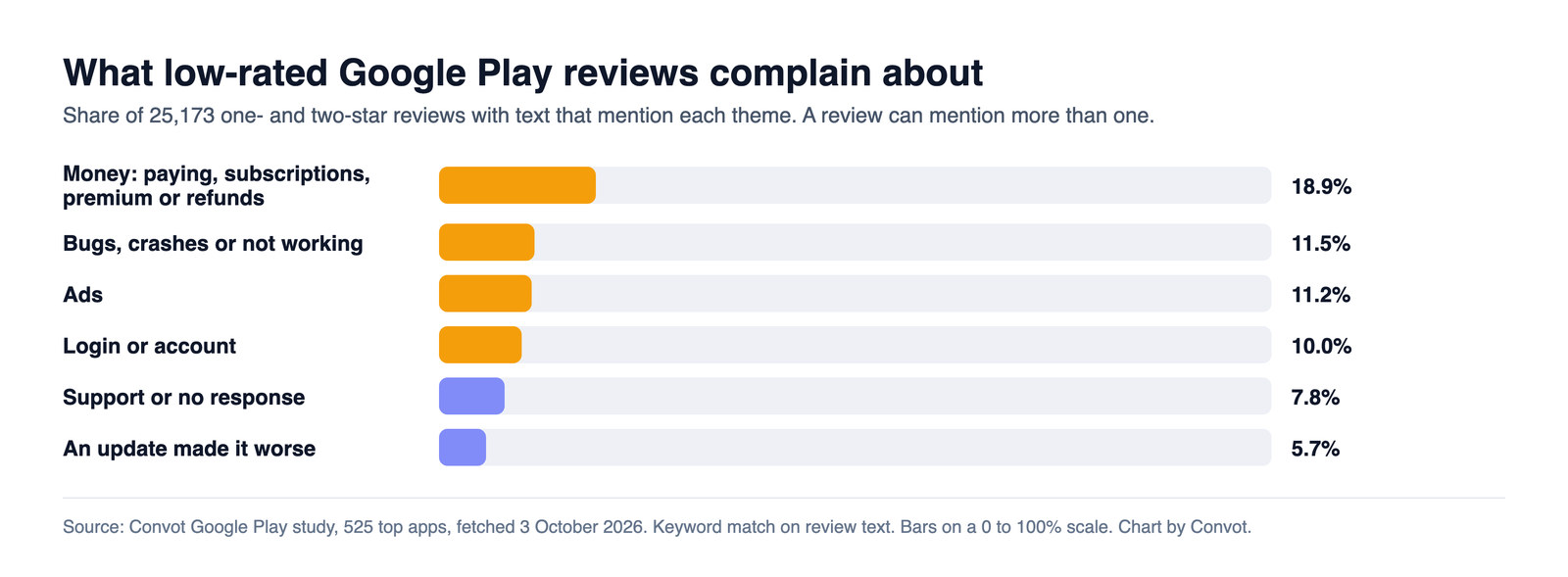 Figure 3: Most low ratings come from problems a support conversation could have caught, from a charge the user did not expect to a login that failed. Source: Convot Google Play study, 25,173 one- and two-star reviews with text, Oct 2026. Chart by Convot.
What themes show up in low ratings?
Keyword matching on 25,173 one- and two-star reviews with text found these themes.
- 11.5% of low-rated reviews mention bugs, crashes or the app not working (Convot Google Play study, Oct 2026).
- 11.2% of low-rated reviews complain about ads (Convot Google Play study, Oct 2026).
- 10.0% of low-rated reviews mention logging in or an account problem, and 5.7% say an update made the app worse (Convot Google Play study, Oct 2026).
What does earlier research find in app reviews?
Academic studies have coded reviews by hand for more than a decade.
- In a hand-coded sample of App Store reviews, 10.00% were bug reports, 6.91% feature requests and 13.27% described a specific shortcoming (Pagano and Maalej, IEEE RE, Jul 2013).
- Across 20 apps on Google Play and the App Store, up to 30% of reviews raised more than one type of issue at once (McIlroy, Ali, Khalid and Hassan, Empirical Software Engineering, Mar 2015).
- Of about 2.2 million Google Play reviews of 539 top apps, 0.5% were about security and privacy (Mukherjee et al., arXiv, Oct 2020).
How often do app reviews mention support?
App reviews rarely mention support, and that is the opportunity. A mobile user who meets your support is unusual enough to remember it.
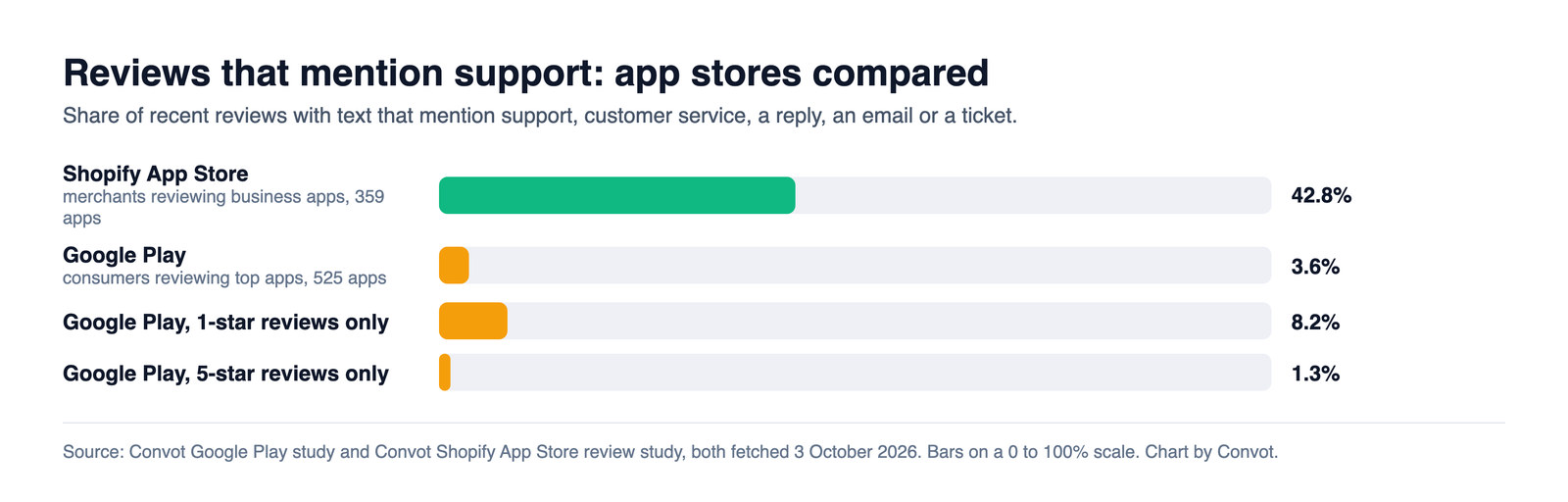 Figure 4: Business buyers review the people behind an app; consumers review the app itself, so on mobile support has to be visible inside the app to be used at all. Source: Convot Google Play study and Convot Shopify App Store review study, Oct 2026. Chart by Convot.
Which reviews mention support?
Support comes up mostly when something went wrong.
- 8.2% of one-star Google Play reviews mention support, against 1.3% of five-star reviews (Convot Google Play study, Oct 2026).
- 7.8% of low-rated reviews complain about support or getting no response (Convot Google Play study, Oct 2026).
Can users find help without contacting anyone?
Self-service rarely finishes the job on its own.
- Only 14% of customer service issues are fully resolved in self-service, according to a Gartner survey of 5,728 customers (Gartner, Aug 2024).
- 43% of failed self-service attempts failed because customers could not find content relevant to their issue (Gartner, Aug 2024).
- 64% of customers would prefer companies did not use AI in customer service, mostly because they fear it will be harder to reach a person (Gartner, Jul 2024).
For the business-app side of the picture, see the Shopify app support statistics.
Do mobile developers reply to app reviews?
Many of the biggest apps barely reply at all, while mid-sized apps reply to almost a third of reviews. Replying is one of the few support moments every future user can see.
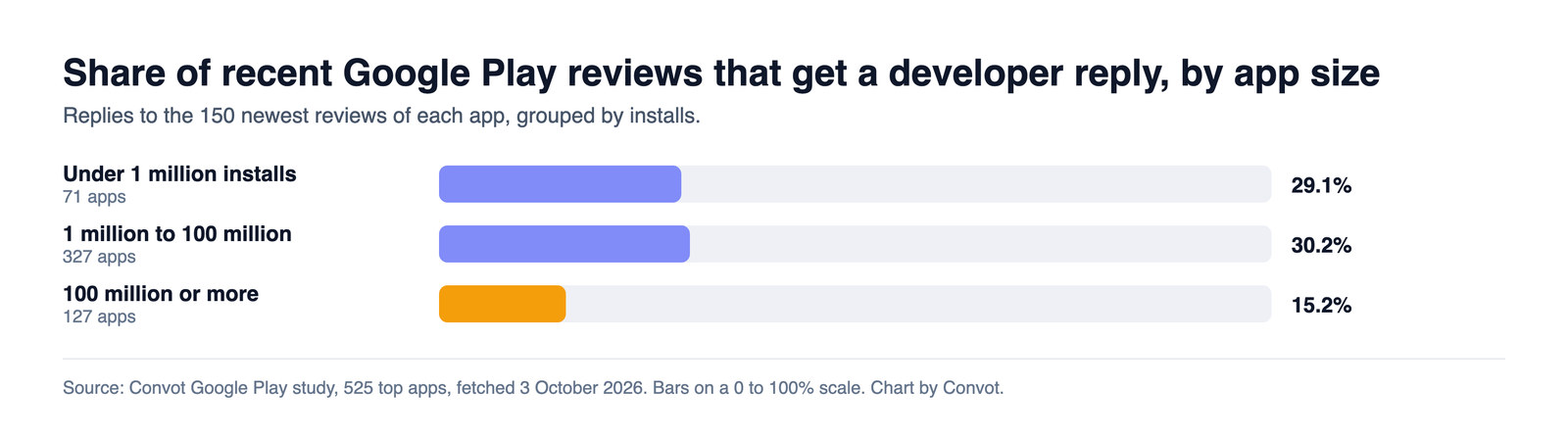 Figure 5: The largest apps reply least, which leaves room for smaller teams to look more responsive than the market leaders on their own listing. Source: Convot Google Play study, 525 top apps, Oct 2026. Chart by Convot.
How many reviews get a reply?
Reply habits split sharply between apps.
- 26.3% of recent Google Play reviews of top apps got a developer reply (Convot Google Play study, Oct 2026).
- 23.0% of apps replied to at least half of their newest reviews, and 13.1% replied to 90% or more (Convot Google Play study, Oct 2026).
- Of apps with five or more recent one- and two-star reviews, 44.8% replied to none of them (Convot Google Play study, Oct 2026).
Which categories reply most?
Category habits differ more than twentyfold.
- Top personalization apps replied to 59.6% of recent reviews and sports apps to 55.8% (Convot Google Play study, Oct 2026).
- Top productivity apps replied to 2.2% of recent reviews and business apps to 8.2% (Convot Google Play study, Oct 2026).
How fast do developers reply to reviews?
Teams that reply tend to reply quickly. Google holds new reviews back for about a day, so a fast reply can be in place before most people see the review.
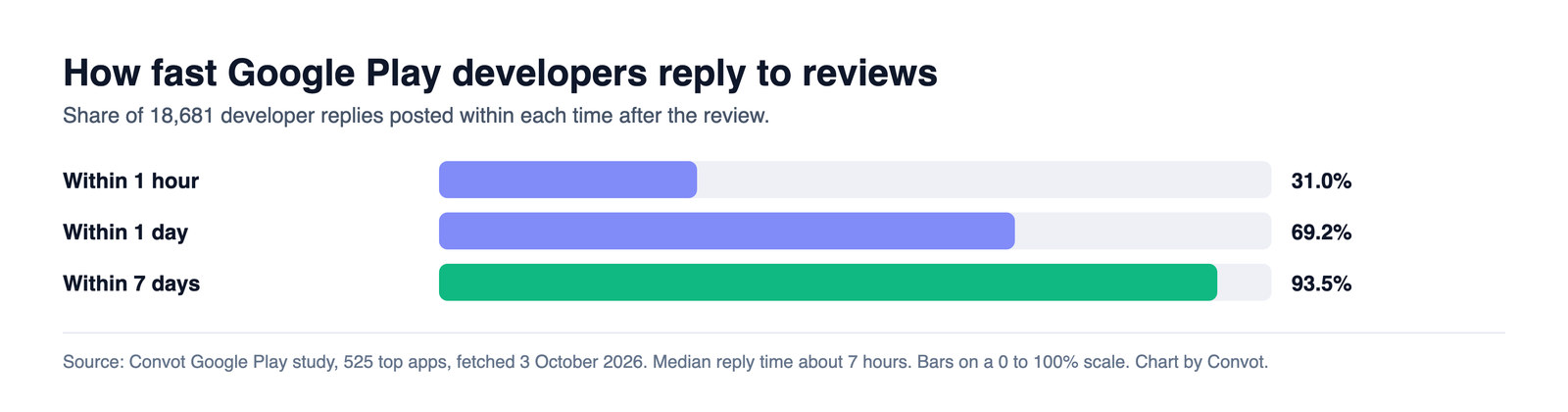 Figure 6: Seven replies in ten arrive within a day, often before the review is even public, which is fast enough to change what the next reader sees. Source: Convot Google Play study, 18,681 developer replies, Oct 2026. Chart by Convot.
How quickly do replies arrive?
Speed varies less than reply rates do.
- 31.0% of developer replies are posted within an hour of the review (Convot Google Play study, Oct 2026).
- 69.2% of developer replies are posted within a day, and 93.5% within a week (Convot Google Play study, Oct 2026).
- Google holds new reviews for around 24 hours before they go public, but developers can see and reply to them straight away (Google Play Console Help, Ratings and reviews, Oct 2026).
What tools do developers reply with?
Both stores let teams reply at scale.
- Google’s Reply to Reviews API limits each reply to 350 characters (Google, Reply to Reviews API, Oct 2026).
- The API allows 200 read requests an hour and 2,000 replies a day per app (Google, Reply to Reviews API, Oct 2026).
- On the App Store, developers can reply to any review in App Store Connect, whenever it was written, and staff with the Customer Support role can reply (Apple, Ratings, Reviews, and Responses, Oct 2026).
Does replying to a review change the rating?
Replying often changes the rating. Developers reply most to the reviews where a fix could change the score, and research shows users do update their ratings after a reply.
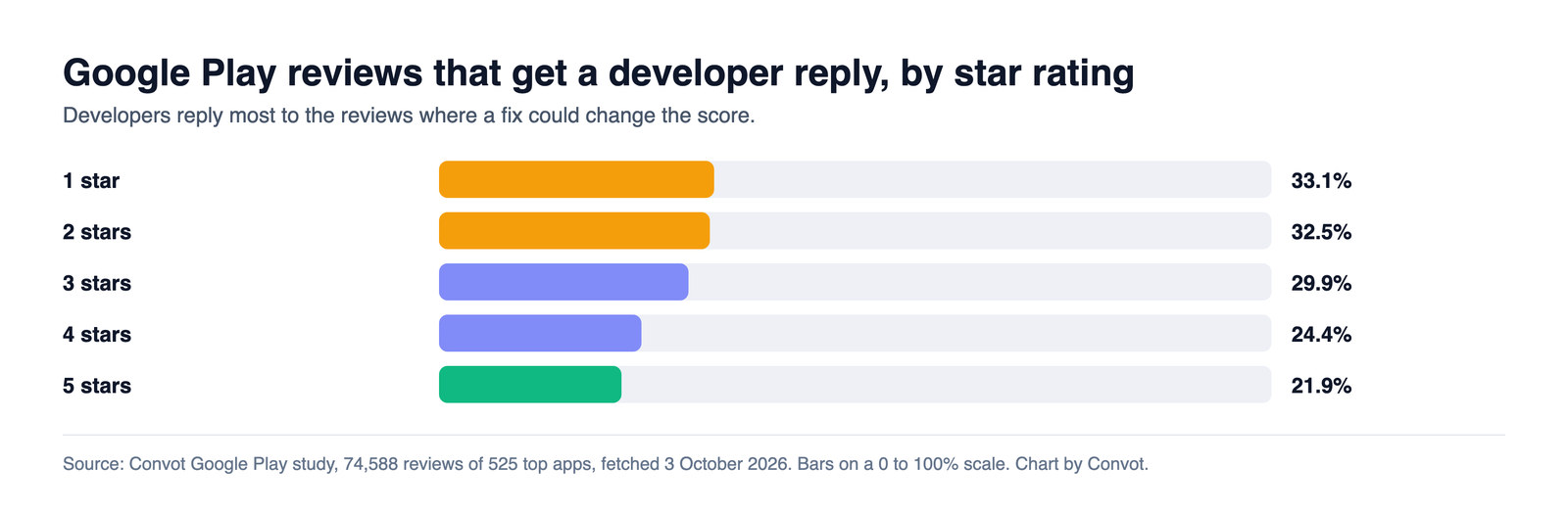 Figure 7: Developers aim their replies at low ratings, the reviews where an answer has the most to win back. Source: Convot Google Play study, 74,588 reviews of 525 top apps, Oct 2026. Chart by Convot.
What does the research say about replies?
Studies of Google Play find replies work as a form of support.
- In a study of 10,713 top Google Play apps, the median rating increase after a developer response was 20% (McIlroy et al., IEEE Software, May 2017).
- A study of 4.5 million reviews and 126,686 developer responses found developers and users use responses as a basic support channel, with conversations of up to ten messages (Hassan et al., Empirical Software Engineering, Sep 2017).
- The same study found developers are more likely to respond to lower-rated and longer reviews, and that responding may raise the rating given (Hassan et al., Empirical Software Engineering, Sep 2017).
- Thanking the user and asking for more detail about a reported issue were the most important of seven reasons developers responded (Hassan et al., Empirical Software Engineering, Sep 2017).
What do the stores show developers about replies?
Both stores notify the reviewer, which is why replies can move a rating.
- Play Console shows whether users who got a reply later raised, kept or lowered their rating, beside users who got no reply (Google Play Console Help, Ratings and reviews, Oct 2026).
- Google Play allows one public reply per review, editable at any time, and sends the user a notification and an email when a developer replies (Google Play Console Help, Ratings and reviews, Oct 2026).
- Google notifies the user only the first time a developer replies to a new or edited review (Google, Reply to Reviews API, Oct 2026).
What do Apple and Google require of app support?
Both stores require a way to reach the developer and police how teams ask for reviews. Neither sets a response time.
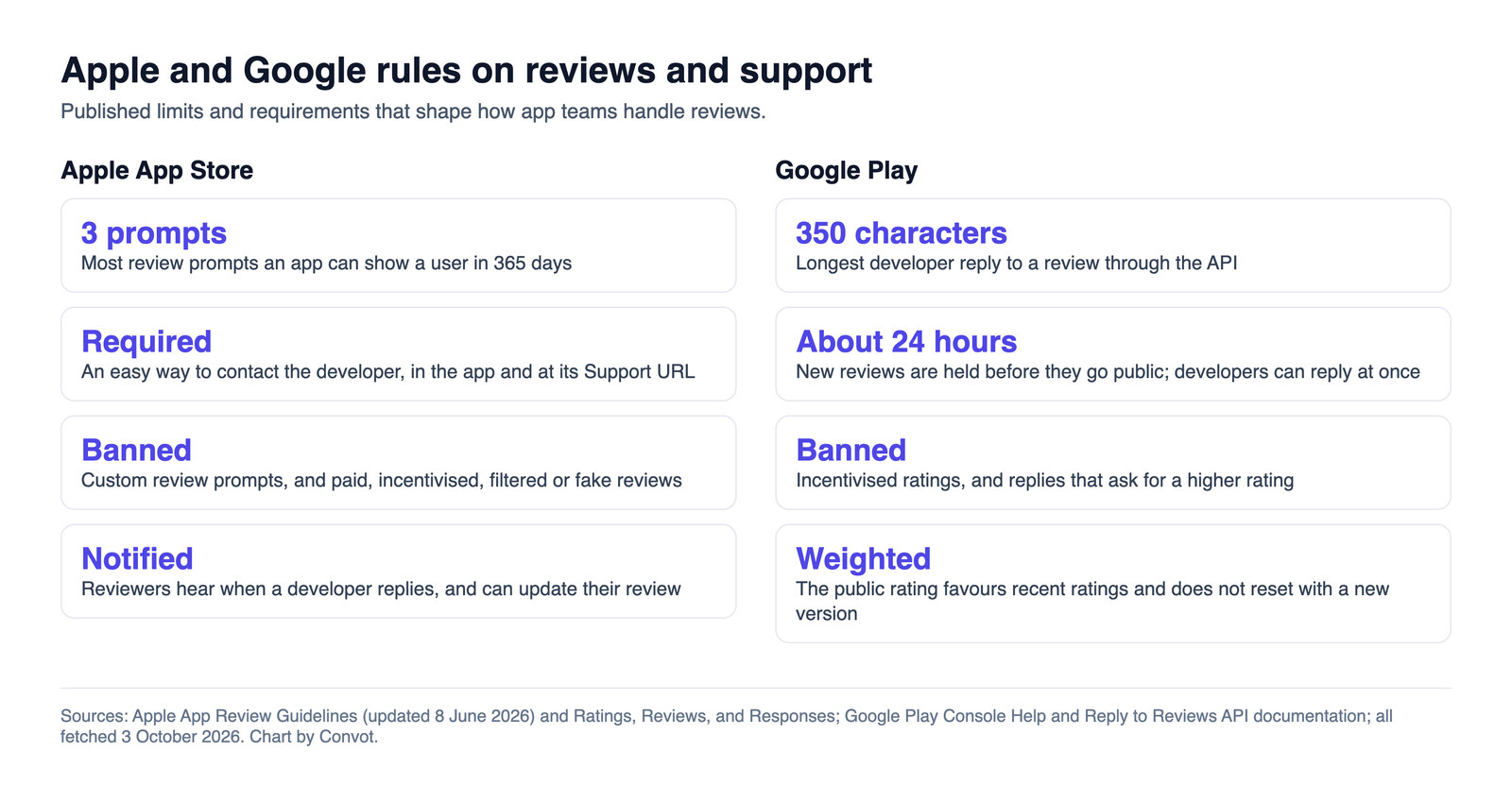 Figure 8: The stores regulate how you ask for ratings in detail, but leave how quickly you answer users entirely to you. Source: Apple App Review Guidelines, Jun 2026, and Google Play Console Help, fetched Oct 2026. Chart by Convot.
What does Apple require?
Apple’s rules sit in its App Review Guidelines and developer pages.
- Apple requires an app and its Support URL to include an easy way to contact the developer, under guideline 1.5 (Apple, App Review Guidelines, Jun 2026).
- Apple requires apps to use its own review-prompt API and disallows custom review prompts, under guideline 5.6.1 (Apple, App Review Guidelines, Jun 2026).
- Developers who manipulate reviews with paid, incentivised, filtered or fake feedback can be expelled from the Apple Developer Program (Apple, App Review Guidelines, Jun 2026).
- Apple says replies should address the user’s comment and leave out personal information, spam and marketing (Apple, App Review Guidelines, Jun 2026).
- When a developer replies, the reviewer is notified and can update their review (Apple, Ratings, Reviews, and Responses, Oct 2026).
- Apple advises making support contact details easy to find in the app and on the product page, to fix bad experiences before they become poor reviews (Apple, Ratings, Reviews, and Responses, Oct 2026).
What does Google require?
Google’s rules sit in Play Console Help and the Android developer docs.
- Google Play bans incentivised ratings and reviews, such as a discount in exchange for a high rating (Google Play Console Help, User Ratings, Reviews, and Installs, Oct 2026).
- Google tells developers to include a support address or FAQ link in review replies and not to ask for a higher rating (Google Play Console Help, User Ratings, Reviews, and Installs, Oct 2026).
- Google limits how often the in-app review dialog can appear, without publishing the quota, so calling it more than once in a short period may show nothing (Android Developers, In-App Reviews API, Jan 2026).
- Apps may not ask users any question, such as “Do you like the app?”, before or while showing the in-app rating card (Android Developers, In-App Reviews API, Jan 2026).
- Google blocked 160 million spam ratings and reviews in 2025 (Google, Feb 2026).
- Every top app in our sample listed a developer email on Google Play, and 96.6% listed a website (Convot Google Play study, Oct 2026).
Convot gives each mobile app its own help center, support email address, changelog and roadmap in one inbox, and your team can answer from the Convot iOS and Android apps. An in-app chat SDK for iOS and Android is in early access. See Convot for mobile apps.
Methodology and Sources
Convot Google Play study (October 2026). On 3 October 2026 we listed the top 15 free apps in each of 36 Google Play categories (all app categories plus overall Games), in the US store in English: 525 apps with median installs of 10 million or more (71 under 1 million, 327 from 1 million to 100 million, 127 with 100 million or more). For each app we collected the listing and its 150 newest reviews, removing duplicates by review ID: 74,588 reviews, with a median date of 28 September 2026. “Mentions support” means the text contains support, customer service or care, help desk, live chat, contact, respond or response, replied, no reply or answer, email, or ticket. Themes are keyword matches, so they are approximate: the money theme counts any mention of paying, subscriptions, premium, money or refunds. The sample is chart-topping apps, so it describes the market leaders rather than small indie apps.
Convot Shopify App Store review study (October 2026). The comparison figures come from our study of 359 Shopify apps and 12,471 reviews, described on the Shopify app support statistics page.
Other sources. Apple and Google policy and help pages mostly show no publication date, so they are dated by the month we checked them; Apple’s App Review Guidelines and Google’s In-App Reviews page show their own update dates. Apple’s $1.4 trillion ecosystem figure comes from a study Apple commissioned. Academic papers are dated by publication; Pagano and Maalej’s App Store data is from 2013 and is labelled as such. We found no primary study of what mobile users expect from in-app support specifically, so this page makes no claim about it.
Sources
- Convot studies: Convot Google Play study; Convot Shopify App Store review study.
- Apple: App Review Guidelines; Ratings, Reviews, and Responses; App Store Small Business Program; Apple Newsroom, App Store ecosystem 2025; Apple Newsroom, App Store fraud prevention 2025.
- Google: Play Console Help, Ratings and reviews; Play Console Help, User Ratings, Reviews, and Installs; Play Console Help, Service fees; Reply to Reviews API; In-App Reviews API; Keeping Google Play and Android app ecosystems safe in 2025.
- Surveys: Pew Research Center, Mobile Fact Sheet; Gartner, self-service resolution survey; Gartner, customer attitudes to AI in service.
- Academic research: McIlroy, Shang, Ali and Hassan, Is It Worth Responding to Reviews?; Hassan, Tantithamthavorn, Bezemer and Hassan, Studying the dialogue between users and developers; McIlroy, Ali, Khalid and Hassan, Analyzing and automatically labelling the types of user issues; Pagano and Maalej, User Feedback in the AppStore; Mukherjee et al., User Reviews Targeting Mobile Apps’ Security and Privacy.
- Related research from Convot: Shopify app support statistics; AI customer service statistics; live chat statistics.
Revenue-aware support for Shopify app teams.
Live chat, help center, and every merchant's MRR, plan, and LTV beside the conversation. Free under $1k MRR.
Start free