76 Shopify App Support Statistics for 2026 (Updated October)
76 Shopify app support statistics from our study of 12,471 App Store reviews, 4,734 new apps and Shopify's own rules. Updated monthly.
On this page
- Key Takeaways
- How big is the Shopify app economy?
- Who builds new Shopify apps?
- How fast do new Shopify apps get their first reviews?
- What support do new Shopify app developers offer?
- How often do merchant reviews mention support?
- What do one-star Shopify app reviews complain about?
- Do Shopify app developers reply to reviews?
- What does Shopify require of app support?
- What does support tooling cost a Shopify app team?
- Methodology and Sources
- Sources
Support is the thing Shopify merchants write about most in app reviews, and the thing most app developers set up last. These 76 statistics show what support looks like for Shopify app developers in 2026: how big the app economy is, who builds new apps, how fast they earn reviews, what support they offer, what merchants say about support in reviews, how developers reply, what Shopify requires, and what the tooling costs.
Most of the numbers are new. We studied 12,471 reviews across 359 apps in 121 App Store categories, 4,734 apps launched in spring 2026, and the websites of 3,813 developers. The rest come from Shopify itself: its developer documentation, partner pages and annual report. The method is set out at the end, including where the data is thin.
Updated October 2026. We re-run the review study and check every Shopify link monthly.
Key Takeaways
- 42.8% of recent Shopify app reviews with text mention support, the team, a reply or a ticket (Convot review study, Oct 2026).
- 96.2% of recent app reviews that mention support give 5 stars (Convot review study, Oct 2026).
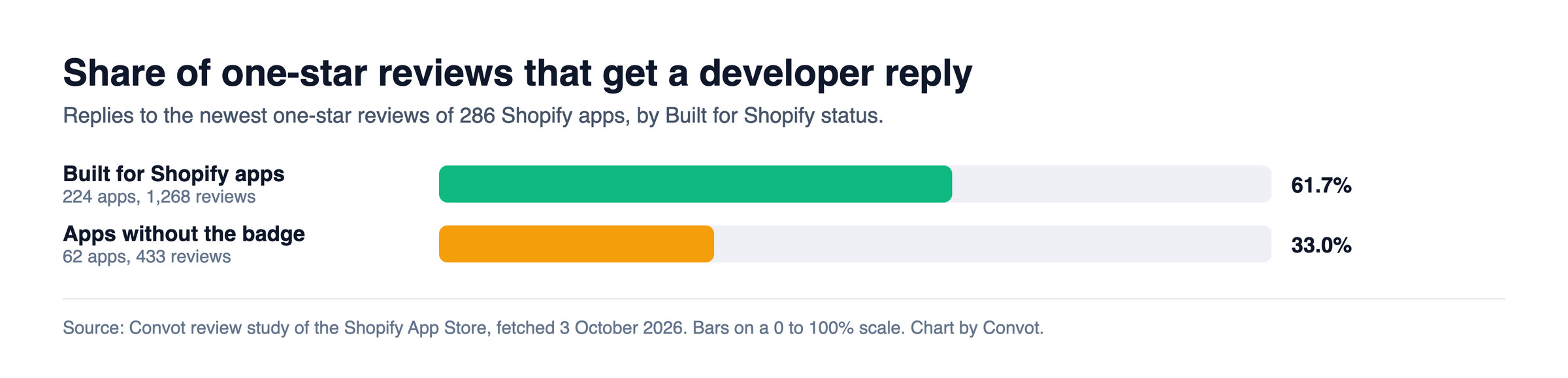
- Built for Shopify apps replied to 61.7% of their one-star reviews, against 33.0% for apps without the badge (Convot review study, Oct 2026).
- 21.0% of established apps did not reply to any of their recent one-star reviews (Convot review study, Oct 2026).
- The median Shopify app developer replies to a review 2 days after it is posted (Convot review study, Oct 2026).
- 20.7% of one-star app reviews with text complain about billing, charges, refunds or cancelling (Convot review study, Oct 2026).
- 85.8% of Shopify apps launched in spring 2026 had no reviews at all by late June (Convot new-app study, Jun 2026).
- 31.2% of new Shopify apps came from 513 developers that launched two or more apps in the same 90 days (Convot new-app study, Jun 2026).
- Only 4.5% of new app developers’ websites load a live chat widget (Convot developer-site scan, Oct 2026).
- Crisp is the most common chat widget on new app developers’ websites, on 35.3% of the sites that have one (Convot developer-site scan, Oct 2026).
- More than 21,000 apps were available in the Shopify App Store at the end of 2025 (Shopify 2025 annual report, Form 10-K, Feb 2026).
- App developers keep 100% of their first $1,000,000 in gross App Store revenue (Shopify, App Store revenue share, Oct 2026).
How big is the Shopify app economy?
The app economy is big enough to support thousands of small software companies, and Shopify’s terms are generous to the smallest of them. That is why so many one- and two-person teams build here, and why support so often falls to the founder.
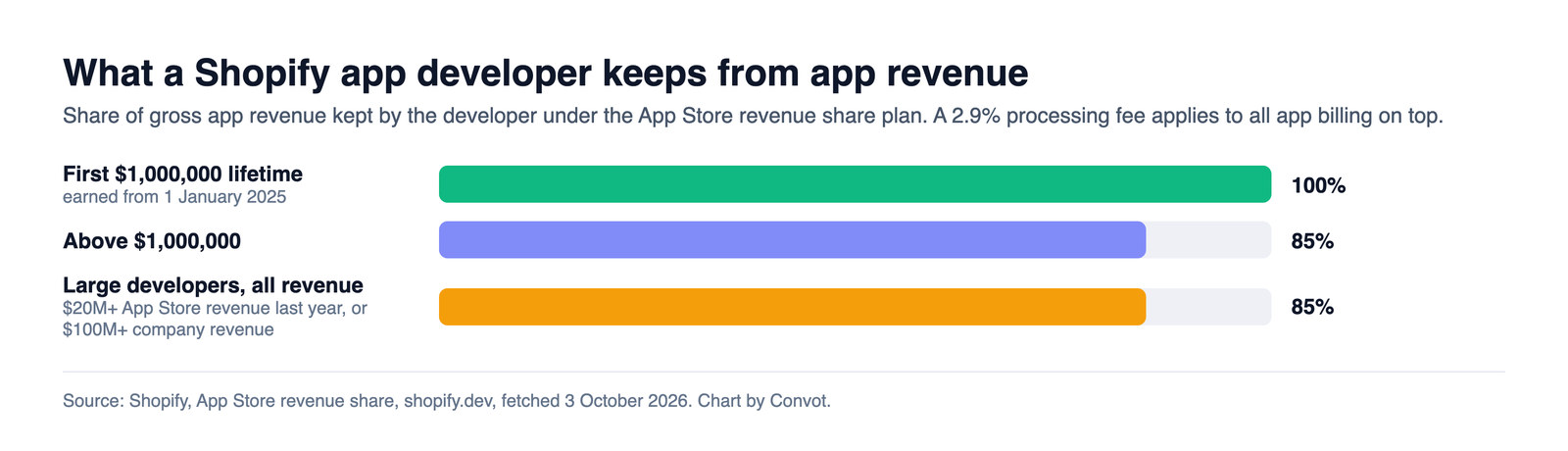 Figure 1: Small developers keep everything up to their first million, so a one-person app team’s main cost is time, and support is where that time goes. Source: Shopify, App Store revenue share, fetched Oct 2026. Chart by Convot from Shopify’s published terms.
How many merchants and how much commerce do apps serve?
Shopify’s annual report gives the scale apps sell into.
- Shopify facilitated $378.4 billion of gross merchandise volume in 2025, up 29% from $292.3 billion in 2024 (Shopify 2025 annual report, Form 10-K, Feb 2026).
- Shopify’s revenue was $11.6 billion in 2025, up 30% year over year (Shopify 2025 annual report, Form 10-K, Feb 2026).
- Shopify had millions of merchants in more than 175 countries at the end of 2025: 44% in the United States, 31% in Europe, the Middle East and Africa, 16% in Asia Pacific, 5% in Canada and 5% in Latin America (Shopify 2025 annual report, Form 10-K, Feb 2026).
- Shopify’s monthly recurring revenue was $205 million at the end of 2025, up 15% (Shopify 2025 annual report, Form 10-K, Feb 2026).
- Shopify reports $1.6 trillion in cumulative GMV and more than 14% of US ecommerce, based on 2025 US GMV (Shopify Investors, Oct 2026).
How many developers build for Shopify, and what do they earn?
Shopify publishes partner totals rather than app-only figures.
- Shopify paid $1.3 billion to partners in 2025, across apps, themes, store builds and referrals (Shopify Partners, Oct 2026).
- Shopify’s partner program has more than 100,000 partners (Shopify Partners, Oct 2026).
- Shopify’s developer community has more than 100,000 builders (Shopify Partners, Oct 2026).
- Shopify says every app goes through a 100-checkpoint review before it reaches the App Store (Shopify App Store, Oct 2026).
What does Shopify take from app revenue?
The revenue share is the cost line every app founder knows.
- Above the first $1,000,000, developers keep 85%, so Shopify’s share is 15% (Shopify, App Store revenue share, Oct 2026).
- Registering for the revenue share plan costs a one-time $19 per Partner account (Shopify, App Store revenue share, Oct 2026).
- All app billing carries a 2.9% processing fee plus applicable sales tax, charged separately from the revenue share (Shopify, App Store revenue share, Oct 2026).
- Developers that earned $20 million or more through the App Store in the prior year, or have $100 million or more in company revenue, pay 15% on all app revenue (Shopify, App Store revenue share, Oct 2026).
Who builds new Shopify apps?
New apps mostly come from tiny teams, and a third of them come from developers running several apps at once. Those multi-app developers answer support for every product they ship, usually from the same few people.
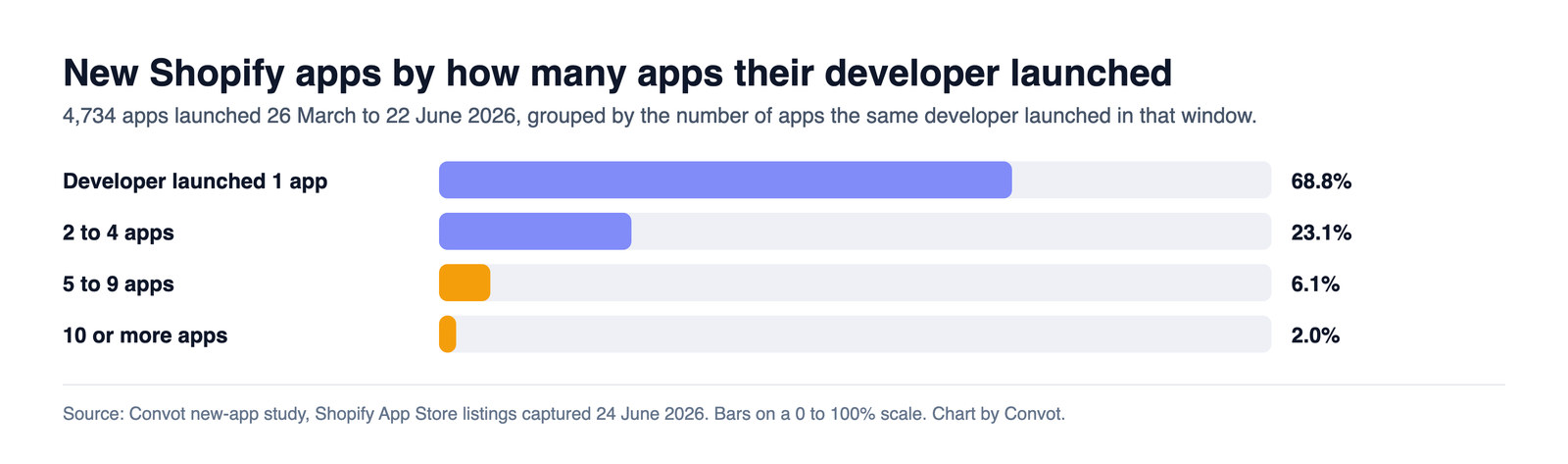 Figure 2: Nearly a third of new apps come from developers juggling several launches at once, which means several inboxes, help centers and chat widgets for one small team. Source: Convot new-app study, Shopify App Store listings captured Jun 2026. Chart by Convot.
How many apps launch, and in which categories?
Our new-app study covers every app listed with a launch date between 26 March and 22 June 2026.
- 4,734 Shopify apps launched in that 90-day window, across 121 App Store categories (Convot new-app study, Jun 2026).
- 2,316 of the new apps, 48.9%, were store management or store design apps, the largest group; marketing and conversion apps were next with 1,062 (Convot new-app study, Jun 2026).
- 261 of the new apps were themselves support, chat or help desk tools (Convot new-app study, Jun 2026).
How many developers run more than one app?
Most developers launched one app, but the multi-app studios are busy.
- The 4,734 apps came from 3,770 developers, and 86.4% of those developers launched a single app (Convot new-app study, Jun 2026).
- 53 developers launched five or more apps in the 90 days, and the busiest launched 30 (Convot new-app study, Jun 2026).
How fast do new Shopify apps get their first reviews?
Slowly. Almost every new app spends its first months with no reviews, which makes the first few merchants’ experience, and their support conversations, the deciding factor in whether an app gets off the ground.
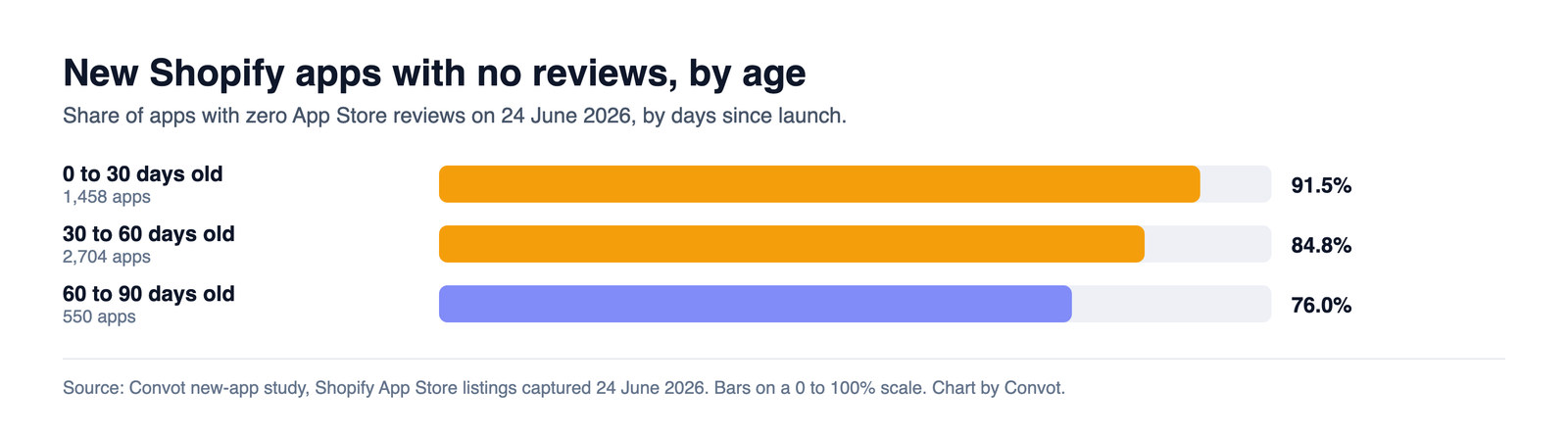 Figure 3: Even at two to three months old, three new apps in four still had no reviews, so each early merchant carries real weight. Source: Convot new-app study, Shopify App Store listings captured Jun 2026. Chart by Convot.
How many reviews does a new app have after 90 days?
Very few reach even a handful.
- 1.7% of the new apps had 5 or more reviews, and 0.5% had 10 or more (Convot new-app study, Jun 2026).
- Among apps 60 to 90 days old, 4.7% had 5 or more reviews (Convot new-app study, Jun 2026).
When does Shopify show more on an app’s reviews?
Shopify ties some listing features to review volume.
- Shopify’s AI-generated review summary appears only on apps with at least 100 reviews with text and a rating of at least 4.0, and can take up to 14 days to show (Shopify, Manage app reviews, Oct 2026).
- Built for Shopify status requires at least five reviews and a minimum recent rating, which Shopify does not publish as a number (Shopify, Built for Shopify requirements, Oct 2026).
- Built for Shopify also requires at least 50 net installs from active shops on paid plans (Shopify, Built for Shopify requirements, Oct 2026).
For practical ways to earn those first reviews, see how to get more Shopify app reviews.
What support do new Shopify app developers offer?
Most new app developers offer no live chat on their own website. Support usually runs through email and the contact details on the App Store listing, which leaves a merchant with a problem waiting for a reply.
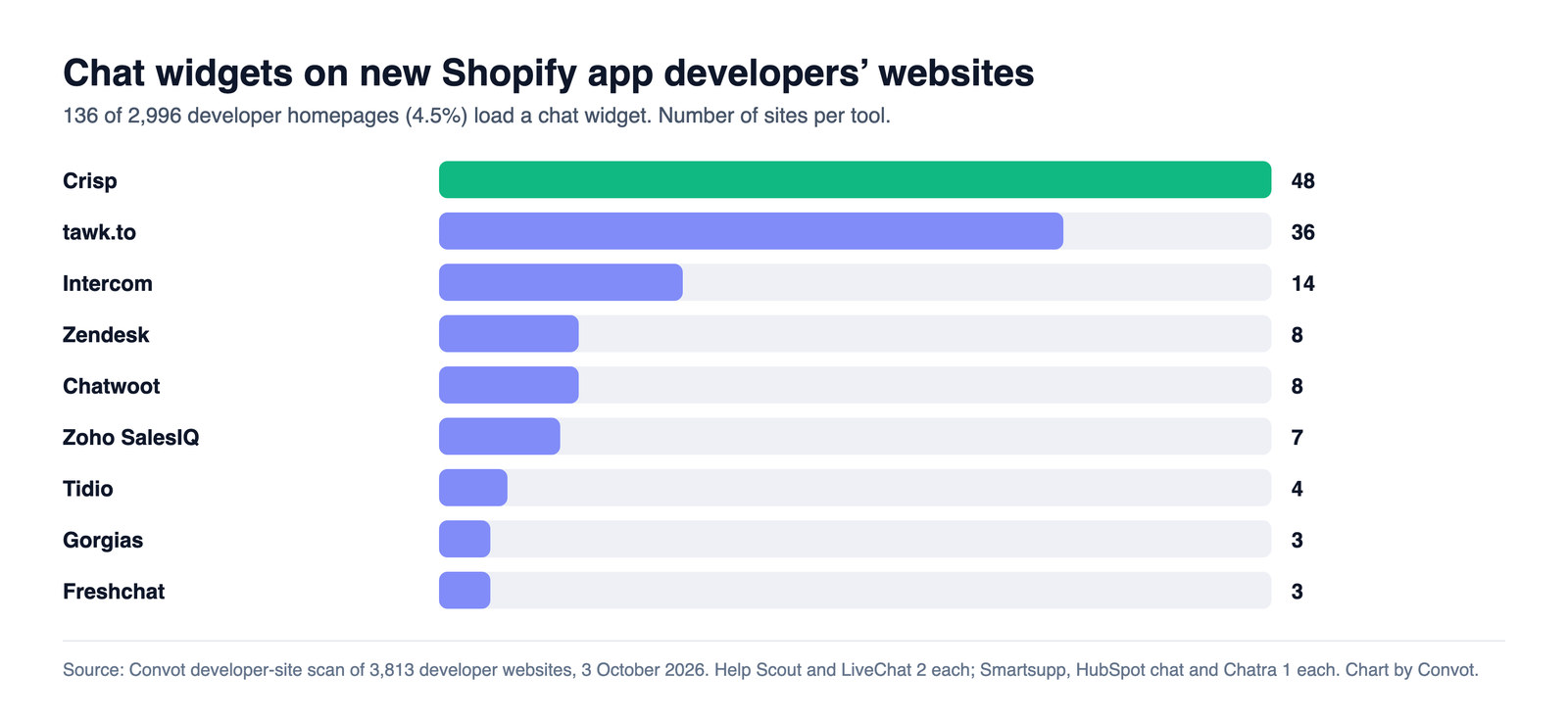 Figure 4: The developers who do add chat lean on free or cheap widgets, with Crisp and tawk.to on most of them, not the big help desks. Source: Convot developer-site scan, 3,813 developer websites, Oct 2026. Chart by Convot.
Which chat tools do app developers use?
Among the 136 developer websites with a chat widget, the tools split like this.
- tawk.to is on 26.5% of the developer websites that have chat, second to Crisp (Convot developer-site scan, Oct 2026).
- Intercom is on 10.3% of the developer websites with chat (Convot developer-site scan, Oct 2026).
- Zendesk and Chatwoot are each on 5.9% of the developer websites with chat, and Zoho SalesIQ on 5.1% (Convot developer-site scan, Oct 2026).
- 4.6% of developer websites link to WhatsApp, about as many as run any chat widget (Convot developer-site scan, Oct 2026).
Are studios more likely to offer chat?
Slightly, and from a low base.
- 4.9% of new apps have a developer website with live chat (Convot developer-site scan, Oct 2026).
- Apps from developers that launched two or more apps had a chat-equipped developer site 5.5% of the time, against 4.6% for single-app developers (Convot developer-site scan, Oct 2026).
If you are adding chat for the first time, the guide to adding live chat to your Shopify app covers the options.
How often do merchant reviews mention support?
Support is the most common thing merchants praise. In our study, reviews that mention support skew overwhelmingly positive: merchants tend to write about support when it rescued them. Consumer apps are different: on Google Play only a small share of reviews mention support at all, as our mobile app support statistics show.
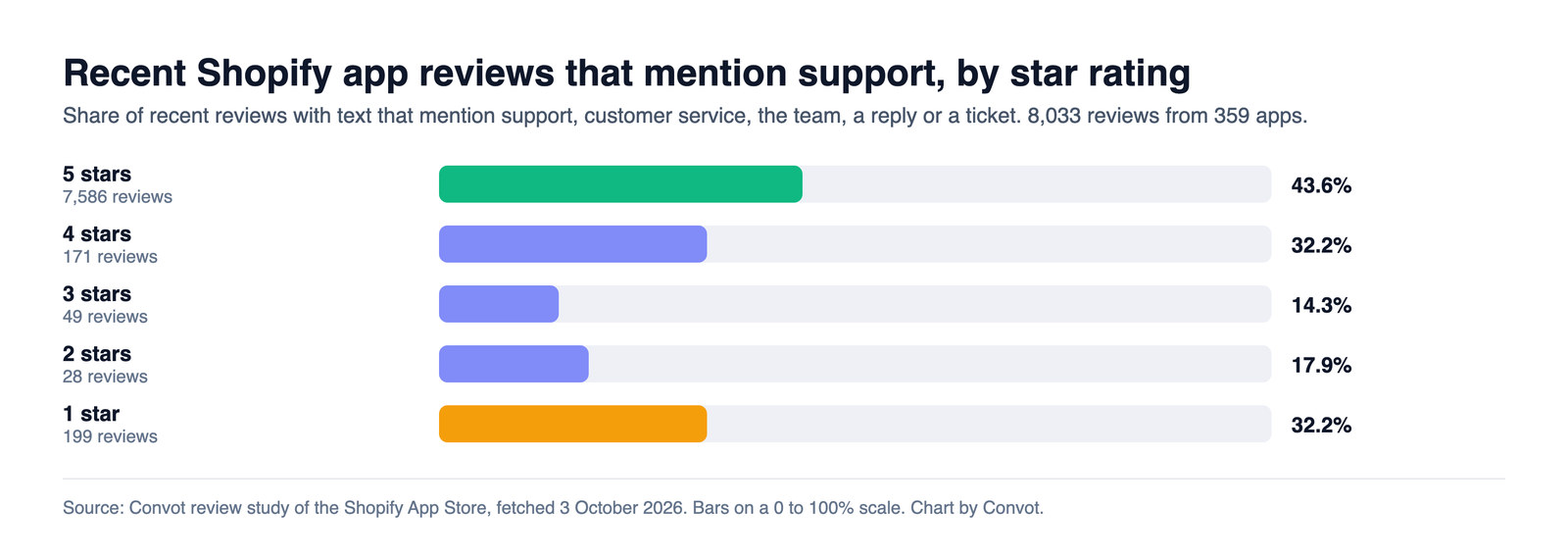 Figure 5: Support shows up most in 5-star reviews and again in 1-star ones, the two moments merchants feel most strongly about a developer. Source: Convot review study, 8,033 reviews with text from 359 apps, Oct 2026. Chart by Convot.
How are app review ratings distributed?
Recent reviews on established apps are almost all 5 stars.
- 94.2% of recent reviews on established apps give 5 stars, and 2.1% give 1 star (Convot review study, Oct 2026).
- 25.4% of recent reviews carry a star rating and no text (Convot review study, Oct 2026).
- 93.6% of the reviews with no text give 5 stars (Convot review study, Oct 2026).
What do 5-star reviews say about support?
Praise for support is usually praise for a person and for speed.
- 34.6% of 5-star reviews with text use the word “support” (Convot review study, Oct 2026).
- 22.3% of 5-star reviews with text mention speed, with words such as fast, quick, prompt or immediately (Convot review study, Oct 2026).
- Reviews that mention support average 4.90 stars, against 4.82 for reviews that do not (Convot review study, Oct 2026).
What do one-star Shopify app reviews complain about?
The worst reviews are mostly about money and broken stores, with slow support close behind. Each of those starts as a support conversation that did not end well.
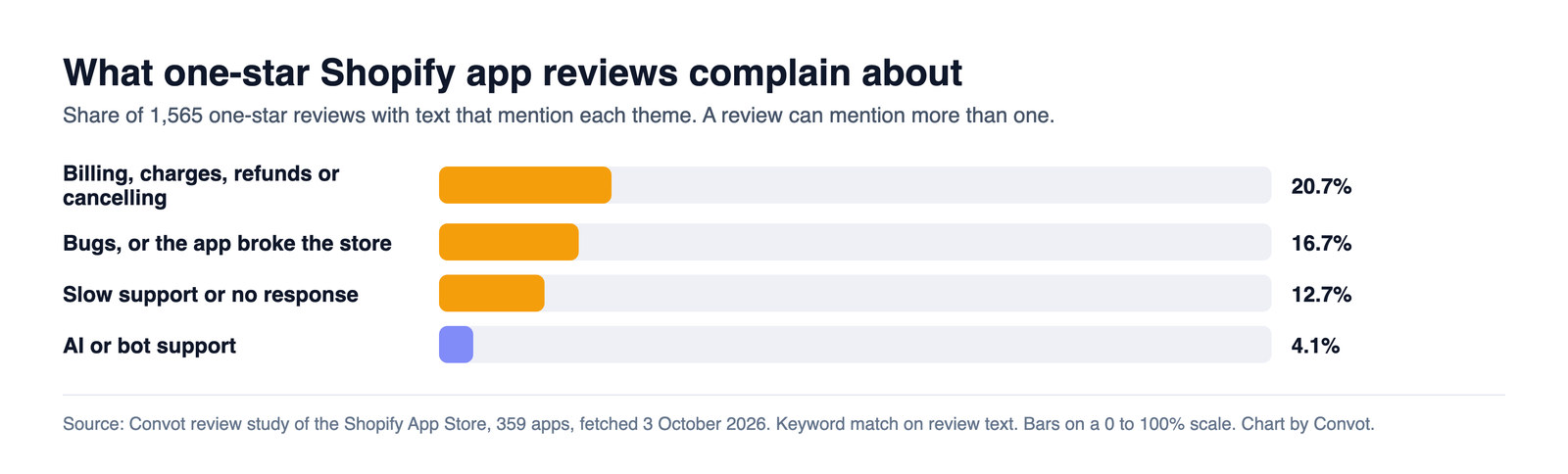 Figure 6: Billing disputes top the list, which makes clear plan changes and fast refund answers some of the cheapest review protection an app can buy. Source: Convot review study, 1,565 one-star reviews with text, Oct 2026. Chart by Convot.
How often do one-star reviews mention support?
A third of the angriest reviews are about the support experience itself.
- 33.7% of one-star reviews with text mention support, the team, a reply or a ticket (Convot review study, Oct 2026).
- 16.7% of one-star reviews with text say the app had bugs or broke the store (Convot review study, Oct 2026).
- 12.7% of one-star reviews with text describe slow support or no response (Convot review study, Oct 2026).
- 4.1% of one-star reviews with text complain about AI or bot support (Convot review study, Oct 2026).
Can merchants leave a review after they uninstall?
Merchants can still review for a while after uninstalling, so an uninstall does not end the review risk.
- Only merchants with the app installed can review it, and they can still review for 45 days after uninstalling (Shopify, Manage app reviews, Oct 2026).
The playbook for catching frustrated merchants before they leave a bad review goes through the warning signs.
Do Shopify app developers reply to reviews?
Most established developers reply to some reviews, and the best reply to their worst ones. The Built for Shopify gap suggests the habit runs with the rest of an app’s quality work.
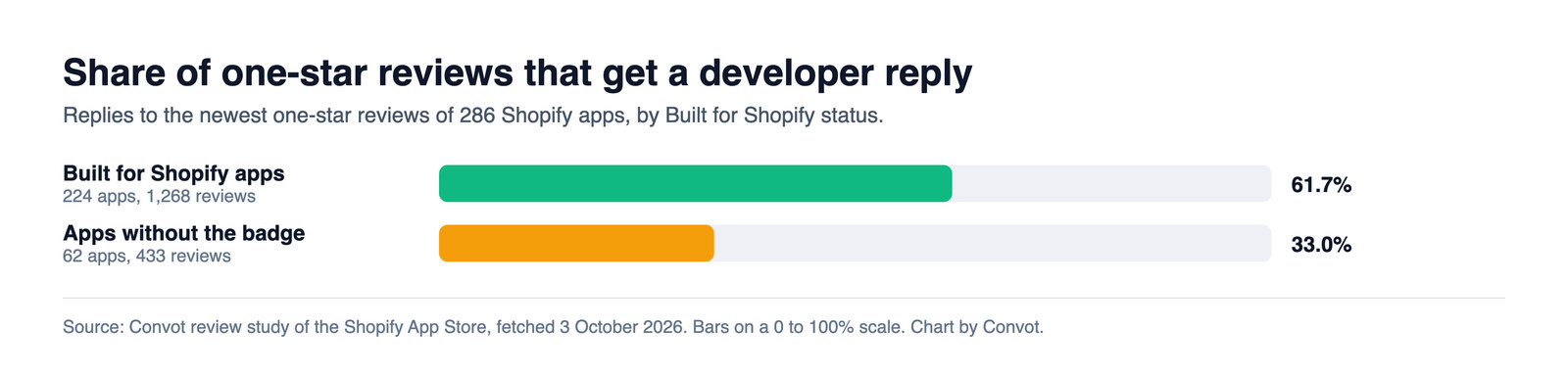 Figure 7: Badged apps answer nearly twice as many of their one-star reviews, a public signal to every merchant reading the listing. Source: Convot review study, newest one-star reviews of 286 apps, Oct 2026. Chart by Convot.
Which reviews get a reply?
Developers reply most to the reviews that hurt.
- Developers replied to 54.4% of one-star reviews (Convot review study, Oct 2026).
- Developers replied to 22.7% of recent 5-star reviews and 16.3% of 4-star reviews (Convot review study, Oct 2026).
- 79.0% of apps replied to at least one of their recent one-star reviews, and 36.7% replied to all of them (Convot review study, Oct 2026).
How fast do developers reply?
Half reply within a day; one-star reviews often wait longer.
- 48.9% of developer replies are posted the same day or the next day (Convot review study, Oct 2026).
- 76.2% of developer replies come within 7 days, and 9.9% come more than 30 days later (Convot review study, Oct 2026).
- 40.4% of replies to one-star reviews come within a day, and 16.4% come more than 30 days later (Convot review study, Oct 2026).
What does Shopify require of app support?
Shopify sets rules on reviews, contacts and data, but no response-time target for support. How fast an app answers merchants is left entirely to the developer.
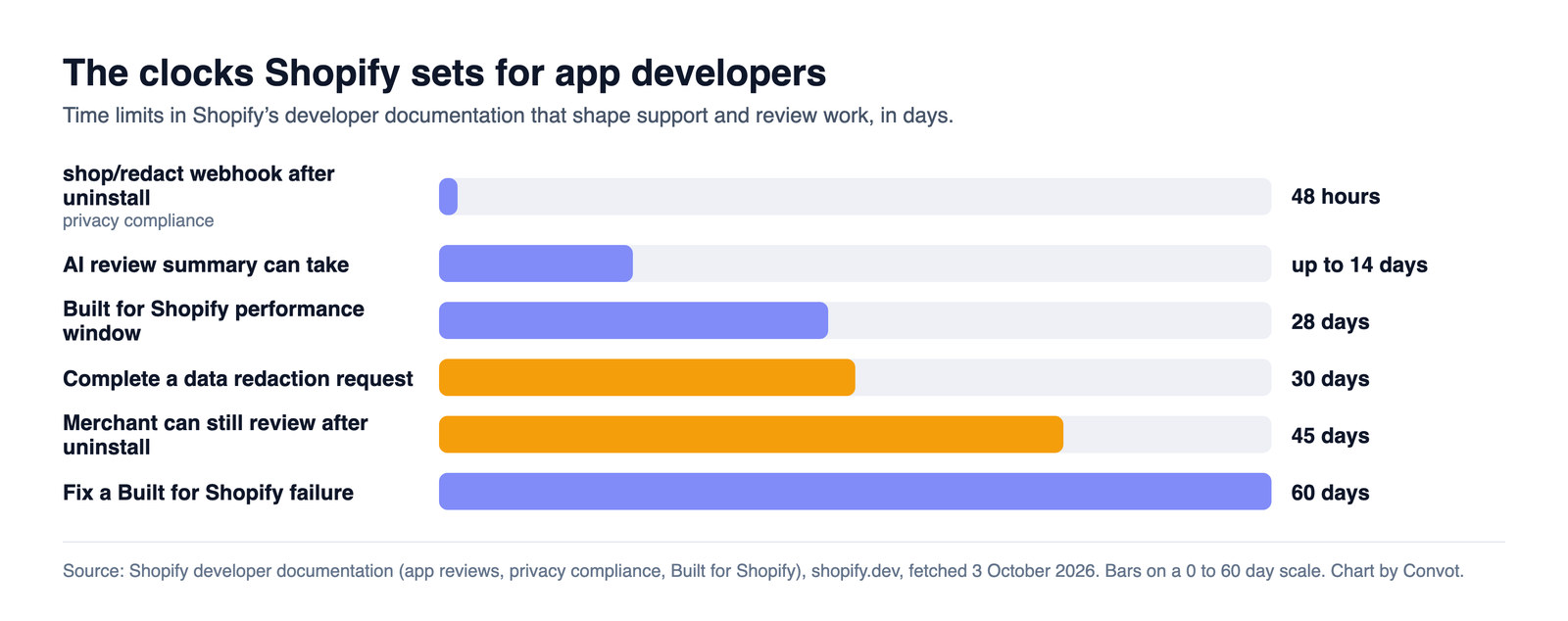 Figure 8: Shopify runs plenty of clocks on developers, from privacy webhooks to badge reviews, yet none of them covers how fast a merchant gets an answer. Source: Shopify developer documentation, fetched Oct 2026. Chart by Convot from Shopify’s published rules.
What are the rules on asking for reviews?
Shopify bans buying reviews and says when to ask.
- Shopify forbids incentives, or withholding features, in exchange for reviews, and requires review requests in neutral language (Shopify, App Store requirements, Oct 2026).
- Developers caught posting fake or incentivised reviews can have reviews removed, the app demoted or delisted, or their Partner account terminated (Shopify, App Store requirements, Oct 2026).
- Shopify advises asking for a review after a support interaction, letting merchants opt out after one ask, and not asking during onboarding or install (Shopify, Manage app reviews, Oct 2026).
- Built for Shopify design rules ban a “Leave us a review” modal that opens automatically and ban rewards for 5-star reviews (Shopify, Built for Shopify requirements, Oct 2026).
- App listings may not include reviews, testimonials or statistics; Shopify adds reviews to the listing from merchant feedback (Shopify, App Store requirements, Oct 2026).
What support and contact rules apply?
The support rules are about reachability and self-service, not speed.
- Every public app must keep an emergency developer contact in the Partner Dashboard to receive critical technical information (Shopify, App Store requirements, Oct 2026).
- Apps must let merchants upgrade and downgrade plans without contacting support or reinstalling (Shopify, App Store requirements, Oct 2026).
- Shopify lists support as a best-practice area and says strong support reduces negative reviews, but sets no numeric response-time requirement (Shopify, App Store best practices, Oct 2026).
What do the privacy and badge rules demand?
Data requests and badge reviews create their own deadlines.
- Every App Store app must subscribe to three mandatory privacy webhooks; shop/redact fires 48 hours after uninstall and requests must be completed within 30 days (Shopify, Privacy law compliance, Oct 2026).
- For customer redaction, Shopify sends the request 10 days later if the customer has not ordered in the past six months, and otherwise holds it until six months have passed (Shopify, Privacy law compliance, Oct 2026).
- Built for Shopify admin performance is measured at the 75th percentile over 28 days with at least 100 calls: LCP of 2.5 seconds or less, CLS of 0.1 or less and INP of 200 milliseconds or less (Shopify, Built for Shopify requirements, Oct 2026).
- Built for Shopify apps are reviewed every year, and an app that falls short gets 60 days to fix the failures (Shopify, Built for Shopify, Oct 2026).
- Since the Winter ‘26 Edition, apps keep the badge during a 60-day grace period while fixing automated criteria failures (Shopify Editions, Winter ‘26, Oct 2026).
What does support tooling cost a Shopify app team?
Most help desks charge per seat or per workspace, so the bill grows with every app a studio adds even when the team stays the same size. Disclosure: Convot makes one of the tools compared here.
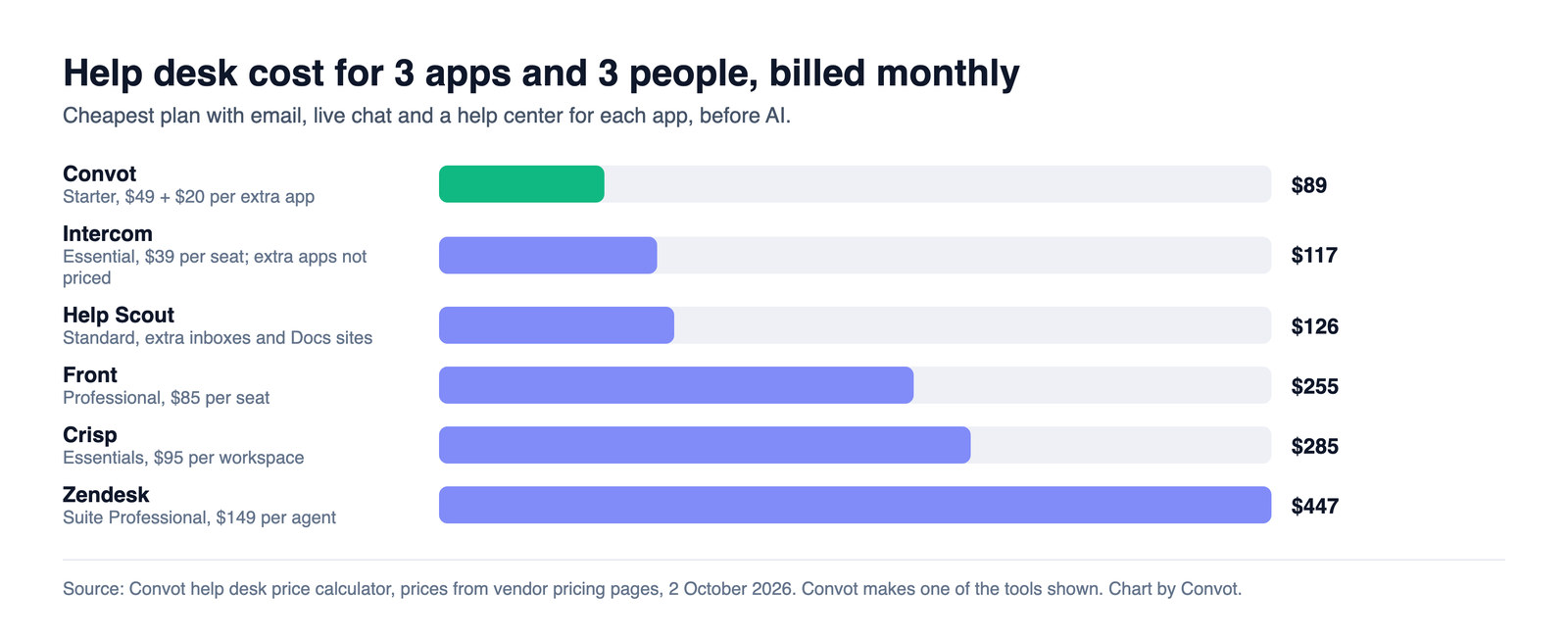 Figure 9: For a three-app studio, the gap between the cheapest and dearest setup is about $358 a month, almost all of it from per-workspace and per-help-center pricing. Source: Convot help desk price calculator, vendor pricing pages checked Oct 2026. Chart by Convot, which sells one of the tools shown.
What does one app cost to support?
For one app and three people, billed monthly, before AI:
- Convot Starter costs $49 a month for 1 app and 3 seats, and Help Scout Standard $90 for three users (Convot help desk price calculator, Oct 2026).
- Crisp Essentials costs $95 per workspace, and Intercom Essential $117 for three seats (Convot help desk price calculator, Oct 2026).
How does the cost change with more apps?
The per-app model is where the tools diverge most.
- At three apps and three people, billed monthly, Convot costs $89, Help Scout $126 with extra inboxes and Docs sites, and Crisp $285 for three workspaces (Convot help desk price calculator, Oct 2026).
- At three apps, Zendesk needs Suite Professional for more than one help center, $447 a month for three agents billed monthly (Convot help desk price calculator, Oct 2026).
- At five apps and three people, Crisp reaches $475 a month and Convot $129 (Convot help desk price calculator, Oct 2026).
Convot is a help desk for small software teams that run one or several apps: each app gets its own chat widget and help center, at $20 per extra app. It covers email and live chat only, with no phone or WhatsApp. Full vendor prices are in the help desk pricing index, and you can price your own setup in the help desk price calculator.
Methodology and Sources
Three datasets on this page are Convot’s own. All three are public-data studies, and the limits of each are stated here.
Convot review study (October 2026). On 3 October 2026 we fetched Shopify App Store category pages for 121 categories and took, in Shopify’s default order, up to the first three apps in each with 50 or more reviews: 359 apps, 287 of them with the Built for Shopify badge, carrying 370,797 reviews between them. For each app we fetched the three newest review pages and the newest page of one-star reviews, then removed duplicates by review ID: 10,770 recent reviews (median date 1 September 2026) and 1,701 one-star reviews. “Mentions support” means the text contains support, customer service or care, help desk, live chat, chat team or agent, a support, dev or customer team, responded, response time, replied, got back to, or ticket. Themes are keyword matches, so they are approximate. The sample leans to established and badged apps, so it describes what good apps experience rather than every app.
Convot new-app study (June 2026). Every app listed in the Shopify App Store with a launch date from 26 March to 22 June 2026, captured on 24 June 2026: 4,734 apps from 3,770 developers. Review counts are as of the capture date. Developers are matched by their listed name.
Convot developer-site scan (October 2026). On 3 October 2026 we fetched the homepage of every developer website linked from those listings, 3,813 sites, of which 2,996 returned a working page. A site counts as having chat only if its homepage loads a known chat widget script. Widgets added through tag managers or after page load are missed, so the 4.5% is a floor.
Shopify data. Shopify’s developer documentation, partner and investor pages show no publication date, so they are dated by the month we checked them. Shopify publishes different app counts on different pages; we use the figure in its annual report filed with the SEC. Prices in the cost section come from vendor pricing pages, checked on 2 October 2026.
Sources
- Convot studies: Convot review study, new-app study and developer-site scan; Convot help desk price calculator.
- Shopify filings and pages: Shopify 2025 annual report, Form 10-K; Shopify Investors; Shopify Partners; Shopify App Store; Shopify Editions, Winter ‘26.
- Shopify developer documentation: App Store requirements; App Store best practices; Built for Shopify; Built for Shopify requirements; Manage app reviews; Privacy law compliance; App Store revenue share.
- Related research from Convot: AI customer service statistics; live chat statistics; customer support metrics for Shopify apps.
Revenue-aware support for Shopify app teams.
Live chat, help center, and every merchant's MRR, plan, and LTV beside the conversation. Free under $1k MRR.
Start free