Why we built Convot for Shopify app developers
What Shopify app teams need from a help desk that store-focused tools miss, and how Convot handles several apps, revenue, translation and developer tools.
On this page
- What do Shopify app teams need from a help desk?
- Why don’t store-focused help desks fit app teams?
- Why does one inbox for several apps matter?
- Why put a merchant’s revenue beside the conversation?
- Why does live translation matter for Shopify apps?
- How does Convot fit a developer’s stack?
- How fast can a small team reply?
- What does AI cost in Convot?
- What else comes with Convot?
- How do you add live chat inside an embedded Shopify app?
- How do you move to Convot from another help desk?
- What does Convot not do?
- Who is Convot the best help desk for?
- Common questions about Convot
- Why Convot, in five lines
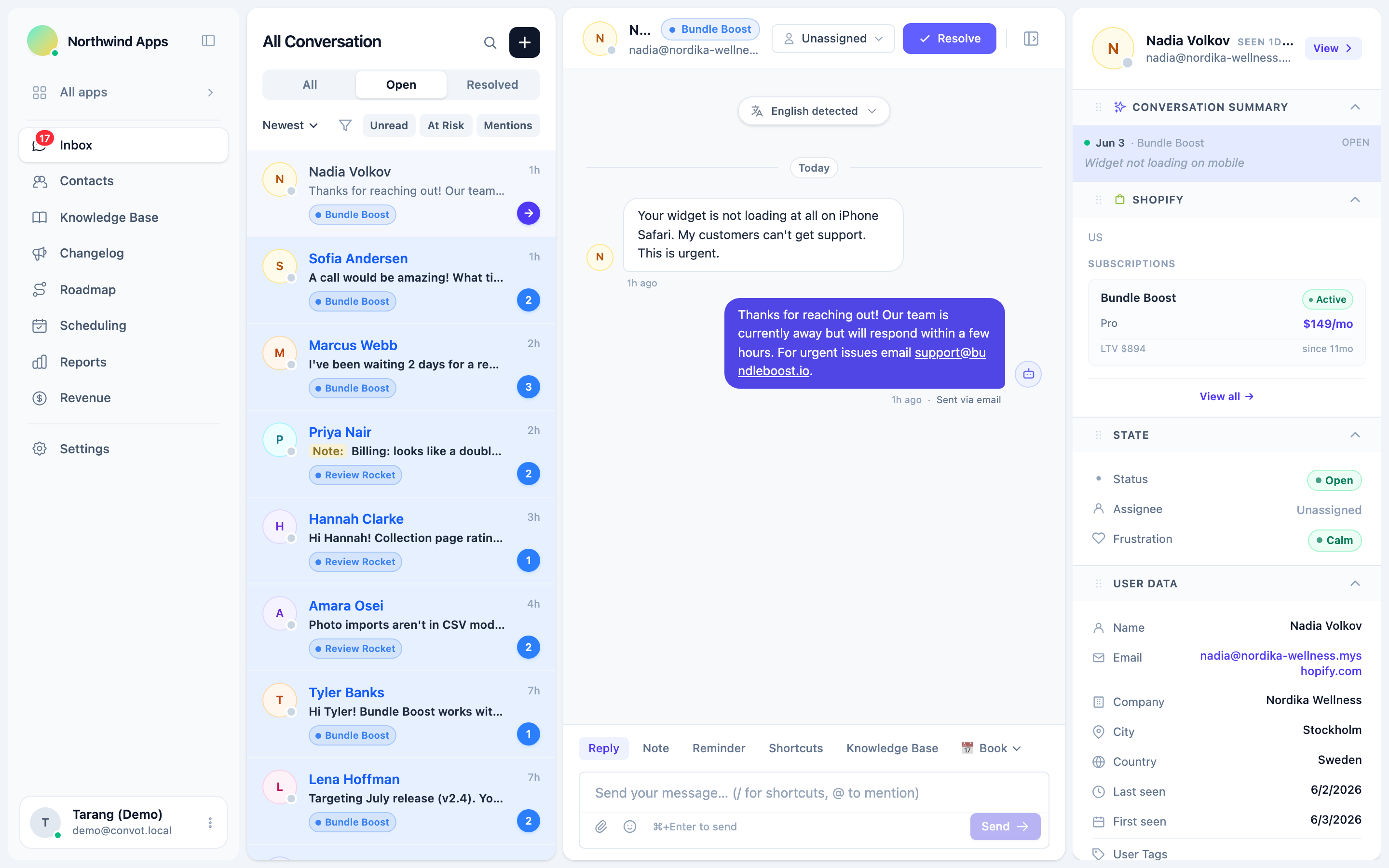
Convot is a help desk for teams that run one or more Shopify apps. It gives every app its own chat widget, help center, changelog, roadmap and status page, sends all conversations to one shared inbox, and shows each merchant’s plan, MRR and lifetime revenue from your Shopify Partner account beside the chat. It is free for teams under $1,000 a month in revenue, then $49 to $299 a month.
We built Convot because the teams who build Shopify apps need a different help desk from the stores that use them. An app team supports merchants who use its software, often across several apps, in many languages, and needs to see what each merchant pays it. Most help desks are built either for stores supporting shoppers or for large companies with large support budgets. Convot is built for the small team in between: one inbox for every app, with each merchant’s Shopify revenue beside the conversation.
At Sidepanda we run several Shopify apps of our own, including Appointo, Depo and Panda Bundle, and we support all of them from one Convot inbox. This post explains what we needed, why existing tools did not fit, and what Convot does and does not do.
What do Shopify app teams need from a help desk?
Shopify app teams need a help desk that treats the merchant as a customer of the app, not a shopper in a store. In practice that means six things:
- One inbox for several apps, because many app teams ship more than one.
- Each merchant’s plan and revenue beside the conversation, so the team knows who it is talking to.
- Replies in the merchant’s language, because merchants come from many countries.
- A chat widget inside the app’s admin, where merchants get stuck during setup.
- Developer tools: webhooks, an API and a way to link support contacts to your own records.
- A price a small team can afford, that does not jump with every seat or every app.
The rest of this post takes each in turn.
Why don’t store-focused help desks fit app teams?
Store-focused help desks are designed around shoppers and orders. Gorgias, for example, shows a shopper’s orders and lets agents refund and tag from the help desk, which is exactly right for a store and mostly irrelevant for an app team, whose customer is the merchant running the store.
General help desks fit better but price for larger teams, by seat or by website:
| Tool | Pricing unit | Entry price | Higher tier or AI price |
|---|---|---|---|
| Intercom | Per seat, billed annually | $29 on Essential | $132 on Expert, needed for multi-brand; Fin from $0.99 per outcome |
| Crisp | Per workspace, one per website | $45 on Mini | $95 on Essentials, the first plan with a knowledge base |
| Convot | By app count, seats included | $49 for 1 app and 3 seats | $299 for unlimited apps; Cove AI $0.20 per resolved conversation |
Prices checked on each vendor’s pricing page on 1 October 2026. For a small team running three apps, the per-website model multiplies: three Crisp Essentials workspaces cost $285 a month at list, while Convot Starter with two extra apps is $89. The Convot vs Intercom and Convot vs Crisp comparisons set out the numbers side by side.
Why does one inbox for several apps matter?
One inbox for several apps matters because the same few people usually answer for all of them. Separate inboxes mean switching tabs, separate bills and no single view of a merchant who uses two of your apps.
In Convot, each app gets its own widget, help center, changelog, roadmap and status page, and every conversation lands in one shared inbox, labelled by app, with one record per customer across apps. Agents can be limited to specific apps, while admins see everything. Pricing follows the same idea: plans are set by how many apps you run, not by seats alone.
| Plan | Price | Apps | Seats |
|---|---|---|---|
| Starter | $49 a month | 1 | 3 |
| Growth | $79 a month | 2 | 7 |
| Pro | $149 a month | 5 | 12 |
| Scale | $299 a month | Unlimited | 20 |
Extra apps are $20 a month and extra seats $10 a month on paid plans, and Convot is free for teams under $1,000 a month in revenue, with 1 app and 3 seats. The guide to help desks for teams running more than one app compares the options.
Why put a merchant’s revenue beside the conversation?
Revenue beside the conversation tells the person replying what is at stake before they type. A merchant on your top plan reporting a bug and a free-plan merchant asking a setup question deserve different speed, and in most help desks they look identical.
For Shopify apps, Convot connects to your Shopify Partner account and shows each merchant’s plan, MRR and lifetime revenue to date beside the conversation, once your app identifies the shop with a signed Convot.identify call. Revenue is visible to owners by default, and owners can grant it to admins. The same data builds a revenue dashboard with MRR, ARR and ARPU across your apps. The guide to Shopify Partner revenue metrics explains each number.
If a merchant uninstalls within 7 days of a support conversation, Convot reopens that conversation and posts the uninstall details, so you can reach out while the reason is fresh.
Why does live translation matter for Shopify apps?
Live translation matters because Shopify merchants are spread across many countries, and a small team cannot hire someone for every language. Convot’s live translation lets you reply in your language while the merchant reads it in theirs, across 60+ languages, and shows incoming messages to you in your language. It detects the merchant’s language from their browser and their first message.
Help center articles are a separate case: you can publish them in up to 12 languages, and you write each language version yourself. The guide to multilingual support for Shopify apps covers both.
How does Convot fit a developer’s stack?
Convot is built for teams who think in webhooks and APIs, so everything is available without a sales call:
- Signed webhooks for nine event types, including messages received and sent, conversations created, assigned, resolved and reopened, and contacts created and identified. Each delivery is signed with HMAC-SHA256.
- A REST API for your conversations, contacts and data.
external_id, so support contacts link to the records in your own system.- An MCP route for Cove AI: you can build a read-only MCP server that Cove calls to answer account-specific questions from your own data.
- A widget API using Crisp-style commands under
Convot.push, to open the chat, prefill a message or open the booking page from your own code.
The widget itself is a short snippet you add to the HTML shell of your embedded Shopify app, so merchants can chat from inside your app’s admin.
How fast can a small team reply?
A small team replies faster when it can answer from anywhere. Convot’s agent app for iOS and Android sends a push notification when a conversation is assigned to you, a teammate @mentions you, or a merchant replies in a conversation you own. With routing set up so night-time questions land on someone’s phone, they can get an answer before they turn into a bad review. The guide to catching frustrated merchants before they leave a bad review covers how Convot flags conversations that show signs of frustration.
Speed also affects your App Store rating. Shopify weights the overall rating toward recent reviews and says positive reviews help an app appear higher in search, which is why getting more Shopify app reviews starts with support.
What does AI cost in Convot?
Convot’s AI agent, Cove AI, costs $0.20 per resolved conversation on paid plans. It answers from each app’s own help center and sources you add, can show which article it used, and hands off to a person when it is not sure. It is not part of the free plan.
For comparison, Intercom’s Fin costs from $0.99 per outcome and Help Scout’s AI Answers $0.75 per resolution (checked 1 October 2026). Some tools, like Crisp, bundle AI credits into plans instead, which is a different unit, so compare carefully. The AI support cost calculator works the numbers for your volume.
What else comes with Convot?
Each app also gets the tools that usually sit in separate subscriptions:
- A public changelog and a roadmap merchants vote on, both of which can appear inside the chat widget.
- A status page with built-in uptime monitoring that opens incidents automatically, linked from the widget.
- Scheduling, with a booking card you can send inside a chat, and Google Meet links.
The guides to a public roadmap and a status page for your Shopify app show how app teams use them.
How do you add live chat inside an embedded Shopify app?
To add live chat inside an embedded Shopify app, paste the Convot widget snippet into the HTML shell that loads your app in the Shopify Admin, then call Convot.identify with the shop domain and a hash signed on your server with the app’s identity secret. Merchants can then chat without leaving your app’s admin, and each conversation arrives labelled with the shop and, once your Partner account is connected, its plan and revenue.
The full setup takes five steps, each covered in Convot’s help docs:
- Create an app in Convot for each Shopify app you support. Each one gets its own widget, help center and settings, and all of them share one inbox.
- Add the widget snippet to the HTML shell that hosts your embedded app in the Shopify Admin, or to any page where merchants should be able to reach you.
- Identify the merchant. Call
Convot.identifyfrom your app with the shop domain and a signed hash computed on your server with the app’s identity secret, so Convot can trust which store is writing in. - Connect your Shopify Partner account. An owner enters your Partner Organization ID and a Partner API token with the Manage apps and Manage financials permissions. Convot then backfills your transaction history and keeps it in sync.
- Write your first help center articles, starting with the questions merchants ask during setup, so the widget and Cove AI have answers to give.
Most of the value arrives after steps 3 and 4: from then on, every conversation shows who the merchant is and what they pay, and uninstalls show up in the inbox.
How do you move to Convot from another help desk?
Moving to Convot depends on where you are coming from. Crisp imports in one click: contacts, conversations and help center articles. Convot also has a Sleekplan importer for roadmap and changelog data. From Intercom, Zendesk and Freshdesk, Convot runs the migration for you, free; the one Intercom migration so far moved a year of history within a day, with original dates kept. The guide to migrating from Crisp walks through the steps.
What does Convot not do?
Convot is honest about its limits, because the wrong tool costs you more than the right one:
- No WhatsApp, social or voice channels. Convot covers chat, email and a help center, plus the changelog, roadmap, status and scheduling tools.
- No self-hosted edition. Convot is hosted only.
- No support inside customers’ shared Slack channels. Convot sends notifications to your own team’s Slack.
- Revenue context is for Shopify apps only. Apps that bill outside Shopify do not get the revenue sidebar.
- No end-user email subscriptions on the status page yet. Your team gets alerts; customers check the page or the widget link.
If any of those is essential, a different tool will serve you better, and our comparison pages say which.
Who is Convot the best help desk for?
Convot is the best fit for a small team that runs one or more Shopify apps, supports merchants through chat, email and a help center, and wants each merchant’s revenue beside the conversation. Plans include 3 to 20 seats and 1 to unlimited apps, with extra seats at $10 a month. It is a poor fit if you need WhatsApp, social or voice channels, a self-hosted install, or support inside customers’ shared Slack channels, and apps that bill outside Shopify do not get the revenue sidebar.
Common questions about Convot
Is Convot only for Shopify apps? Convot works for any team running one or more apps, including SaaS products and mobile apps. The Shopify-specific parts are the revenue sidebar, the revenue dashboard and the uninstall alerts.
How much does Convot cost? Convot is free for teams under $1,000 a month in revenue, with 1 app and 3 seats, then $49 a month for 1 app, $79 for 2, $149 for 5 and $299 for unlimited apps. Cove AI is $0.20 per resolved conversation on paid plans.
Can Convot run support for several apps at once? Convot runs support for several apps from one inbox, with a widget, help center, changelog, roadmap and status page for each app.
Is there a free trial on paid plans? Growth and Pro start with a 14-day trial, Scale starts with a demo, and teams under $1,000 a month in revenue can stay on the free plan, with 1 app and 3 seats and “Powered by Convot” shown in the widget.
Does Convot work inside an embedded Shopify app? Convot’s widget works inside an embedded Shopify app: you add its snippet to the HTML shell that hosts your app in the Shopify Admin.
Why Convot, in five lines
- One inbox for every app you run, priced by app count.
- Each merchant’s Shopify revenue beside the conversation.
- Live translation across 60+ languages.
- Webhooks, an API and an MCP route, with no sales call.
- AI at $0.20 per resolved conversation, with the changelog, roadmap, status page and scheduling included.
Start free while you are under $1,000 in monthly revenue, or see the full pricing.
About the author
Tarang Agarwal is the founder of Convot. Convot is built by Sidepanda, a small studio that runs several Shopify apps of its own, including Appointo, Depo and Panda Bundle, and supports all of them from one Convot inbox.
Revenue-aware support for Shopify app teams.
Live chat, help center, and every merchant's MRR, plan, and LTV beside the conversation. Free under $1k MRR.
Start free